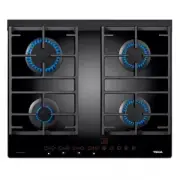
Page 2 - DESCRIPTION OF THE HOT PLATES
2 1 Ultra rapid burner of 3100 W 2 Rapid gas burner of 2800 W 3 Semirapid gas burner of 1750 W 4 Auxiliary gas burner of 1000 W 5 Enamelled steel pan support 2F6 Enamelled steel pan support 1F7 Burner n° 1 control knob8 Burner n° 2 control knob9 Burner n° 3 control knob10 Burner n° 4 control knob11 ...
Page 3 - HOW TO USE THE BURNERS; USE
1) BURNERS A diagram is screen-printed above each knob onthe front panel. This diagram indicates to whichburner the knob in question corresponds. Afterhaving opened the gas mains or gas bottle tap, lightthe burners as described below:- Manual ignitionP u s h a n d t u r n t h e k n o b c o r r e s p...
Page 5 - CLEANING
5 CLEANING IMPORTANT:Always disconnect the appliance from the gasand electricity mains before carrying out anycleaning operation. 2) HOT PLATE Periodically wash the hot plate, the enamelled stellpan support, the enamelled burner caps "C" and theburner heads "T" (see fig. 6) with luke...
Page 6 - INSTALLATION; TECHNICAL INFORMATION; ) INSTALLING THE HOT PLATE
6 INSTALLATION TECHNICAL INFORMATION FOR THE INSTALLER I n s t a l l a t i o n , a d j u s t m e n t s o f c o n t r o l s a n dmaintenance must only be carried out by aqualified engineer. Incorrect installation may cause damage topersons, animals or property for which theM a n u f a c t u r e r s h...
Page 7 - ) LOCATION AND AERATION
7 I M P O R T A N T I N S T A L L A T I O N I N S T R U C T I O N S The installer should note that the appliance thatside walls should be no higher than the hot plateitself. Furthermore, the rear wall, the surfacessurrounding and adjacent to the appliance mustbe able to withstand an overtemperature ...
Page 8 - ) ELECTRICAL CONNECTION
8 8) ELECTRICAL CONNECTION The electrical connections of the appliancemust be carried out in compliance with theprovisions and standards in force.Before connecting the appliance, check that:- The electrical capacity of the mains supply and current sockets suit the maximum power rating ofthe applianc...
Page 9 - ADJUSTMENTS
9 ADJUSTMENTS A l w a y s d i s c o n n e c t t h e a p p l i a n c e f r o m t h eelectricity main before making any adjustments.All seals must be replaced by the technician atthe end of any adjustments or regulations.O u r b u r n e r s d o n o t r e q u i r e p r i m a r y a i radjustment. 9) TAP...
Page 10 - CONVERSIONS; 0) REPLACING THE INJECTORS
10 CONVERSIONS 10) REPLACING THE INJECTORS The burners can be adapted to different types ofgas by mounting injectors suited to the type of gasin question. To do this, first remove the burnertops using a wrench "B". Now unscrew injector "A"(see fig. 13) and fit a injector correspondin...
Page 11 - SERVICING; 1) REPLACING HOT PLATE PARTS
11 SERVICING A l w a y s d i s c o n n e c t t h e a p p l i a n c e f r o m t h eelectricity and gas mains before proceedingwith any servicing operation. 11) REPLACING HOT PLATE PARTS Replacement of the components housed insidethe appliance: remove the trivets and the burnersfrom the upper part of ...
Page 12 - CABLE TYPES AND SECTIONS
12 SERVICING Gas hot plate H05 RR - F Section 3 x 0.75 mm 2 TYPE OF HOT PLATE TYPE OF CABLE SINGLE - PHASEPOWER SUPPLY CABLE TYPES AND SECTIONS ATTENTION!!!If the power supply cable is replaced, the installe should leave the ground wire longer than thephase conductors (fig. 20) and comply with the r...
Page 13 - TECHNICAL DATA ON THE DATA LABEL; BURNERS
13 TECHNICAL DATA ON THE DATA LABEL 5 BURNERS CATEGORY = II 2H3+ G30 - BUTANE = 28 - 30 mbarG31 - PROPANE = 37 mbarG20 - NATURAL = 20 mbar Σ Qn LPG Gas Rate = 10.40 kW Σ Qn LPG Gas Rate = 756 g/h Voltage = 230 - 240 V ~Frequency = 50/60 Hz 4 BURNERS CATEGORY = II 2H3+ G30 - BUTANE = 28 - 30 mbarG31 ...
Page 14 - TECHNICAL DATA FOR THE APPLIANCE GAS REGULATION; TECHNICAL ASSISTENCE AND SPARE PARTS
14 TECHNICAL DATA FOR THE APPLIANCE GAS REGULATION Before leaving the factory, this appliance will have been tested and regulated by expert and specialized personnel in order to guarantee the best performances. Any repairs or adjustments which may be subsequently required may only be carried out by ...