Page 3 - TO REDUCE THE RISK OF ELECTRIC SHOCK:; WARNING –; TO REDUCE THE RISK OF BURNS, FIRE, ELECTRIC; recommended by the manufacturer as contained in this manual.
This household sewing machine is designed to comply with IEC/EN 60335-2-28 and UL1594. IMPORTANT SAFETY INSTRUCTIONS When using an electrical appliance, basic safety precautions should always be followed, including the following: Read all instructions before using this household sewing machine. Keep...
Page 4 - SAVE THESE INSTRUCTIONSFOR EUROPE; SERVICING OF DOUBLE INSULATED PRODUCTS; INSULATION’ or ‘DOUBLE INSULATED’.
SAVE THESE INSTRUCTIONSFOR EUROPE ONLY: FOR EUROPE ONLY: This appliance can be used by children aged from 13 years and above and persons with reduced physical, sensory or mental capabilities or lack of experience and knowledge if they have been given supervision or instruction concerning use of the ...
Page 6 - TABLE OF CONTENTS; Technical Specification
TABLE OF CONTENTS INTRODUCTION ............................................. 1 Intended Use .................................................................. 1 Machine Overview .......................................................... 1 Needle Area Overview ...........................................
Page 7 - INTRODUCTION; Intended Use
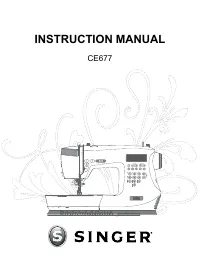
7 8 10 11 12 13 9 6 5 1 2 3 4 Introduction – 1 English Introduction – 1 English INTRODUCTION Optimal use and maintenance are described in these instructions. This product is not intended for industrial or commercial use. Additional assistance, by region, may be found online at www.singer.com. 1. Fee...
Page 8 - Needle Area Overview; to guide fabric while sewing.
1 2 3 4 5 6 7 8 9 10 11 12 13 14 6 5 4 2 7 9 8 1 3 2 – Introduction English 2 – Introduction English Needle Area Overview Top of Machine 1. Needle Plate — provides a flat area around presser foot for sewing. Guidelines indicate various seam allowances used to guide fabric while sewing. 2. Feed Teeth...
Page 9 - Overview Accessories; Foot control; Bobbin x4; — Two sizes (large and small) for various thread spool styles.; Auxiliary Spool Pin; — Used to remove stitches/brush off lint.
Introduction – 3 English Introduction – 3 English Overview Accessories Included Accessories (Not Pictured) • Needles• Foot control • Power cord Bobbin x4 — Only use the type of transparent bobbins delivered with your machine (SINGER® Class 15 transparent bobbins). One of the bobbins is inserted in t...
Page 10 - Presser Feet; from left to right, depending on which stitch you sew.; Optional Accessories
4 – Introduction English 4 – Introduction English Presser Feet All Purpose Foot (T) (attached to the machine upon delivery)This foot is used for general sewing on most types of fabric. The bottom of the foot is flat, so that the fabric is held down firmly against the feed teeth while sewing. It also...
Page 11 - Application; two pieces of fabric together.; Stitch Overview; Utility Stitches; that can be pulled out at the bottom of the machine.
Introduction – 5 English Introduction – 5 English Application Straight Stitch Center Position The basic stitch used for sewing. The most common use for a straight stitch is to sew two pieces of fabric together. Straight Stitch Left Position For all types of sewing. Straight Stretch Stitch Stronger t...
Page 13 - Decorative Stitches; Stitch Menu 1 and 2
Introduction – 7 English Introduction – 7 English In addition to utility stitches, your machine features decorative and lettering stitches. When sewing these stitches, it is recommended to use a stabilizer underneath the fabric to help prevent the dense stitching from possibly puckering the fabric. ...
Page 14 - PREPARATIONS; Note: Consult a qualified electrician if in doubt as how to co; Unpacking the Machine; For the USA and Canada; proper outlet. Do not modify the plug in any way.
A B C 8 – Preparations English 8 – Preparations English PREPARATIONS 1. Place the box on a steady, flat surface. Lift the machine out of the box, and remove the packaging. 2. Remove all outer packing material and the plastic bag.3. Wipe off the machine with a dry cloth to remove any lint and/or exce...
Page 15 - Free Arm/Removable Accessory Tray; Store presser feet, bobbins, needles and other accessories in the
A Preparations – 9 English Preparations – 9 English Free Arm/Removable Accessory Tray Presser Foot Lifter Thread Knife Store presser feet, bobbins, needles and other accessories in the accessory tray so that they are easily accessible. Keep the accessory tray on the machine to provide a larger, flat...
Page 16 - Main Spool Pin; Note: Not all thread spools are manufactured in the same way.; Spool Pin
A B 10 – Preparations English 10 – Preparations English Your machine has two spool pins, a main spool pin and an Auxiliary Spool Pin. The spool pins are designed for various types of thre - ad. The main spool pin is used in a horizontal position (the thread reels off the spool) and the Auxiliary Spo...
Page 17 - Note: You can also start the winding by long pressing the; Wind the Bobbin; Note: Make sure that the needle is fully raised and the machine
A B 1 2 3 C D 4 5 E A B C D Preparations – 11 English Preparations – 11 English 1. Place the thread spool on the spool pin. Slide a spool cap firmly against the spool. 2. Place the thread into the thread guide (A) from front to the back. Bring the thread clockwise around the bobbin win - ding tensio...
Page 18 - stitch quality when you start to sew.; Thread the Machine; Machine from above
C A D B E F E F 12 – Preparations English 12 – Preparations English Important! Make sure that the presser foot is raised and the needle is in its highest position by turning the handwheel toward you. This is very important to help ensure that the machine is correctly threaded. Not doing so can resul...
Page 19 - Needle Threader; Universal Needle
C A B D Preparations – 13 English Preparations – 13 English Needle Threader Needles The built-in needle threader allows you to thread the needle quickly and easily. The needle must be in its highest position to use the built-in needle threader. Turn the hand wheel towards you until the needle is in ...
Page 20 - Important Needle Information; Note: Before you begin changing the needle, it can be helpful; Change the Needle; Selection Guide — Needle Size, Fabric, Thread
A B C 4 3 1 2 14 – Preparations English 14 – Preparations English Change the needle often. As a general rule, needles should be changed every 6-8 hours of actual stit- ching time. Important Needle Information Always use a straight needle with a sharp point and make sure the point is not bent or dama...
Page 21 - Thread Tension
2 1 A B C 3 Preparations – 15 English Preparations – 15 English Thread Tension Sew without Feed Teeth Presser Foot Pressure To set the thread tension, turn the dial on top of the machine. Depending on the fabric, thread, etc, the tension may need to be adjusted. For the best stitch appearance and du...
Page 22 - extends out the back of the presser foot holder. Press this; Change the Presser Foot
2 1 16 – Preparations English 16 – Preparations English 1. Make sure that the needle is in the highest position and the presser foot is lifted. The presser foot release button extends out the back of the presser foot holder. Press this lever to release the presser foot. 2. To attach a presser foot t...
Page 23 - OPERATING YOUR MACHINE; Machine Operation Controls; Reverse Button; Stitch Menu 1; Stitch Menu 1; again to stop sewing.
Operating Your Machine – 17 English Operating Your Machine – 17 English OPERATING YOUR MACHINE Machine Operation Controls Reverse Button Start/Stop Needle Up/Down Tie-Off Speed Control Lever The Reverse Button has two different functions, depending on what stitch has been selected. Stitch Menu 1 (st...
Page 24 - adjust stitches and program fonts. Each functionality is listed; Stitch Control Panel; Display
7 1 2 34 5 6 8 9 10 11 18 – Operating Your Machine English 18 – Operating Your Machine English The functions on the Stitch Control Panel are used to select and adjust stitches and program fonts. Each functionality is listed and described further below.1. Display2. Stitch menu / Sound on/off 3. Seque...
Page 25 - Sewing Mode; Sequence Controls; is recommended to use for the selected stitch to obtain the
2 3 4 10 9 7 8 6 1 5 1 2 3 4 Operating Your Machine – 19 English Operating Your Machine – 19 English Sewing Mode Sequence Controls Automatic Stop Setting Needle Up/Down Setting Display in Sewing Mode 1. Sequencing — Press to enter Sequence mode. 2. Navigation Arrows — Use these buttons to move back ...
Page 26 - Select a Stitch
= + A B C D E F 20 – Operating Your Machine English 20 – Operating Your Machine English Your machine has four stitch menus. Menu 1 includes the most frequently used utility stitches, and are printed on the machine next to the stitch selection buttons. Menus 2–3 have both utility and decorative stitc...
Page 27 - Sequence Mode; Display in Sequence Mode; recommended to use for the selected stitch to obtain the
2 3 4 8 9 7 1 5 6 Operating Your Machine – 21 English Operating Your Machine – 21 English Sequence Mode Display in Sequence Mode Press the Sequence Button to enter sequence mode. Letters and numbers that can be programmed and are found on Stitch Menu 4, Fonts. This menu is selected automatically whe...
Page 28 - Menu 4 is selected automatically.; Edit a Sequence; to add the stitch. Enter the stitch number and the new stitch will; Adjust a Stitch in the Sequence; Use the navigation arrows to select the stitch to be adjusted.; Create a Sequence; Delete Button
D C B A 22 – Operating Your Machine English 22 – Operating Your Machine English 1. Press the Sequence button (A) to enter Sequence mode. Stitch Menu 4 is selected automatically. 2. Pull out the Stitch Chart to see which stitch number refers to which letter/number. To program “SINGER”, would be stitc...
Page 29 - SEWING; Sewing; Change Needle Position; on of the manual is a chart showing the recommended settings
A B D C E 3.5 3-5 2.5 3.5 2.0– 4.0 3–5 A B Sewing – 23 English Sewing – 23 English SEWING Sewing Start to Sew – Straight Stitch Change Needle Position Next to each stitch or sewing technique described in this secti - on of the manual is a chart showing the recommended settings and presser foot. See ...
Page 30 - To change sewing direction, stop the machine. Press the; Change Sewing Direction; Set up for Straight Stretch Stitch
3.5 2.5 3–5 24 – Sewing English 24 – Sewing English To change sewing direction, stop the machine. Press the Needle Stop button to activate the Needle Down position. The needle is brought down into the fabric.Raise the presser foot. Pivot the fabric around the needle to change sewing direction as des...
Page 31 - Multi-Step Zigzag Stitch; Multi-step zigzag stitch is used to overcast raw edges. Make
3.0–5.0 1.0 3–5 5.0 2.5 3–5 Sewing – 25 English Sewing – 25 English Multi-Step Zigzag Stitch Slant Overedge Stitch Multi-step zigzag stitch is used to overcast raw edges. Make sure the needle pierces the fabric on the left side and overcasts the edge on the right side. The stitch can also be used as...
Page 32 - Closed Overlock Stitch; Set up for closed overlock stitch
5.0 2.5 3–5 A B F (1) (2) 3.5 1.5–2.0 3–5 B A 26 – Sewing English 26 – Sewing English The closed overlock stitch can be used for sewing medium to heavier weight stretch fabrics. Use this stitch to hem stretch fabrics (A) and for belt loops (B). Fold a hem to the wrong side and stitch with closed ove...
Page 33 - Darning and Mending; Repair Large Holes; To cover large holes it is necessary to sew a new piece of fabric
4.0–6.0 2.0 3–5 5.0 1.0–2.0 3–5 Sewing – 27 English Sewing – 27 English Darning and Mending Repair Large Holes Repair Tears To cover large holes it is necessary to sew a new piece of fabric onto the damaged area. Baste the new piece of fabric onto the damaged area on the right side of the fabric. Se...
Page 34 - Note: To make the darning even sturdier, place a fabric under-; Repair Small Holes; Set up for darning stitch
7.0 2.0 2–4 A B C D 28 – Sewing English 28 – Sewing English A small hole or tear is easily darned with the darning stitch. This stitch automatically sews small stitches back and forth to cover small holes or tears.Thread your machine with a thread in a color as close to your fabric as possible.1. Se...
Page 35 - Note: Always sew a test buttonhole on a piece of scrap fabric.
5.0 0.4 3–5 B A C E G D F Sewing – 29 English Sewing – 29 English Sew buttonholes perfectly sized for your button. The fabric should be interfaced and/or stabilized where buttonholes are to be sewn.1. Mark the start position of the buttonhole on the fabric (A). 2. On the One-Step Buttonhole Foot, pu...
Page 36 - Sew Zippers; Centered Zipper; To sew the left side of zipper, attach the foot in the right presser
A B F E C D 3.5 2.0–3.0 3–5 30 – Sewing English 30 – Sewing English Sew Zippers Centered Zipper The Zipper Foot can be attached on either the right or the left of the needle, making it easy to sew both sides of the zipper.To sew the right side of the zipper, attach the foot in the left presser foot ...
Page 37 - Hand-Look Quilt Stitch; Set up for hand-look quilt stitch; Button Sewing; Set up for button sewing
3.5 2.0–3.0 6–9 A B 3.5 — 2– 4 H A B C Sewing – 31 English Sewing – 31 English Simulate the look of hand sewn quilting with the Hand-look Quilting stitch. Thread the needle with either transparent thread or with a thread that blends with the color of the top of the fab- ric. Thread the bobbin with a...
Page 38 - MAINTENANCE; Cleaning the Machine; Raise the needle and turn off the machine.; Cleaning under the Bobbin Area; Note: Do not blow air into the bobbin case area. The dust and
A C B 32 – Maintenance English 32 – Maintenance English MAINTENANCE Cleaning the Machine Cleaning the Bobbin Area Raise the needle and turn off the machine. Raise the needle and turn off the machine. Cleaning under the Bobbin Area To keep your sewing machine operating well, clean it often. No lubric...
Page 39 - Troubleshooting; Thread Loops on Underside of Fabric; Bobbin threaded incorrectly.; Bobbin Thread Showing on Top of Fabric; Reduce upper thread tension.; Bobbin Winding Difficulties; Bobbin thread loosely wound on bobbin.
Maintenance – 33 English Maintenance – 33 English Troubleshooting Thread Loops on Underside of Fabric Possible cause: Thread looping on the underside of the fabric is always an indication that the upper thread is not correctly threaded. This happens when the upper thread is not correctly placed in t...
Page 40 - fill, then stop to trim the thread tail close to the bobbin.; Fabric Puckers; Top thread is too tight.; Fabric Is Tunneling Under Stitches; Thread path is obstructed.; Machine is Not Feeding Fabric; turn to completely re-engage the feed teeth.; Machine Will Not Run; Bobbin winding spindle is engaged when you try to sew.
34 – Maintenance English 34 – Maintenance English Possible cause: Bobbin is winding sloppily because thread end not held at beginning of winding process. Solution: Before starting to wind, hold the thread tail (coming out of the bobbin) securely, allow the bobbin to partially fill, then stop to trim...
Page 41 - Needles Breaking; “Pushing” or “pulling” fabric.; Needle Threader Not Working; “Pushing” or “pulling” the fabric.; Thread Bunching at Beginning
Maintenance – 35 English Maintenance – 35 English Needles Breaking Possible cause: Bent, dull or damaged needle. Solution: Discard needle, insert new needle. Possible cause: Wrong size needle for fabric. Solution: Insert appropriate needle for fabric type. Possible cause: Machine not threaded correc...
Page 42 - Sewing was started with no fabric under the presser foot.; Upper Thread Breaking; Thread path obstructed; (using straight stitch with default stitch length)
36 – Maintenance English 36 – Maintenance English Possible cause: Sewing was started with no fabric under the presser foot. Solution: Place fabric under foot, making sure that needle comes down into fabric; lightly hold both thread tails for first few stitches. Possible cause: Stabilizer may be need...
Page 43 - to the benefit of the user and the product.; INTELLECTUAL PROPERTY; MANUFACTURER; VSM Group AB; oldattorpsgatan
We reserve the right to change the machine equipment and the assortment of accessories without prior notice, or make modifications to the performance or design. Such modifications, however, will always be to the benefit of the user and the product. INTELLECTUAL PROPERTY SINGER, and the Cameo “S” Des...


 Singer 14CG754
User Manual
Singer 14CG754
User Manual
 Singer 7442
User Manual
Singer 7442
User Manual
 Singer 9134
User Manual
Singer 9134
User Manual
 Singer H74
User Manual
Singer H74
User Manual
 Singer 4572
User Manual
Singer 4572
User Manual
 Singer CE-200
User Manual
Singer CE-200
User Manual
 Singer 3820
User Manual
Singer 3820
User Manual
 Singer 4228
User Manual
Singer 4228
User Manual
 Singer 9940
User Manual
Singer 9940
User Manual
 Singer 9920
User Manual
Singer 9920
User Manual