Page 2 - Table of Contents; Installation Manual
Table of Contents Installation Manual Indoor Unit Installation ......... 11 1. Select installation location ........................... 112. Attach mounting plate to wall .................. 123. Drill wall hole for connective piping ....... 124. Prepare refrigerant piping ..............................
Page 4 - Page 4; Safety Precautions; Read safety precautions before installation; WARNING; WARNING; Do not
Page 4 This symbol indicates that ignoring instructions may cause death or serious injury. This symbol indicates that ignoring instructions may cause moderate injury to your person, or damage to your unit or other property. Safety Precautions Read safety precautions before installation Incorrect...
Page 5 - Page 5; do not
Page 5 WARNING 6. For all electrical work, follow all local and national wiring standards, regulations, and the installation manual. You must use an independent circuit and single outlet to supply power. Do not connect other appliances to the same outlet. Insufficient electrical capacity or defe...
Page 6 - Accessories; Page 6
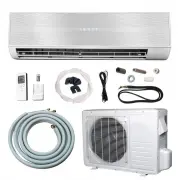
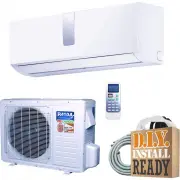
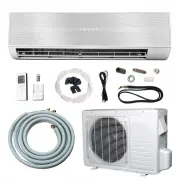
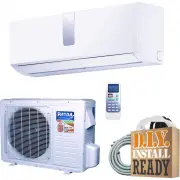
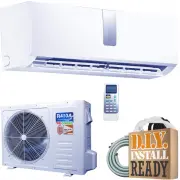
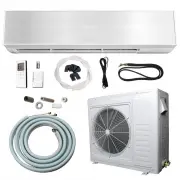
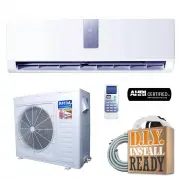
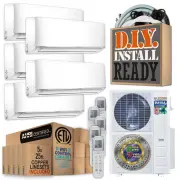
Name Shape Quantity 1 1 1 1 (For cooling & heating models only) Clip anchor Mounting plate fixing screw ST3.9 X 25 Remote control Fixing screw for remote control holder ST2.9 x 10 Remote control holder Dry battery AAA.LR03 Air freshening filter Seal Drain joint Mounting plate 1 Accessories The a...
Page 7 - Installation manual; Page 7; 5 Feet Included for longer
1 1 1 User's manual Installation manual Quick-Start Guide Page 7 Name Shape Quantity 25 Feet Included; for longer line sets, consult an HVAC professional - additional freon may be needed. Co n n e ct in g pipe assembly L iq u id sid e G a s sid e Ø 1/ 4 in ( 6.35 mm) Ø 3/ 8 in ( 9.52 mm) Ø 3/ 8 ...
Page 8 - Installation Summary - Indoor Unit; Determine wall hole position
Page 8 Select installation location (Page 11) Attach mounting plate (Page 12) Drill wall hole (Page 12) Installation Summary - Indoor Unit 2 Installation Overview Determine wall hole position (Page 12) 1 2 3 4 4.75 in(12 cm) 90.55 in (2.3 m) 4.75 in (12 cm) 5.9 in (15 cm)
Page 10 - Unit Parts; NOTE ON ILLUSTRATIONS; slightly different. The actual shape prevails.
Page 10 Unit Parts 3 Installation Overview Fig. 2.1 NOTE ON ILLUSTRATIONS Illustrations in this manual are for explanatory purposes. The actual shape of your indoor unit may be slightly different. The actual shape prevails. Wall mounting plate Power cable (some units) Refrigerant piping Signal c...
Page 11 - Indoor Unit Installation; Installation Instructions – Indoor; PRIOR TO INSTALLATION
Page 11 Indoor Unit Installation 4 Installation Instructions – Indoor Unit PRIOR TO INSTALLATION Before installing the indoor unit, refer to the label on the product box to make sure that the model number of the indoor unit matches the model number of the outdoor unit. Step 1: Select installatio...
Page 12 - for detailed; CAUTION
Page 12 Refer to the following diagram to ensure proper distance from walls and ceiling: Step 2: Attach mounting plate to wall The mounting plate is the device on which you will mount the indoor unit.1. Remove the screw that attaches the mounting plate to the back of the indoor unit. 2. Place th...
Page 13 - MOUNTING PLATE DIMENSIONS; Correct orientation of mounting plate
Page 13 4 in (101 mm) 7.05 in (179 mm) 5.35in(136mm) 1.45 in (37 mm) 11.4 in (290 mm) 1.95 in (49 mm) Left rear wall hole 2.5 in (65 mm) Right rear wall hole 2.5 in (65 mm) Indoor unit outline Model A 28.45 in (722 mm) 1.95 in (49 mm) 7.55 in (192 mm) 9.15 in (232 mm) 16.8 in (426 mm) 5.05in(128...
Page 16 - BEFORE PERFORMING ELECTRICAL WORK, READ THESE REGULATIONS; licensed electrician.
Page 16 BEFORE PERFORMING ELECTRICAL WORK, READ THESE REGULATIONS 1. All wiring must comply with local and national electrical codes and must be installed by a licensed electrician. 2. All electrical connections must be made according to the Electrical Connection Diagram located on the panels of...
Page 17 - Rated Current of; AWG
ALL WIRING MUST BE PERFORMED STRICTLYIN ACCORDANCE WITH THE WIRINGDIAGRAM LOCATED ON THE INSIDE OF THEINDOOR UNIT’S WIRE COVER. Page 17 Step 6: Connect signal cable The signal cable enables communication between the indoor and outdoor units. You must first choose the right cable size before prep...
Page 19 - Move to the left or right; Refrigerant Piping Connection
Page 19 If refrigerant piping is already embedded in the wall, do the following: 1. Hook the top of the indoor unit on the upper hook of the mounting plate. 2. Use a bracket or wedge to prop up the unit, giving you enough room to connect the refrigerant piping, signal cable, and drain hose. Refe...
Page 20 - Outdoor Unit Installation; Installation Instructions – Outdoor; Select installation location
Page 20 Outdoor Unit Installation 5 Installation Instructions – Outdoor Unit Step 1: Select installation location Before installing the outdoor unit, you must choose an appropriate location. The following are standards that will help you choose an appropriate location for the unit. Proper instal...
Page 21 - Step 2: Install drain joint; IN COLD CLIMATES
Page 21 SPECIAL CONSIDERATIONS FOR EXTREME WEATHERIf the unit is exposed to heavy wind: Install the unit so that the air outlet fan is at a 90° angle to the direction of the wind. If needed, build a barrier in front of the unit to protect it from extremely heavy winds.See Fig. 4.2 and Fig. 4.3 b...
Page 22 - Step 3: Anchor outdoor unit; W x H x D
Page 22 If you will install the unit on the ground or on a concrete mounting platform, do the following: 1. Mark the positions for four expansion bolts based on dimensions in the Unit Mounting Dimensions chart. 2. Pre-drill holes for expansion bolts.3. Clean concrete dust away from holes.4. Plac...
Page 23 - The wall; READ THESE REGULATIONS
Page 23 If you will install the unit on a wall-mounted bracket , do the following: CAUTION Before installing a wall-mounted unit, make sure that the wall is made of solid brick, concrete, or similarly strong material. The wall must be able to support at least four times the weight of the unit. 1...
Page 24 - POWER SUPPLY
Page 24 WARNING 1. Prepare the cable for connection: USE THE RIGHT CABLE • Indoor Power Cable (if applicable): H05VV-F or H05V2V2-F • Outdoor Power Cable: H07RN-F • Signal Cable: H07RN-F Minimum Cross-Sectional Area of Power and Signal Cables Other Regions Rated Current of Appliance (A) Nominal ...
Page 25 - Note on Pipe Length; Model
Page 25 Refrigerant Piping Connection 6 Note on Pipe Length The length of refrigerant piping will affect the performance and energy efficiency of the unit. Nominal efficiency is tested on units with a pipe length of 16.5 ft (5 m).Refer to the table below for specifications on the maximum length ...
Page 26 - Step 3: Flare pipe ends; PIPING EXTENSION BEYOND FLARE FORM; Outer Diameter of
Page 26 DO NOT DEFORM PIPE WHILE CUTTING Be extra careful not to damage, dent, or deform the pipe while cutting. This will drastically reduce the heating efficiency of the unit. Step 2: Remove burrs Burrs can affect the air-tight seal of the refrigerant piping connection. They must be completely...
Page 27 - Radius; TORQUE REQUIREMENTS; Tightening Tor; DO NOT USE EXCESSIVE TORQUE; Torque Requirements
Page 27 6. Place the flaring tool onto the form.7. Turn the handle of the flaring tool clockwise until the pipe is fully flared. 8. Remove the flaring tool and flare form, then inspect the end of the pipe for cracks and even flaring. Step 4: Connect pipes When connecting refrigerant pipes, be ca...
Page 28 - Valve cover
Page 28 Instructions for Connecting Piping to Outdoor Unit 1. Unscrew the cover from the packed valve on the side of the outdoor unit. (See Fig. 5.9 ) Valve cover 2. Remove the protective caps from the ends of the valves. 3. Align flared pipe end with each valve and tighten the flare nut as tigh...
Page 29 - Preparations and Precautions; BEFORE PERFORMING EVACUATION; Evacuation Instructions
Page 29 Air Evacuation 7 Preparations and Precautions Air and foreign matter in the refrigerant circuit can cause abnormal rises in pressure, which can damage the air conditioner, reduce its efficiency, and cause injury. Use a vacuum pump and manifold gauge to evacuate the refrigerant circuit, r...
Page 30 - OPEN VALVE STEMS GENTLY; ADDITIONAL REFRIGERANT PER PIPE LENGTH; Connective Pipe; DO NOT; calculated using the following formula:
Page 30 3. Open the low pressure side of the manifold gauge. Keep the high pressure side closed. 4. Turn on the vacuum pump to evacuate the system. 5. Run the vacuum for at least 15 minutes, or until the compound meter reads -76 cm HG (-10 Pa). 6. Close the low pressure side of the manifold gaug...
Page 31 - Electrical and Gas Leak Checks; Electrical Safety Checks; WARNING – RISK OF
Page 31 Electrical and Gas Leak Checks 8 Electrical Safety Checks After installation, confirm that all electrical wiring is installed in accordance with local and national regulations, and according to the installation manual. BEFORE TEST RUN Check Grounding Work Measure grounding resistance by ...
Page 32 - Before Test Run; Test Run Instructions; test run; List of Checks to Perform
Page 32 Test Run 9 Before Test Run Only perform the test run after you have completed the following steps: • Electrical Safety Checks – Confirm that the unit’s electrical system is safe and operating properly • Gas Leak Checks – Check all flare nut connections and confirm that the system is not ...
Page 34 - INSTALLATION INFORMATION; DEALERSHIP/INSTALLER INFORMATION
For your convenience, please record the model and serial numbers of your new equipment in the spaces provided. This information, along with the installation data and dealer contact information, will be helpful should your system require maintenance or service. PRODUCT & INSTALLATION RECORD UNIT ...