Page 2 - Introduction; Important Safety Instructions; WARNING; AVIS
2 En Introduction Important Safety Instructions 1. Read these instructions. 2. Keep these instructions. 3. Heed all warnings. 4. Follow all instructions. 5. Do not use this apparatus near water. 6. Clean only with dry cloth. 7. Do not block any ventilation openings. Install in accordance with the ma...
Page 3 - Precautions; For Canadian Models
3 En Precautions 1. Recording Copyright —Unless it’s for personal use only, recording copyrighted material is illegal without the permission of the copyright holder. 2. AC Fuse —The AC fuse inside the unit is not user- serviceable. If you cannot turn on the unit, contact your Onkyo dealer. 3. Care —...
Page 4 - Supplied Accessories; Make sure you have the following accessories:; Installing the batteries; Aiming the remote controller; Declaration of Conformity
4 En For British models Replacement and mounting of an AC plug on the power supply cord of this unit should be performed only by qualified service personnel. IMPORTANT The wires in the mains lead are coloured in accordance with the following code: Blue: Neutral Brown: Live As the colours of the wire...
Page 5 - Contents
5 En Contents Important Safety Instructions ......................................... 2Precautions....................................................................... 3Supplied Accessories ...................................................... 4Features ..............................................
Page 6 - Features; Amplifier
6 En Features Amplifier • 65 Watts/Channel @ 8 ohms (FTC)• 100 Watts/Channel @ 6 ohms (IEC)• 120 Watts/Channel @ 6 ohms (JEITA)• Optimum Gain Volume Circuitry• H.C.P.S. (High Current Power Supply) Massive High Power Transformer Processing • HDMI (Audio Return Channel, 3D, DeepColor, x.v.Color *1 , L...
Page 7 - Front Panel; c d
7 En Front & Rear Panels The page numbers in parentheses show where you can find the main explanation for each item. a 8 ON/STANDBY button ( 17 ) b HDMI THRU indicator ( 35 ) c SPEAKERS A and B buttons ( 26 ) d Remote control sensor ( 4 ) e LISTENING MODE buttons ( 23 ) f Display ( 8 ) g DIMMER ...
Page 8 - For detailed information, see the pages in parentheses.; Display; to
8 En For detailed information, see the pages in parentheses. a A and B speaker indicators ( 26 ) b Audio input indicators c Listening mode and format indicators ( 23 , 27 ) d Tuning indicators ( 20 ) e RDS indicator (excluding North American models) ( 21 ) f SLEEP indicator ( 26 ) g MUTING indicator...
Page 9 - Remote Controller; Controlling the AV Receiver
9 En Remote Controller For detailed information, see the pages in parentheses. a 8 button ( 17 ) b REMOTE MODE/INPUT SELECTOR buttons ( 18 , 40 to 41 ) c TONE and Tone Level buttons ( 36 ) d SP A/B button ( 26 ) e Arrow q / w / e / r and ENTER buttons f SETUP button ( 29 ) g LISTENING MODE buttons (...
Page 10 - Connections; Connecting the AV Receiver; Connecting the Speaker Cables; Push-type speaker terminals; Connecting Your Speakers
10 En Connections Connecting the AV Receiver Connecting the Speaker Cables The following illustration shows which speaker should be connected to each pair of terminals. ■ Push-type speaker terminals Strip 3/8" to 1/2" (10 to 12 mm) of insulation from the ends of the speaker cables, and twist...
Page 12 - About AV Connections; HDMI cable
12 En Connected image with AV components • Before making any AV connections, read the manuals supplied with your AV components.• Don’t connect the power cord until you’ve completed and double-checked all AV connections.• Push plugs in all the way to make good connections (loose connections can cause...
Page 13 - HDMI OUT; of the; ” is set to “; On; Connecting Components with HDMI
13 En Connect your components to the appropriate jacks. The default input assignments are shown below. ✔ : Assignment can be changed ( ➔ page 30 ). See also: • “Connection Tips and Video Signal Path” ( ➔ page 47 ) • “About HDMI” ( ➔ page 49 ) • “Using an RIHD-compatible TV, Player, or Recorder” ( ➔ ...
Page 14 - How to record the video; See “Recording” to make a connection for video recording (; Connecting Your Components
14 En Connect your components to the appropriate jacks. The default input assignments are shown below. ✔ : Assignment can be changed ( ➔ page 30 ). *1 When USB input is selected, you can input video signals from the AUX INPUT VIDEO jack. Video signals input from AUX INPUT VIDEO will be output from t...
Page 15 - Connecting Onkyo; Make the; Connecting a Recording Component
15 En With u (Remote Interactive), you can use the following special functions: ■ System On/Auto Power On When you start playback on a component connected via u , if the AV receiver is on Standby, it will automatically turn on and select that component as the input source. ■ Direct Change When playb...
Page 16 - • Before connecting the power cord, connect all of your; Connecting Antenna; • Be careful that you don’t injure yourself when; AC INLET
16 En This section explains how to connect the supplied indoor FM antenna and AM loop antenna.The AV receiver won’t pick up any radio signals without any antenna connected, so you must connect the antenna to use the tuner. Note • Once your AV receiver is ready for use, you’ll need to tune into a rad...
Page 17 - Turning On & Basic Operations; Turning On/Off the AV Receiver; Turning On; RECEIVER; Turning Off; or; RECEIVER; RECEIVER
17 En Turning On & Basic Operations Turning On/Off the AV Receiver Tip • See “Auto Standby” about a power management setting ( ➔ page 34 ). Turning On 1 Press 8 ON/STANDBY on the front panel. or Press RECEIVER followed by 8 on the remote controller. The AV receiver comes on, the display lights. ...
Page 18 - Playback; Playing the Connected Component; • “Playing USB Device” (; Controlling Contents of USB Devices
18 En Playback ■ Operating with the remote controller ■ Operating on the AV receiver See “Controlling Other Onkyo Components” about the operation of other components ( ➔ page 40 ). This manual describes the procedure using the remote controller unless otherwise specified. Playing the Connected Compo...
Page 19 - Standard Mode control; Understanding Icons on the Display; ” appears on the display.
19 En Note • The buttons you can use will differ depending on the devices and media used for playback. This section describes icons that appear on the display during media playback. This section explains how to play music files on the iPod/iPhone.Compatible iPod/iPhone modelsMade for:iPod touch (1st...
Page 20 - Extended Mode control; Using the Tuner; Playing USB Device; Listening to AM/FM Radio; indicator
20 En Extended Mode control The content information is displayed (lists are displayed) on-screen, and you can control the content while looking at the screen.Top screen list:Playlists, Artists, Albums, Genres, Songs, Composers, Shuffle Songs, Now Playing This section explains how to play music files...
Page 21 - Presetting AM/FM Stations
21 En ■ Manual tuning mode In manual tuning mode, FM stations will be in mono. ■ Tuning into stations by frequency You can tune into AM and FM stations directly by entering the appropriate frequency. Presetting AM/FM Stations You can store a combination of up to 40 of your favorite AM/FM radio stati...
Page 22 - PRESET
22 En ■ Displaying Radio Text (RT) ■ Finding Stations by Type (PTY) You can search for radio stations by type. ■ Listening to Traffic News (TP) You can search for stations that broadcast traffic news. RDS program types (PTY) 1 Press RT/PTY/TP once. The RT information scrolls across the display. Note...
Page 23 - Using Basic Functions; Selecting Listening Modes; Listening Mode Buttons; About Listening Modes; Explanatory Notes; The following audio formats are supported by the listening mode.; Using the Listening Modes; MUSIC
23 En Using Basic Functions Selecting Listening Modes See “Listening Modes” for detailed information about the listening modes ( ➔ page 24 ). ■ Listening Mode Buttons MOVIE/TV button This button selects the listening modes intended for use with movies and TV. MUSIC button This button selects the lis...
Page 25 - • The listening modes cannot be selected with some source formats.
25 En Note *1 These listening modes cannot be selected during USB or iPod playback. *2 For the Blu-ray Discs, Dolby Digital is used. *3 AV receiver can input the DSD signal from HDMI IN. Setting the output setting on the player side to PCM might obtain a better sound according to the player. In that...
Page 26 - Using the Home Menu
26 En The Home menu provides you quick access to frequently used menus without having to go through the long standard menu. This menu enables you to change settings and view the current information. Note *1 Depending on the input source and listening mode, not all channels shown here output the soun...
Page 27 - Changing the Input Display; Using the Music Optimizer
27 En You can adjust the brightness of the AV receiver’s display. You can display various information about the current input source as follows. The following information can typically be displayed. Tip • Alternatively, you can use the AV receiver’s DISPLAY . *1 When AM or FM radio is used, the band...
Page 28 - Muting the AV Receiver; Using Headphones; Recording
28 En You can temporarily mute the output of the AV receiver. This section explains how to record the selected input source to a component with recording capability, and how to record audio and video from different sources. AV Recording Audio sources can be recorded to a recorder (e.g., cassette tap...
Page 29 - Advanced Operations; Advanced Setup; On-screen Setup Menus; Common Procedures in Setup Menu; RETURN
29 En Advanced Operations Advanced Setup Note • The on-screen setup menus are displayed when: – There is no video input, or– The video input is 480p, 576p, 720p, 1080i, or 1080p. The on-screen setup menus appear on the connected TV and provide a convenient way to change the AV receiver’s various set...
Page 30 - OPTICAL1; HDMI Input; Yes
30 En Explanatory Notes Menu HDMI Input If you connect a video component to an HDMI input, you must assign that input to an input selector. For example, if you connect your Blu-ray Disc/DVD player to HDMI IN 2 , you must assign “ HDMI2 ” to the “ BD/DVD ” input selector.Here are the default assignme...
Page 31 - Large; Subwoofer; Small; Double Bass; Unit
31 En • Available sampling rate for PCM signals from a digital input (optical and coaxial) is 32/44.1/48/88.2/96 kHz/16, 20, 24 bit. Menu Sp Config This section explains how to specify which speakers are connected and their sizes.For speakers with a cone diameter larger than 6-1/2 inches (16 cm), sp...
Page 32 - Multiplex/Mono Settings; Audio Adjust
32 En Menu Level Cal Here you can adjust the level of each speaker with the built-in test tone so that the volume of each speaker is the same at the listening position. ■ Left, Center *1 , Right, Surround Right, Surround Left ` –12 dB to 0 dB to +12 dB in 1 dB step. ■ Subwoofer *1 ` –15 dB to 0 dB t...
Page 33 - Theater-Dimensional Setting; Name; Audio Selector; Source Setup
33 En Theater-Dimensional Setting ■ Listening Angle ` Wide : Select if the listening angle is 40 degrees. ` Narrow : Select if the listening angle is 20 degrees. With this setting, you can optimize the Theater-Dimensional listening mode by specifying the angle of the front left and right speakers re...
Page 34 - OSD Setting; Tuner; Hardware
34 En Setting the Incoming Digital Signal (Fixed Mode) ■ Fixed Mode ` Off : The format is detected automatically. If no digital input signal is present, the corresponding analog input is used instead. ` PCM : Only 2-channel PCM format input signals will be heard. If the input signal is not PCM, the ...
Page 35 - HDMI Setup
35 En Menu HDMI Setup ■ HDMI Ctrl (RIHD) ` Off ` On Turn this setting on to allow p -compatible components connected via HDMI to be controlled by the AV receiver ( ➔ page 50 ). Note • When set to “ On ” and close the menu, the name of connected p -compatible components and “ RIHD On ” are displayed ...
Page 36 - Tone Control Settings; Speaker Levels; Late Night Function; Using the Audio Settings
36 En ■ LipSync ` Off ` On This function allows the AV receiver to automatically correct any delay between the video and the audio, based on the data from the connected monitor. Note • This function works only if your HDMI-compatible TV supports HDMI Lip Sync. You can change various audio settings f...
Page 37 - Music Optimizer; CinemaFILTER; Cinema Filter
37 En Music Optimizer ■ Music Optimizer ` Off ` On Turn this setting on to enhance the sound quality of compressed music files. Use it with music files that use “lossy” compression, such as MP3. Tip • Alternatively, you can use the AV receiver’s MUSIC OPTIMIZER . Note • The Music Optimizer function ...
Page 38 - Controlling Other Components; iPod/iPhone Playback via Onkyo Dock; RI Dock; With the RI Control; DOCK; Without the RI Control; Using the Onkyo Dock
38 En Controlling Other Components iPod/iPhone Playback via Onkyo Dock RI Dock With the RI Dock, you can easily play the music stored on your Apple iPod/iPhone through the AV receiver and enjoy great sound, and watch iPod/iPhone slideshows and videos on your TV. In addition, the onscreen display (OS...
Page 40 - Controlling Other Onkyo Components; Entering Remote Control Codes; REMOTE MODE; REMOTE MODE
40 En Controlling Other Onkyo Components You can use the AV receiver’s remote controller to control your other Onkyo AV components. This section explains how to enter the remote control code (with the default underlined) for a component that you want to control: DVD, CD, etc. The following REMOTE MO...
Page 41 - Resetting REMOTE MODE Buttons
41 En You can reset a REMOTE MODE to its default remote control code. You can reset the remote controller to its default settings. By pressing REMOTE MODE that’s been programmed with the remote control code for your component, you can control Onkyo component as below.For details on entering a remote...
Page 43 - Appendix; Troubleshooting; , press and hold down; Power; HOME; Audio
43 En Appendix Troubleshooting If you have any trouble using the AV receiver, look for a solution in this section. If you can’t resolve the issue yourself, contact your Onkyo dealer. ■ Can’t turn on the AV receiver ■ The AV receiver turns off unexpectedly ■ When the power is restored after a power i...
Page 44 - Video
44 En ■ Only the front speakers produce sound ■ Only the center speaker produces sound ■ The surround speakers produce no sound ■ The center speaker produces no sound ■ The subwoofer produces no sound ■ There’s no sound with a certain signal format ■ Can’t get 5.1 playback ■ The speaker volume canno...
Page 47 - Connection Tips and Video Signal Path; Video Connection Formats
47 En Connection Tips and Video Signal Path The AV receiver supports several connection formats for compatibility with a wide range of AV equipment. The format you choose will depend on the formats supported by your components. Use the following sections as a guide. Note • The on-screen setup menus ...
Page 48 - USB Features; • USB mass storage device class (but not always; USB Device Requirements
48 En USB Features • USB mass storage device class (but not always guaranteed). • FAT16 or FAT32 file system format.• Each folder may contain up to 255 music files and folders, and folders may be nested up to 8 levels deep. • USB hubs and USB devices with hub functions are not supported. For and pla...
Page 49 - About HDMI; , so TVs and displays with; Supported Audio Formats
49 En About HDMI Designed to meet the increased demands of digital TV, HDMI (High Definition Multimedia Interface) is a new digital interface standard for connecting TVs, projectors, Blu-ray Disc/DVD players, set-top boxes, and other video components. Until now, several separate video and audio cabl...
Page 50 - TV; For; About
50 En Using an RIHD-compatible TV, Player, or Recorder p , which stands for Remote Interactive over HDMI, is the name of the system control function found on Onkyo components. The AV receiver can be used with CEC (Consumer Electronics Control), which allows system control over HDMI and is part of th...
Page 51 - HDMI IN 1
51 En ■ How to connect and setup 1 Confirm the connecting and setting. 1. Connect the HDMI OUT jack to the HDMI input jack of the TV. 2. Connect the audio output from the TV to the OPTICAL IN 2 jack of the AV receiver using an optical digital cable. Note • When the audio return channel (ARC) functio...
Page 52 - Specifications; Amplifier Section
52 En Specifications Amplifier Section Video Section Tuner Section General ■ HDMI ■ Video Inputs ■ Video Outputs ■ Audio Inputs ■ Audio Outputs ■ Others Specifications and features are subject to change without notice. Rated Output Power All channels: (North American)65 watts minimum continuous powe...
Page 53 - Memo


 Onkyo M5010
User Manual
Onkyo M5010
User Manual
 Onkyo TX-NR1007
Manual
Onkyo TX-NR1007
Manual
 Onkyo TX-NR1008
Manual
Onkyo TX-NR1008
Manual
 Onkyo TX-NR1009
Manual
Onkyo TX-NR1009
Manual
 Onkyo TX-NR1010
Manual
Onkyo TX-NR1010
Manual
 Onkyo TX-NR1030
Manual
Onkyo TX-NR1030
Manual
 Onkyo TX-NR3007
Manual
Onkyo TX-NR3007
Manual
 Onkyo TX-NR3008
Manual
Onkyo TX-NR3008
Manual
 Onkyo TX-NR3009
Manual
Onkyo TX-NR3009
Manual
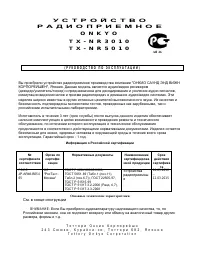 Onkyo TX-NR3010
Manual
Onkyo TX-NR3010
Manual
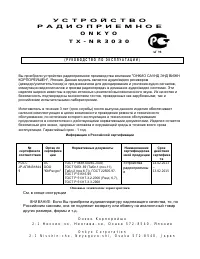 Onkyo TX-NR3030
Manual
Onkyo TX-NR3030
Manual
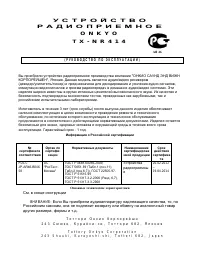 Onkyo TX-NR414
Manual
Onkyo TX-NR414
Manual
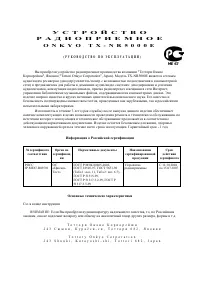 Onkyo TX-NR5000E
Manual
Onkyo TX-NR5000E
Manual
 Onkyo TX-NR5007
Manual
Onkyo TX-NR5007
Manual
 Onkyo TX-NR5008
Manual
Onkyo TX-NR5008
Manual
 Onkyo TX-NR5009
Manual
Onkyo TX-NR5009
Manual
 Onkyo TX-NR515
Manual
Onkyo TX-NR515
Manual
 Onkyo TX-NR525
Manual
Onkyo TX-NR525
Manual
 Onkyo TX-NR535
Manual
Onkyo TX-NR535
Manual
 Onkyo TX-NR579
Manual
Onkyo TX-NR579
Manual