Page 3 - Table of contents; A quick look
3 Table of contents 1 A quick look Package contents ........................................................................................ 5Your wireless router .................................................................................... 5 2 Creating your network Positioning your router......
Page 4 - Using the utilitie
4 Table of contents Using the Network Place (Samba) Share service .................... 34Using the FTP Share service............................................................ 35Using the Miscellaneous setting ................................................... 37 Configuring the Advanced settings ...
Page 5 - Package contents; • If any of the items is damaged or missing, contact ASUS for; RT-AC66U Wireless Router; Warranty card; Your wireless router
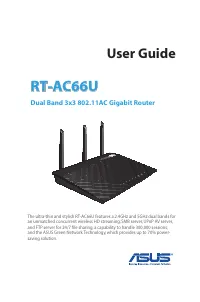
5 1 A quick look Package contents NOTES: • If any of the items is damaged or missing, contact ASUS for technical inquiries and support, Refer to the ASUS Support Hotline list at the back of this user manual. • Keep the original packaging material in case you would need future warranty services such ...
Page 8 - Creating your network; Positioning your router
8 2 Creating your network Positioning your router For the best wireless signal transmission between the wireless router and the network devices connected to it, ensure that you: • Place the wireless router in a centralized area for a maximum wireless coverage for the network devices. • Keep the devi...
Page 9 - What you need; Google Chrome
9 What you need To set up your network, you need one or two computers that meet the following system requirements: • Ethernet RJ-45 (LAN) port (10Base-T/100Base-TX/ 1000BaseTX) • IEEE 802.11a/b/g/n/ac wireless capability • An installed TCP/IP service • Web browser such as Internet Explorer, Firefox,...
Page 10 - Setting up your wireless router; Wired connection; To set up your wireless router via wired connection:; Insert your wireless router’s AC adapter to the DC-IN port and
10 Setting up your wireless router Wired connection IMPORTANT! • Use wired connection in setting up your wireless router to avoid possible setup problems due to wireless uncertainty. • Before setting up your ASUS wireless router, do the following: • If you are replacing an existing router, disconnec...
Page 11 - Ensure that the LAN LED is blinking.; Wireless connection
11 2. Using the bundled network cable, connect your computer to your wireless router’s LAN port. IMPORTANT! Ensure that the LAN LED is blinking. 3 Using another network cable, connect your modem to your wireless router’s WAN port. 4. Insert your modem’s AC adapter to the DC-IN port and plug it to a ...
Page 12 - Setting up the wireless security settings; in this user; Mounting to the stand; To mount to the stand:; • Align and insert the stand’s mounting hooks to the wireless
12 NOTES: • For details on connecting to a wireless network, refer to the WLAN adapter’s user manual. • To set up the security settings for your network, refer to the section Setting up the wireless security settings in this user manual. Mounting to the stand To mount to the stand: • Align and inser...
Page 13 - Before you proceed; Windows; to launch the browser.; Before configuring your wireless router, do the steps; From the Local Area
13 Before you proceed A. Disable the proxy server, if enabled. Windows ® 7 1. Click Start > Internet Explorer to launch the browser. 2. Click Tools > Internet options > Connections tab > LAN settings . NOTE: Before configuring your wireless router, do the steps described in this section ...
Page 14 - MAC OS; From your Safari; Refer to your browser's help feature for details on; B. Set the TCP/IP settings to automatically obtain an IP; or
14 MAC OS 1. From your Safari browser, click Safari > Preferences > Advanced > Change Settings... 2. From the Network screen, deselect FTP Proxy and Web Proxy (HTTP) . 3. Cllick Apply Now when done. NOTE: Refer to your browser's help feature for details on disabling the proxy server. B. Set...
Page 15 - Refer to your operating system’s help and support
15 3. To obtain the IPv4 IP settings automatically, tick Obtain an IP address automatically . To obtain the IPv6 IP settings automatically, tick Obtain an IPv6 address automatically . 4. Click OK when done. MAC OS 1. Click the Apple icon located on the top left of your screen. 2. Click System Prefer...
Page 17 - Configuring via the web GUI; Logging into the web GUI; To log into the web GUI:; or Google Chrome, manually key in the wireless router’s default; admin; NOTES; • For your network clients, ensure that you set the TCP/IP; in
17 3 Configuring via the web GUI Logging into the web GUI Your ASUS Wireless Router comes with an intuitive web graphics user interface (GUI) that allows you to easily configure its various features through a web browser such as Internet Explorer, Firefox, Safari, or Google Chrome. To log into the w...
Page 18 - Setting up the Internet connection; NOTE; : When setting the Internet connection for the first time,
18 3. The wireless router’s web GUI launches. Use the web GUI to configure various settings. Setting up the Internet connection NOTE : When setting the Internet connection for the first time, press the Reset button on your wireless router to reset it to its factory default settings. Quick Internet S...
Page 19 - type is; Dynamic IP; the necessary information for your ISP connection type.; IMPORTANT; Obtain the necessary information about your
19 2. The wireless router automatically detects if your ISP connection type is Dynamic IP , PPPoE , PPTP , L2TP , and Static IP . Key in the necessary information for your ISP connection type. IMPORTANT ! Obtain the necessary information about your Internet connection type from your ISP.
Page 20 - Apply
20 NOTES : • The auto-detection of your ISP connection type takes place when you configure the wireless router for the first time or when your wireless router is reset to its default settings. • If QIS failed to detect your Internet connection type, click Skip to manual setting and manually configur...
Page 21 - Your Internet and wireless settings are displayed. Click; Next; to; Finish
21 4. Your Internet and wireless settings are displayed. Click Next to continue. 5. Read the wireless network connection tutorial. When done, click Finish .
Page 22 - To set up the wireless security settings:; on your web browser.; . The wireless router’s web GUI; System status; icon to; : You can set up different wireless security settings for; GHz security settings
22 Setting up the wireless security settings To protect your wireless network from unauthorized access, you need to configure its security settings. To set up the wireless security settings: 1. Key in 192.168.1.1 on your web browser. 2. On the login screen, key in the default user name ( admin ) and...
Page 23 - GHz security settings; field, key in a unique name for; Security Level; dropdown list, select the encryption; The IEEE 802.11n/ac standard prohibits using
23 5GHz security settings 4. On the Wireless name (SSID) field, key in a unique name for your wireless network. 5. From the Security Level dropdown list, select the encryption method for your wireless network. IMPORTANT ! The IEEE 802.11n/ac standard prohibits using High Throughput with WEP or WPA-T...
Page 24 - Managing your network clients; To manage your network clients:; icon to
24 Managing your network clients To manage your network clients: 1. Launch the wireless router’s web GUI.2. On the Network Map screen, select the Client Status icon to display the information about your network clients.
Page 25 - Using AiDisk for sharing files; in this; To monitor your USB device:; Monitoring your USB device
25 NOTE: To use this feature, you need to plug a USB storage device, such as a USB hard disk or USB flash drive, to the USB 2.0 port on the rear panel of your wireless router. Ensure that the USB storage device is formatted and partitioned properly. Refer to the Plug-n-Share Disk Support List at htt...
Page 26 - GO; to set up an FTP server for
26 NOTES : • For more details, refer to the section Using the Network Place (Samba) Share service and Using the FTP Share service in this user manual. • On USB External HDD/Flash disk: • The wireless router works with most USB HDDs/Flash disks (up to 2TB size) and supports read-write access for FAT1...
Page 27 - Creating your Guest Network; To create your guest network:; to create a network
27 Creating your Guest Network The Guest Network provides Internet connectivity for temporary visitors without providing access to your private network. To create your guest network: 1. Launch the wireless router’s web GUI.2. On the Guest Network screen, click Create to create a network for your vis...
Page 28 - Using the Traffic Manager; Managing QoS (Quality of Service) Bandwidth; To set up the bandwidth priority:; to enable the default rule and fill in the upload and; • Get the bandwidth information from your ISP.
28 Using the Traffic Manager Managing QoS (Quality of Service) Bandwidth The Quality of Service (QoS) allows you to set the bandwidth priority and manage the network traffic. To set up the bandwidth priority: 1. Launch the wireless router’s web GUI.2. On the Traffic Manager screen, select the QoS ta...
Page 29 - Monitoring Traffic; Using the USB Extension; The USB Extension function provides; AiDisk; and; Download Master
29 Monitoring Traffic The traffic monitor function allows you to assess the bandwidth usage and speed of your Internet, LAN, Wired, WLAN (2.4GHz or 5GHz) connections. Using the USB Extension The USB Extension function provides AiDisk , Servers Center , Network Printer Server and Download Master subm...
Page 30 - Using AiDisk for Files Sharing; Before using AiDisk, ensure that you have inserted a; icon in USB Extension.; Go
30 Using AiDisk for Files Sharing AiDisk allows you to share files in the USB disk through the Internet. NOTE: Before using AiDisk, ensure that you have inserted a USB disk into the USB port of your wireless router. To use AiDisk: 1. Click the AiDisk icon in USB Extension. 2. From the Welcome to AiD...
Page 31 - will use the service and accept the Terms of service; and key
31 3. Select the access rights that you want to assign to the clients accessing your shared data. 4. Create your domain name via the ASUS DDNS services, select I will use the service and accept the Terms of service and key in your domain name. When done, click Next .
Page 32 - to finish the setup.
32 5. Click Finish to finish the setup. 6. To access the FTP site that you created, launch a web browser or a third-party FTP client utility and key in the ftp link ( ftp://<domain name> ) you have previously created.
Page 33 - Using the Servers Center service; : Before using the UPnP Media Server function, install a; To use your router as a Servers center:; Click USB Extension from the navigation menu at the left side; Servers Center; . Your wireless router is now ready to
33 Using the Servers Center service Your wireless router allows UPnP (Universal Plug and Play) multimedia devices, such as PS3 and XBox 360, to access multimedia files from the USB disk connected to your wireless router. NOTE : Before using the UPnP Media Server function, install a wireless adapter ...
Page 34 - Using the Network Place (Samba) Share service; tab in the Servers; Add; Modify; to add, delete or modify the
34 Using the Network Place (Samba) Share service Network Place (Samba) Share allows you to set the account and permission for samba service. To use Samba share: 1. Click the Network place (Samba) Share tab in the Servers Center of USB Extension. 2. Click Add , Delete or Modify to add, delete or modi...
Page 35 - Using the FTP Share service; Sharing files via the FTP server; To use this feature, you need to insert a USB; : Ensure that you safely remove the USB disk. Incorrect
35 Using the FTP Share service Sharing files via the FTP server The ASUS Wireless Router enables you to share files from your USB storage device via the FTP server with computers in LAN or through the Internet. IMPORTANT ! To use this feature, you need to insert a USB storage device, such as a USB h...
Page 37 - Using the Miscellaneous setting; To use miscellaneous setting:; tab in the Servers Center of
37 Using the Miscellaneous setting Miscellaneous setting allows you to configure other settings for the USB disk, including maximum login user, device name, work group and language on FTP server. To use miscellaneous setting: 1. Click the Miscellaneous setting tab in the Servers Center of USB Extens...
Page 38 - Configuring the Advanced settings; Setting up the DHCP Server; You may enable the; DHCP Server; function in your wireless router; : The ASUS Wireless Router can support up to 253 IP; To set up the DHCP server:; from the navigation menu at the left
38 Configuring the Advanced settings Advanced Setting allows you to configure the advanced features of your wireless router. Setting up the DHCP Server You may enable the DHCP Server function in your wireless router so your network clients can automatically obtain IP addresses from your wireless rou...
Page 39 - field, key in the starting IP; IP Pool Ending Address; field, key in the ending IP; Lease Time; field, key in the time that the IP addresses; • For the IP Pool Starting and Ending IP addresses, we; IP address; • IP Pool Starting Address should not be greater than the IP
39 3. In the Enable the DHCP Server? field, tick Yes . 4. In the IP Pool Starting Address field, key in the starting IP address. 5. In the IP Pool Ending Address field, key in the ending IP address. 6. In the Lease Time field, key in the time that the IP addresses expire and the wireless router auto...
Page 40 - Upgrading the firmware; : Download the latest firmware from the ASUS website; : If the upgrade process fails, the wireless router
40 To upgrade the firmware: 1. Click Advanced Setting from the navigation menu at the left side of your screen. 2. Under the Administration menu, click Firmware Upgrade . 3. In the New Firmware File field, click Browse to locate the new firmware in your computer. 4. Click Upload . The uploading proc...
Page 42 - Setting up your network printer; • To check if your USB printer is compatible with your ASUS; To set up your USB Printer:; Network Printer Server; in the ASUS EZ printer sharing mode to
42 Setting up your network printer Use the Network Printer Setup utility to set up a USB printer on your wireless router and allow network clients to access the USB printer. NOTES : • To check if your USB printer is compatible with your ASUS wireless router, refer to the Printer Support List at http...
Page 43 - Unzip the downloaded file and click the Printer icon to run the
43 4. Follow the onscreen instructions to set up your hardware, then click Next . 3. Unzip the downloaded file and click the Printer icon to run the network printer setup program.
Page 44 - Wait for a few minutes for the initial setup to finish. Click; to complete the installation.
44 5. Wait for a few minutes for the initial setup to finish. Click Next . 6. Click Finish to complete the installation.
Page 46 - Using the utilities; • Install the wireless router's utilities from the bundled support; Device Discovery; • From your computer’s desktop, click; When you set the router to Access Point mode, you
46 4 Using the utilities NOTES: • Install the wireless router's utilities from the bundled support CD. • If Autorun is disabled, run setup.exe from the root directory of the support CD. Device Discovery Device Discovery is an ASUS WLAN utility that detects an ASUS wireless router device, and enables...
Page 47 - Firmware Restoration; To launch the rescue mode and use the Firmware; re-plug the wireless router into the power source. Release the; Launch the rescue mode before using the
47 Firmware Restoration Firmware Restoration is used on an ASUS Wireless Router that failed during its firmware upgrading process. It uploads the firmware that you specify. The process takes about three to four minutes. To launch the rescue mode and use the Firmware Restoration utility: 1. Unplug th...
Page 48 - : This is not a firmware upgrade utility and cannot be; Chapter 3: Configuring via the web GUI; Upload
48 NOTE : This is not a firmware upgrade utility and cannot be used on a working ASUS Wireless Router. Normal firmware upgrades must be done through the web interface. Refer to Chapter 3: Configuring via the web GUI for more details. 5. Specify a firmware file, then click Upload .
Page 49 - : If you encounter problems that are not mentioned in; Troubleshooting; I cannot access a web browser for configuring the router.; : The commands for deleting cookies and files vary with
49 5 Troubleshooting NOTE : If you encounter problems that are not mentioned in this chapter, contact the ASUS Technical Support. Troubleshooting I cannot access a web browser for configuring the router. • Delete the cookies and files in your web browser. To do this, follow these steps: 1. Launch yo...
Page 52 - ASUS DDNS Service; • If there is no activity in the domain - such as reconfiguring; Will the registered information be lost or registered by
52 ASUS DDNS Service RT-AC66U supports the ASUS DDNS service. When exchanging devices at the service center, if you have registered the ASUS DDNS service and want to keep the original domain name, data transfer is a must. Visit your local service center for more information. NOTES : • If there is no...
Page 54 - Appendices; Notices; ASUS Recycling/Takeback Services; interference that may cause undesired operation.
54 Appendices Notices ASUS Recycling/Takeback Services ASUS recycling and takeback programs come from our commitment to the highest standards for protecting our environment. We believe in providing solutions for you to be able to responsibly recycle our products, batteries, other components, as well...
Page 55 - Prohibition of Co-location; Caution; : Any changes or modifications not expressly approved; from that to which the receiver is connected.
55 Prohibition of Co-location This device and its antenna(s) must not be co-located or operating in conjunction with any other antenna or transmitter Caution : Any changes or modifications not expressly approved by the party responsible for compliance could void the user’s authority to operate the e...
Page 56 - This Class B digital apparatus complies with Canadian ICES-003
56 Safety Information To maintain compliance with FCC’s RF exposure guidelines, this equipment should be installed and operated with minimum distance 20cm between the radiator and your body. Use on the supplied antenna. Declaration of Conformity for R&TTE directive 1999/5/EC Essential requiremen...
Page 57 - Radio Frequency (RF) Exposure Information
57 and RSS-210.Operation is subject to the following two conditions: (1) this device may not cause interference, and (2) this device must accept any interference, including interference that may cause undesired operation of the device. Radio Frequency (RF) Exposure Information The radiated output po...
Page 58 - NCC; 警語; GNU General Public License; Licensing information
58 doit accepter toute interférence, notamment les interférences qui peuvent a ecter son fonctionnement. NCC 警語 經型式認證合格之低功率射頻電機,非經許可,公司、商號或使用者均不得擅自變更頻率、加大功率或變更原設計之特性及功能。低功率射頻電機之使用不得影響飛航安全及干擾合法通信;經發現有干擾現象時,應立即停用,並改善至無干擾時方得繼續使用。前項合法通信,指依電信法規定作業之無線電通信。低功率射頻電機須忍受合法通信或工業、科學及醫療用電波輻射性電機設備之干擾。 GNU General P...
Page 59 - Preamble
59 Preamble The licenses for most software are designed to take away your freedom to share and change it. By contrast, the GNU General Public License is intended to guarantee your freedom to share and change free software--to make sure the software is free for all its users. This General Public Lice...
Page 60 - modification
60 We protect your rights with two steps: (1) copyright the software, and (2) offer you this license which gives you legal permission to copy, distribute and/or modify the software. Also, for each author’s protection and ours, we want to make certain that everyone understands that there is no warran...
Page 66 - NO WARRANTY
66 derivatives of our free software and of promoting the sharing and reuse of software generally. NO WARRANTY 11 BECAUSE THE PROGRAM IS LICENSED FREE OF CHARGE, THERE IS NO WARRANTY FOR THE PROGRAM, TO THE EXTENT PERMITTED BY APPLICABLE LAW. EXCEPT WHEN OTHERWISE STATED IN WRITING THE COPYRIGHT HOLD...
Page 67 - ASUS Contact information
67 ASUS Contact information ASUSTeK COMPUTER INC. (Asia Pacific) Address 15 Li-Te Road, Peitou, Taipei, Taiwan 11259 Website www.asus.com.tw Technical Support Telephone +886228943447 Support Fax +886228907698 Online support support.asus.com ASUS COMPUTER INTERNATIONAL (America) Address 800 Corporate...
Page 68 - Networks Global Hotline Information
68 Area Hotline Number Support Languages Working Hour Working Day Australia 1300-2787-88 English 8:00-20:00 Mon. to Fri. Austria 0043-820240513 German 9:00-18:00 Mon. to Fri. Belgium 0032-78150231 Dutch /French 9:00-17:00 Mon. to Fri. China 400-620-6655 Simplified Chinese 9:00-18:00 Mon. to Sun. Den...
Page 70 - EEE Yönetmeliğine Uygundur.
70 Manufacturer: ASUSTeK Computer Inc. Tel: +886-2-2894-3447 Address: No. 150, LI-TE RD., PEITOU, TAIPEI 112, TAIWAN Authorised representative in Europe: ASUS Computer GmbH Address: HARKORT STR. 21-23, 40880 RATINGEN, GERMANY Authorised distributors in Turkey: BOGAZICI BIL GISAYAR SAN. VE TIC. A.S. ...


 Asus 1001P-MU17-WT
User Manual
Asus 1001P-MU17-WT
User Manual
 Asus 1 E1309
User Manual
Asus 1 E1309
User Manual
 Asus 1015E
User Manual
Asus 1015E
User Manual
 Asus 1064E - PIKE Storage Controller SAS
User Manual
Asus 1064E - PIKE Storage Controller SAS
User Manual
 Asus 136-480A
User Manual
Asus 136-480A
User Manual
 Asus 1225 Series
User Manual
Asus 1225 Series
User Manual
 Asus 13VH192C
Manual
Asus 13VH192C
Manual
 Asus 1U
User Manual
Asus 1U
User Manual
 Asus 1U Rackmount Barebone Server RS160-E3/PS4
User Manual
Asus 1U Rackmount Barebone Server RS160-E3/PS4
User Manual
 Asus 200/266 MHZ FSB AGP 4X
User Manual
Asus 200/266 MHZ FSB AGP 4X
User Manual
 Asus 1U Rackmount Chassis Kit R10-A2P4
User Manual
Asus 1U Rackmount Chassis Kit R10-A2P4
User Manual
 Asus 24T1E
User Manual
Asus 24T1E
User Manual
 Asus 22T1E
User Manual
Asus 22T1E
User Manual