Page 3 - Table of Contents; Chapter 1: Hardware Setup
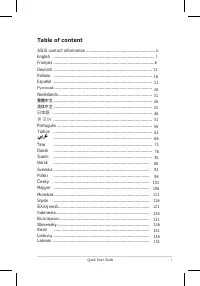
Notebook PC E-Manual 3 Table of Contents About this manual .....................................................................................................7 Conventions used in this manual ............................................................................. 9Icons ........................
Page 7 - About this manual; features of your Notebook PC, organized through the following; This chapter details the hardware components of your Notebook; Chapter 2: Using your Notebook PC; This chapter shows you how to use the different parts of your
Notebook PC E-Manual 7 About this manual This manual provides information about the hardware and software features of your Notebook PC, organized through the following chapters: Chapter 1: Hardware Setup This chapter details the hardware components of your Notebook PC. Chapter 2: Using your Notebook...
Page 9 - Conventions used in this manual; Typography; Bold; = This indicates a menu or an item that must be selected.; Icons; The icons below indicate the devices you can use for completing a
Notebook PC E-Manual 9 Conventions used in this manual To highlight key information in this manual, some text are presented as follows: IMPORTANT! This message contains vital information that must be followed to complete a task. NOTE: This message contains additional information and tips that can he...
Page 10 - Safety precautions; Using your Notebook PC
10 Notebook PC E-Manual Safety precautions Using your Notebook PC This Notebook PC should only be used in environments with ambient temperatures between 5°C (41°F) and 35°C (95°F). Refer to the rating label on the bottom of your Notebook PC and ensure that your power adapter complies with this ratin...
Page 11 - Caring for your Notebook PC
Notebook PC E-Manual 11 Caring for your Notebook PC Disconnect the AC power and remove the battery pack (if applicable) before cleaning your Notebook PC. Use a clean cellulose sponge or chamois cloth dampened with a solution of nonabrasive detergent and a few drops of warm water. Remove any extra mo...
Page 12 - Proper disposal
12 Notebook PC E-Manual Proper disposal Do not throw your Notebook PC in municipal waste. This product has been designed to enable proper reuse of parts and recycling. The symbol of the crossed out wheeled bin indicates that the product (electrical, electronic equipment and mercury- containing butto...
Page 13 - Hardware Setup
Page 14 - Getting to know your Notebook PC; Top View
14 Notebook PC E-Manual Getting to know your Notebook PC Top View NOTE: The keyboard's layout may vary per region or country. The Notebook view may also vary in appearance depending on the Notebook PC model.
Page 15 - Touchpad
Notebook PC E-Manual 15 Camera The built-in camera allows you to take pictures or record videos using your Notebook PC. Display panel This high-definition display panel provides excellent viewing features for photos, videos, and other multimedia files on your Notebook PC. Audio speakers The built-in...
Page 16 - The power indicator lights up when the Notebook PC; Two-color battery charge indicator; The two-color LED provides a visual indication of the
16 Notebook PC E-Manual Status indicators The status indicators help identify the current hardware status of your Notebook PC. Power indicator The power indicator lights up when the Notebook PC is turned on and blinks slowly when the Notebook PC is in sleep mode. Two-color battery charge indicator T...
Page 17 - Airplane mode; Capital lock indicator
Notebook PC E-Manual 17 Color Status Solid Green The Notebook PC is plugged to a power source and the battery power is between 95% and 100%. Solid Orange The Notebook PC is plugged to a power source, charging its battery, and the battery power is less than 95%. Blinking Orange The Notebook PC is run...
Page 18 - Power button
18 Notebook PC E-Manual Power indicator The power indicator lights up when the Notebook PC is turned on and blinks slowly when the Notebook PC is in sleep mode. Numeric keypad The numeric keypad toggles between these two functions: for numeric input and as pointer direction keys. NOTE: For more deta...
Page 19 - Bottom; Battery pack; The battery pack is automatically charged when your Notebook
Notebook PC E-Manual 19 Bottom NOTE: The bottom side may vary in appearance depending on model. WARNING! The bottom of the Notebook PC can get warm to hot while in use or while charging the battery pack. When working on your Notebook PC, do not place it on surfaces that can block the vents. IMPORTAN...
Page 20 - Spring battery lock; Manual battery lock; Compartment cover
20 Notebook PC E-Manual Spring battery lock The spring battery lock automatically locks the battery pack in place once it is inserted into the battery slot. IMPORTANT! This lock should be held in an unlocked position when removing the battery pack. Manual battery lock The manual battery lock is used...
Page 21 - Right Side; Headphone output jack port
Notebook PC E-Manual 21 Right Side Headphone output jack port This port allows you to connect your Notebook PC to amplified speakers or headphones. Microphone input jack port The microphone input jack port is used to connect your Notebook PC to an external microphone. USB 2.0 port These USB (Univers...
Page 22 - Optical disc drive manual eject hole; The manual eject hole is used to eject the drive tray in case the; Kensington® security slot; The Kensington® security slot allows you to secure your; Optical disc drive eject button; Press this button to eject the optical drive tray.
22 Notebook PC E-Manual Optical disc drive manual eject hole The manual eject hole is used to eject the drive tray in case the electronic eject button does not work. WARNING! Use the manual eject hole only when the electronic eject button does not work. NOTE: For more details, refer to the Using the...
Page 23 - Left Side; Insert the bundled power adapter into this port to charge the; Air vents; The air vents allow cool air to enter and warm air to exit the; VGA port; This port allows you to connect your Notebook PC to an
Notebook PC E-Manual 23 Left Side Power (DC) input port Insert the bundled power adapter into this port to charge the battery pack and supply power to your Notebook PC. WARNING! The adapter may become warm to hot while in use. Do not cover the adapter and keep it away from your body while it is conn...
Page 24 - HDMI port; This port is for a High-Definition Multimedia Interface (HDMI); LAN port; Insert the network cable into this port to connect to a local area
24 Notebook PC E-Manual HDMI port This port is for a High-Definition Multimedia Interface (HDMI) connector and is HDCP compliant for HD DVD, Blu-ray, and other protected content playback. LAN port Insert the network cable into this port to connect to a local area network. USB 3.0 ports This Universa...
Page 25 - Front Side; Memory card reader; This Notebook PC has a single built-in memory card reader slot; Status indicators
Notebook PC E-Manual 25 Front Side Memory card reader This Notebook PC has a single built-in memory card reader slot that supports MMC, SD, and SDHC card formats. Status indicators The status indicators help identify the current hardware status of your Notebook PC. NOTE: For more details, refer to t...
Page 28 - hours; Getting started; Charge your Notebook PC
28 Notebook PC E-Manual Charge the Notebook PC for 3 hours before using it in battery mode for the first time. NOTE: The power adapter may vary in appearance, depending on models and your region. IMPORTANT! Power adapter information: • Input voltage: 100-240Vac • Input frequency: 50-60Hz • Rating ou...
Page 31 - Gestures for the touchpad; Moving the pointer; Slide horizontally
Notebook PC E-Manual 31 Gestures for the touchpad Gestures allow you to launch programs and access the settings of your Notebook PC. Refer to the following illustrations when using hand gestures on your touchpad. Moving the pointer You can tap or click anywhere on the touchpad to activate its pointe...
Page 32 - In Desktop mode, double tap/click an application to launch it.; Drag and drop
32 Notebook PC E-Manual One-finger gestures Tap/click, Double tap/click • In the Start screen, tap/click an app to launch it. • In Desktop mode, double tap/click an application to launch it. Drag and drop Double-tap/click an item, then slide the same finger without lifting it off the touchpad. To dr...
Page 33 - All Apps; In Desktop mode, use this
Notebook PC E-Manual 33 Left-click Right-click • In the Start screen, click an app to launch it. • In Desktop mode, double- click an application to launch it. • In the Start screen, click an app to select it and launch the settings bar. You can also press this button to launch the All Apps bar. • In...
Page 34 - Top edge swipe; In the Start screen, swipe from the top edge to launch the; All; In a running app, swipe from the top edge to view its menu.; Left edge swipe; Swipe from the left edge to shuffle
34 Notebook PC E-Manual Top edge swipe • In the Start screen, swipe from the top edge to launch the All Apps bar. • In a running app, swipe from the top edge to view its menu. Left edge swipe Right edge swipe Swipe from the left edge to shuffle your running apps. Swipe the right edge to launch the C...
Page 35 - Rotate
Notebook PC E-Manual 35 Two-finger gestures Tap/click Rotate Tap/click two fingers on the touchpad to simulate the right- click function. To rotate an image, place two fingers on the touchpad then turn one finger clockwise or counterclockwise while the other stays still. Two-finger scroll (up/down) ...
Page 36 - Bring together your two fingers on; Select an item then press and hold the left button. Using your other
36 Notebook PC E-Manual Zoom out Zoom in Bring together your two fingers on the touchpad. Spread apart your two fingers on the touchpad. Drag and drop Select an item then press and hold the left button. Using your other finger, slide down the touchpad to drag and drop the item to a new location.
Page 37 - Three-finger gestures; Swipe up; Swipe three fingers upward to
Notebook PC E-Manual 37 Three-finger gestures Swipe up Swipe down Swipe three fingers upward to show all running applications. Swipe three fingers downward to show the Desktop mode.
Page 38 - Function keys; Using the keyboard; Sleep mode
38 Notebook PC E-Manual Function keys The function keys on your Notebook PC’s keyboard can trigger the following commands: Using the keyboard Puts the Notebook PC into Sleep mode Turns Airplane mode on or off NOTE: When enabled, the Airplane mode disables all wireless connectivity. Decreases display...
Page 40 - Multimedia control keys; as audios and videos, when played in your Notebook PC.
40 Notebook PC E-Manual Multimedia control keys The multimedia control keys allow you to control multimedia files, such as audios and videos, when played in your Notebook PC. Press in combination with the arrow keys on your Notebook PC, illustrated as below. Stop Play or pause Skip to previous track...
Page 41 - Using the numeric keypad
Notebook PC E-Manual 41 Using the numeric keypad A numeric keypad is available on selected Notebook PC models. You can use this keypad for numeric input or as pointer direction keys. Press to toggle between using the keypad as number keys or as pointer direction keys. NOTE: Actual numeric keypad may...
Page 42 - Using the optical drive; Inserting an optical disc; While the Notebook PC is on, press the electronic eject button to
42 Notebook PC E-Manual Using the optical drive NOTE: • The actual location of the electronic eject button may vary depending on your Notebook PC model. • The actual appearance of the Notebook PC optical drive may also vary depending on model but usage procedures remaing the same. Inserting an optic...
Page 43 - Gently pull out the drive tray.; Hold the disc by the edge, with its printed side up, then gently
Notebook PC E-Manual 43 2. Gently pull out the drive tray. IMPORTANT! Be careful not to touch the optical drive lens. Ensure that there are no objects that may get jammed under the drive tray. 3. Hold the disc by the edge, with its printed side up, then gently place it inside the hub. 4. Push down t...
Page 44 - Push the drive tray gently to close the optical drive.; Using the manual eject hole; into the manual eject hole until the drive tray opens.
44 Notebook PC E-Manual 5. Push the drive tray gently to close the optical drive. NOTE: While data is being read, it is normal to hear some spinning and vibrating in the optical drive. Using the manual eject hole The manual eject hole is located on the optical drive door and is used to eject the opt...
Page 45 - Working with Windows® 8.1
Notebook PC E-Manual 45 Chapter 3: Working with Windows® 8.1
Page 46 - Starting for the first time; Personalize
46 Notebook PC E-Manual Starting for the first time When you start your computer for the first time, a series of screens appear to guide you in configuring your Windows® 8.1 operating system. To start your Notebook PC for the first time: 1. Press the power button on your Notebook PC. Wait for a few ...
Page 47 - Start screen; Windows® Apps
Notebook PC E-Manual 47 Windows ® UI Windows® 8.1 comes with a tile-based user interface (UI) which allows you to organize and easily access Windows® apps from the Start screen. It also includes the following features that you can use while working on your Notebook PC. Start screen The Start screen ...
Page 48 - Hotspots; Onscreen hotspots allow you to launch programs and access the; Hotspots on a running app
48 Notebook PC E-Manual Hotspots Onscreen hotspots allow you to launch programs and access the settings of your Notebook PC. The functions in these hotspots can be activated using the touchpad. Hotspots on a running app Hotspots on the Start screen
Page 50 - Hover your mouse pointer on the top side; upper or lower right; Hover your mouse pointer on the upper or
50 Notebook PC E-Manual Hotspot Action top side Hover your mouse pointer on the top side until it changes to a hand icon. Drag then drop the app to a new location. NOTE: This hotspot function only works on a running app or when you want to use the Snap feature. For more details, refer to the Snap fe...
Page 51 - Start button; Windows® 8.1 features the Start button which allows you to switch; Start button on the Start screen
Notebook PC E-Manual 51 Start button Windows® 8.1 features the Start button which allows you to switch between the two most recent apps that you opened. The Start button may be accessed from the Start screen, while on Desktop mode, and on any app that is currently open onscreen. Start button on the ...
Page 52 - the programs inside Windows® 8.1 when you right-click on the Start
52 Notebook PC E-Manual Start button on Desktop mode Context menu The context menu appears as a box filled with quick access to some of the programs inside Windows® 8.1 when you right-click on the Start button. The context menu also includes the following shut down options for your Notebook PC: sign...
Page 53 - Customizing your Start screen; Properties
Notebook PC E-Manual 53 Customizing your Start screen Windows® 8.1 also enables you to customize your Start screen, allowing you to boot directly to the Desktop mode and customize the arrangement of your apps onscreen. To customize the settings of your Start screen: 1. Launch the Desktop. 2. Right-c...
Page 54 - Launching apps; Moving apps
54 Notebook PC E-Manual Working with Windows ® apps Use your Notebook PC’s touch screen panel*, touchpad, or keyboard to launch, customize, and close apps. Launching apps Customizing apps You can move, resize, unpin, or close apps from the Start screen using the following steps: Position your mouse ...
Page 55 - Right-click on the app to activate the Customize bar,
Notebook PC E-Manual 55 Unpinning apps Resizing apps Right-click on the app to activate the Customize bar, then tap/click and select an app tile size. Right-click on the app to activate the Customize bar then tap/click .
Page 56 - Closing apps
56 Notebook PC E-Manual 1. Move your mouse pointer on the top side of the launched app then wait for the pointer to change to a hand icon. 2. Drag then drop the app to the bottom of the screen to close it. From the running app’s screen, press . Closing apps
Page 57 - Accessing the Apps screen; open other applications through the Apps screen.; Launching the Apps screen; Launch the Apps screen using your Notebook PC's touch screen panel,
Notebook PC E-Manual 57 Accessing the Apps screen Aside from the apps already pinned on your Start screen, you can also open other applications through the Apps screen. NOTE: Actual apps shown onscreen may vary per model. The following screenshot is for reference only. Launching the Apps screen Laun...
Page 58 - Pinning more apps on the Start screen; You can pin more apps on the Start screen using your touch screen
58 Notebook PC E-Manual Pinning more apps on the Start screen You can pin more apps on the Start screen using your touch screen panel* or touchpad. 1. Launch the All Apps screen 2. Right-click on the apps that you want to add on the Start screen. 3. Tap/click on the icon to pin the selected apps on ...
Page 59 - The Charms bar is a toolbar that can be triggered on the right side
Notebook PC E-Manual 59 Charms bar The Charms bar is a toolbar that can be triggered on the right side of your screen. It consists of several tools that allow you to share applications and provide quick access for customizing the settings of your Notebook PC. Charms bar
Page 60 - Launching the Charms bar; Use your Notebook PC’s touch screen panel, touchpad, or keyboard to
60 Notebook PC E-Manual Launching the Charms bar NOTE: When called out, the Charms bar initially appears as a set of white icons. The image above shows how the Charms bar looks like once activated. Use your Notebook PC’s touch screen panel, touchpad, or keyboard to launch the Charms bar. Move your m...
Page 61 - Inside the Charms bar
Notebook PC E-Manual 61 Search This charm allows you to look for files, applications, or programs in your Notebook PC. Share This charm allows you to share applications via social networking sites or email. Start This charm reverts the display back to the Start screen. From the Start screen, you can...
Page 62 - Snap feature; or switch between apps.
62 Notebook PC E-Manual Snap feature The Snap feature displays two apps side-by-side, allowing you to work or switch between apps. IMPORTANT! Ensure that your Notebook PC’s screen resolution is set to 1366 x 768 pixels or higher before using the Snap feature. Snap bar
Page 63 - Using Snap
Notebook PC E-Manual 63 Using Snap Use your Notebook PC’s touch screen panel, touchpad, or keyboard to activate and use Snap. 1. Launch the app you wish to snap. 2. Hover the mouse point on the top side of your screen. 3. Once the pointer changes to a hand icon, drag then drop the app to the left or...
Page 64 - Other keyboard shortcuts
64 Notebook PC E-Manual Other keyboard shortcuts Using the keyboard, you can also use the following shortcuts to help you launch applications and navigate Windows® 8.1. \ Switches between the Start screen and the last running app Launches the desktop Launches the This PC window on Desktop mode Opens...
Page 66 - Connecting to wireless networks; Connect; Yes
66 Notebook PC E-Manual Connecting to wireless networks Wi-Fi Access emails, surf the Internet, and share applications via social networking sites using your Notebook PC’s Wi-Fi connection. IMPORTANT! The Airplane mode disables this feature. Ensure that Airplane mode is turned off before enabling th...
Page 67 - Bluetooth; Pairing with other Bluetooth-enabled devices
Notebook PC E-Manual 67 Bluetooth Use Bluetooth to facilitate wireless data transfers with other Bluetooth- enabled devices. IMPORTANT! The Airplane mode disables this feature. Ensure that Airplane mode is turned off before enabling the Bluetooth connection of your Notebook PC. Pairing with other Bl...
Page 68 - Turning Airplane mode on
68 Notebook PC E-Manual 1. Launch the Charms bar . 2. Tap/click and tap/click . 3. Move the slider to the right to turn the Airplane mode on. Press . Airplane mode The Airplane mode disables wireless communication, allowing you to use your Notebook PC safely while in-flight. Turning Airplane mode on...
Page 69 - Connecting to wired networks; Configuring a dynamic IP/PPPoE network; Open Network and
Notebook PC E-Manual 69 Connecting to wired networks You can also connect to wired networks, such as local area networks and broadband Internet connection, using your Notebook PC’s LAN port. NOTE: Contact your Internet Service Provider (ISP) for details or your network administrator for assistance i...
Page 70 - Configuring a static IP network connection; Configuring a dynamic
70 Notebook PC E-Manual 7. Return to the Network and Sharing Center window then tap/click Set up a new connection or network . 8. Select Connect to the Internet then tap/click Next . 9. Tap/click Broadband (PPPoE) . 10. Type your User name, Password, and Connection name then tap/click Connect . 11. ...
Page 71 - Turning your Notebook PC off; Putting your Notebook PC to sleep; You can also shut down your Notebook PC using
Notebook PC E-Manual 71 Turning your Notebook PC off You can turn off your Notebook PC by doing either of the following procedures: Putting your Notebook PC to sleep To put your Notebook PC on Sleep mode, press the power button once. You can also put your Notebook PC to sleep mode using Desktop mode...
Page 72 - Windows; The Windows® 8.1 lock screen appears when you wake your Notebook; To proceed from the lock screen
72 Notebook PC E-Manual Windows ® 8.1 lock screen The Windows® 8.1 lock screen appears when you wake your Notebook PC from sleep or hibernate mode. It also appears when you lock or unlock Windows® 8.1. The lock screen can be customized to regulate access to your operating system. You can change its ...
Page 73 - Customizing your lock screen; Playing a slideshow; Lock screen preview; Selecting a photo
Notebook PC E-Manual 73 Customizing your lock screen You can customize your lock screen to show your preferred photo, a photo slideshow, app updates, and quickly access your Notebook PC’s camera. To change the settings of your lock screen, you may refer to the following information: 1. Launch the Ch...
Page 74 - Adding app updates; Lock screen apps; Activating your Notebook PC camera from the lock screen; Camera
74 Notebook PC E-Manual Adding app updates 1. Launch the Charms bar > Settings. 2. Select Change PC Settings > Lock screen. 3. Scroll down until you see the Lock screen apps option. 4. Use the following options to add the apps whose updates you would like to see from your lock screen: Activati...
Page 76 - Using POST to access BIOS and Troubleshoot; BIOS; An error message appears onscreen during system bootup and; Accessing BIOS
76 Notebook PC E-Manual The Power-On Self-Test (POST) The Power-On Self-Test (POST) is a series of software-controlled diagnostic tests that run when you turn on or restart your Notebook PC. The software that controls the POST is installed as a permanent part of the Notebook PC’s architecture. Using...
Page 77 - BIOS Settings; the following procedures when setting your boot priority.; Boot
Notebook PC E-Manual 77 BIOS Settings NOTE: The BIOS screens in this section are for reference only. The actual screens may differ by model and territory. Boot This menu allows you to set your boot option priorities. You may refer to the following procedures when setting your boot priority. 1. On th...
Page 78 - and select a device as the
78 Notebook PC E-Manual 2. Press and select a device as the Boot Option #1 . →← : Select Screen ↑↓ : Select Item Enter: Select +/— : Change Opt. F1 : General Help F9 : Optimized Defaults F10 : Save & Exit ESC : Exit Sets the system boot order Aptio Setup Utility - Copyright (C) 2012 American Meg...
Page 79 - Security; This menu allows you to set up the administrator and user password
Notebook PC E-Manual 79 Security This menu allows you to set up the administrator and user password of your Notebook PC. It also allows you to control the access to your Notebook PC’s hard disk drive, input/output (I/O) interface, and USB interface. NOTE: • If you install a User Password, you will b...
Page 81 - In the Security menu, you can access I/O Interface Security to lock; To lock an interface:; Select an interface you would like to lock then press; Lock
Notebook PC E-Manual 81 I/O Interface Security In the Security menu, you can access I/O Interface Security to lock or unlock some interface functions of your Notebook PC. I/O Interface Security LAN Network Interface [UnLock] Wireless Network Interface [UnLock]HD AUDIO Interface [UnLock]USB Interface...
Page 82 - Through the I/O Interface Security menu, you can also access USB; To lock the USB interface:; Select an interface that you would like to lock then select; USB Interface; External Ports; USB Interface Security
82 Notebook PC E-Manual USB Interface Security Through the I/O Interface Security menu, you can also access USB Interface Security to lock or unlock ports and devices. Version 2.15.1226. Copyright (C) 2012 American Megatrends, Inc. USB Interface Security USB Interface [UnLock] External Ports [UnLock...
Page 84 - To keep your configuration settings, select; Save Changes and Exit; before exiting the BIOS.
84 Notebook PC E-Manual Save & Exit To keep your configuration settings, select Save Changes and Exit before exiting the BIOS. Aptio Setup Utility - Copyright (C) 2012 American Megatrends, Inc. Main Advanced Boot Security Save & Exit →← : Select Screen ↑↓ : Select Item Enter: Select +/— : Ch...
Page 86 - After the BIOS update process, select; Exit > Restore Defaults
86 Notebook PC E-Manual FSOFS1FS2FS3FS4 0 EFI <DIR> ASUSTek Easy Flash Utility [ ←→]: Switch [ ↑↓]: Choose [q]: Exit [Enter]: Enter/Execute Current BIOS Platform: GL552Version: 101Build Date: Oct 26 2012Build Time: 11:51:05 New BIOS Platform: UnknownVersion: UnknownBuild Date: UnknownBuild Tim...
Page 87 - Recovering your system; Refresh your PC without affecting your files
Notebook PC E-Manual 87 Recovering your system Using recovery options on your Notebook PC allows you to restore the system to its original state or simply refresh its settings to help improve performance. IMPORTANT! • Back up all your data files before doing any recovery option on your Notebook PC. ...
Page 88 - Advanced startup; - Using this option allows you to perform; Troubleshoot; to enable any of these advanced
88 Notebook PC E-Manual • Advanced startup - Using this option allows you to perform other advanced recovery options on your Notebook PC such as: - Using a USB drive, network connection or Windows recovery DVD to startup your Notebook PC. - Using Troubleshoot to enable any of these advanced recovery...
Page 89 - Enabling a recovery option; Refer to the following steps if you want to access and use any of the; Change PC Settings
Notebook PC E-Manual 89 Enabling a recovery option Refer to the following steps if you want to access and use any of the available recovery options for your Notebook PC. 1. Launch the charms bar and select Settings. 2. Select Change PC Settings .
Page 90 - PC Settings; Under the; Update and recovery; then
90 Notebook PC E-Manual 3. Under the PC Settings options, select Update and recovery. 4. Under the Update and recovery options, select Recovery then select the recovery option you would like to do.
Page 91 - Upgrading your Notebook PC
Notebook PC E-Manual 91 Chapter 5: Upgrading your Notebook PC
Page 92 - Installing the Hard Disk Drive
92 Notebook PC E-Manual Installing the Hard Disk Drive Refer to the following steps if you need to install a new HDD (hard disk drive) of your Notebook PC. IMPORTANT! Purchase an HDD from authorized retailers of this Notebook PC to ensure maximum compatibility and reliability. WARNING! Disconnect al...
Page 94 - Remove the screws securing the HDD bay to the compartment.
94 Notebook PC E-Manual C. Remove the screws securing the HDD bay to the compartment.
Page 96 - Use the flap on the HDD bay to pull it out of the compartment.
96 Notebook PC E-Manual HDD bay E. Use the flap on the HDD bay to pull it out of the compartment.
Page 101 - The following steps show you how to install a RAM module into your
Notebook PC E-Manual 101 Installing a Random-access Memory module Upgrade the memory capacity of your Notebook PC by installing a RAM (random-access memory module) in the memory module compartment. The following steps show you how to install a RAM module into your Notebook PC: IMPORTANT! Purchase an...
Page 105 - Tips and FAQs
Page 106 - Useful tips for your Notebook PC; Update Windows® periodically to ensure that your applications
106 Notebook PC E-Manual Useful tips for your Notebook PC To help you maximize the use of your Notebook PC, maintain its system performance, and ensure all your data are kept secured, here are some useful tips that you can follow: • Update Windows® periodically to ensure that your applications have ...
Page 107 - Hardware FAQs; A black dot, or sometimes a colored dot, appears onscreen; Use the function keys to adjust the display brightness.
Notebook PC E-Manual 107 Hardware FAQs 1. A black dot, or sometimes a colored dot, appears onscreen when I turn on the Notebook PC. What should I do? Although these dots normally appear onscreen, they will not affect your system. If the incident continues and subsequently affects system performance,...
Page 110 - Software FAQs; When I turn on my Notebook PC, the power indicator lights; Force shutdown your Notebook PC by pressing the power; What should I do when my screen displays this message:; Remove all connected USB devices then restart your; My Notebook PC boots slower than usual and my operating
110 Notebook PC E-Manual Software FAQs 1. When I turn on my Notebook PC, the power indicator lights up but nothing appears on my screen. What can I do to fix this? You can try doing any of the following suggestions: • Force shutdown your Notebook PC by pressing the power button for about ten (10) se...
Page 111 - My Notebook PC does not boot up. How can I fix this?; You can try doing any of the following suggestions:; Why can’t my Notebook PC wake up from sleep mode?; You need to press the power button to resume your last
Notebook PC E-Manual 111 4. My Notebook PC does not boot up. How can I fix this? You can try doing any of the following suggestions: • Remove all connected devices to your Notebook PC then restart your system. • If the problem still exists, contact your local ASUS service center for assistance. 5. W...
Page 113 - Appendices
Page 114 - DVD-ROM Drive Information; Regional Playback Information
114 Notebook PC E-Manual DVD-ROM Drive Information (on selected models) The DVD-ROM drive allows you to view and create your own CDs and DVDs. You can purchase an optional DVD viewer software to view DVD titles. Regional Playback Information Playback of DVD movie titles involves decoding MPEG2 video...
Page 115 - Region Definitions
Notebook PC E-Manual 115 Region Definitions Region 1 Canada, US, US Territories Region 2 Czech, Egypt, Finland, France, Germany, Gulf States, Hungary, Iceland, Iran, Iraq, Ireland, Italy, Japan, Netherlands, Norway, Poland, Portugal, Saudi Arabia, Scotland, South Africa, Spain, Sweden, Switzerland, ...
Page 116 - Region A; Blu-ray ROM Drive Information
116 Notebook PC E-Manual The Blu-ray ROM Drive allows you to view high definition (HD) videos and other disc file formats such as DVDs and CDs. Region Definitions Region A North, Central and South American countries, and their territories; Taiwan, Hong Kong, Macao, Japan, Korea (South and North), So...
Page 118 - This table shows the countries currently under the CTR21; Country
118 Notebook PC E-Manual This table shows the countries currently under the CTR21 standard. Country Applied More Testing Austria 1 Yes No Belgium Yes No Czech Republic No Not Applicable Denmark 1 Yes Yes Finland Yes No France Yes No Germany Yes No Greece Yes No Hungary No Not Applicable Iceland Yes ...
Page 119 - Federal Communications Commission
Notebook PC E-Manual 119 This information was copied from CETECOM and is supplied without liability. For updates to this table, you may visit http://www.cetecom.de/technologies/ctr_21. html 1 National requirements will apply only if the equipment may use pulse dialling (manufacturers may state in th...
Page 120 - FCC Radio Frequency (RF) Exposure Caution
120 Notebook PC E-Manual • Connect the equipment into an outlet on a circuit different from that to which the receiver is connected. • Consult the dealer or an experienced radio/TV technician for help. WARNING! The use of a shielded-type power cord is required in order to meet FCC emission limits an...
Page 121 - Declaration of Conformity (R&TTE directive; CE Marking; CE marking for devices without wireless LAN/Bluetooth
Notebook PC E-Manual 121 Declaration of Conformity (R&TTE directive 1999/5/EC) The following items were completed and are considered relevant and sufficient: • Essential requirements as in [Article 3] • Protection requirements for health and safety as in [Article 3.1a] • Testing for electric saf...
Page 122 - IC Radiation Exposure Statement for Canada
122 Notebook PC E-Manual IC Radiation Exposure Statement for Canada This equipment complies with IC radiation exposure limits set forth for an uncontrolled environment. To maintain compliance with IC RF exposure compliance requirements, please avoid direct contact to the transmitting antenna during ...
Page 124 - France Restricted Wireless Frequency Bands; Wireless Operation Channel for Different
124 Notebook PC E-Manual France Restricted Wireless Frequency Bands Some areas of France have a restricted frequency band. The worst case maximum authorized power indoors are: • 10mW for the entire 2.4 GHz band (2400 MHz–2483.5 MHz) • 100mW for frequencies between 2446.5 MHz and 2483.5 MHz NOTE: Cha...
Page 126 - UL Safety Notices
126 Notebook PC E-Manual UL Safety Notices Required for UL 1459 covering telecommunications (telephone) equipment intended to be electrically connected to a telecommunication network that has an operating voltage to ground that does not exceed 200V peak, 300V peak-to-peak, and 105V rms, and installe...
Page 128 - Nordic Lithium Cautions (for lithium-ion
128 Notebook PC E-Manual Nordic Lithium Cautions (for lithium-ion batteries) CAUTION! Danger of explosion if battery is incorrectly replaced. Replace only with the same or equivalent type recommended by the manufacturer. Dispose of used batteries according to the manufacturer’s instructions. (Englis...
Page 129 - Optical Drive Safety Information
Notebook PC E-Manual 129 Optical Drive Safety Information Laser Safety Information WARNING! To prevent exposure to the optical drive’s laser, do not attempt to disassemble or repair the optical drive by yourself. For your safety, contact a professional technician for assistance. CD-ROM Drive Safety ...
Page 130 - CTR 21 Approval (for Notebook PC with built-in; Danish
130 Notebook PC E-Manual CTR 21 Approval (for Notebook PC with built-in Modem) Danish Dutch English Finnish French
Page 132 - EU REACH SVHC
132 Notebook PC E-Manual ENERGY STAR complied product ENERGY STAR is a joint program of the U.S. Environmental Protection Agency and the U.S. Department of Energy helping us all save money and protect the environment through energy efficient products and practices. All ASUS products with the ENERGY ...
Page 133 - Regional notice for Singapore; This ASUS product complies with IDA Standards.; Regional notice for California
Notebook PC E-Manual 133 ASUS Recycling/Takeback Services ASUS recycling and takeback programs come from our commitment to the highest standards for protecting our environment. We believe in providing solutions for you to be able to responsibly recycle our products, batteries, other components as we...
Page 134 - Avis concernant les batteries remplaçables
134 Notebook PC E-Manual Regional notice for India This product complies with the “India E-waste (Management and Handling)Rule 2011” and prohibits use of lead, mercury, hexavalent chromium, polybrominated biphenyls(PBBs) and polybrominated diphenyl ethers (PBDEs) in concentrations exceeding 0.1 % by...
Page 135 - EC Declaration of Conformity
Notebook PC E-Manual 135 EC Declaration of Conformity We, the undersigned, Manufacturer: ASUSTeK COMPUTER INC. Address: 4F, No. 150, LI-TE Rd., PEITOU, TAIPEI 112, TAIWAN Authorized representative in Europe: ASUS COMPUTER GmbH Address, City: HARKORT STR. 21-23, 40880 RATINGEN Country: GERMANY declar...


 Asus 1001P-MU17-WT
User Manual
Asus 1001P-MU17-WT
User Manual
 Asus 1 E1309
User Manual
Asus 1 E1309
User Manual
 Asus 1015E
User Manual
Asus 1015E
User Manual
 Asus 1064E - PIKE Storage Controller SAS
User Manual
Asus 1064E - PIKE Storage Controller SAS
User Manual
 Asus 136-480A
User Manual
Asus 136-480A
User Manual
 Asus 1225 Series
User Manual
Asus 1225 Series
User Manual
 Asus 13VH192C
Manual
Asus 13VH192C
Manual
 Asus 1U
User Manual
Asus 1U
User Manual
 Asus 1U Rackmount Barebone Server RS160-E3/PS4
User Manual
Asus 1U Rackmount Barebone Server RS160-E3/PS4
User Manual
 Asus 200/266 MHZ FSB AGP 4X
User Manual
Asus 200/266 MHZ FSB AGP 4X
User Manual
 Asus 1U Rackmount Chassis Kit R10-A2P4
User Manual
Asus 1U Rackmount Chassis Kit R10-A2P4
User Manual
 Asus 24T1E
User Manual
Asus 24T1E
User Manual
 Asus 22T1E
User Manual
Asus 22T1E
User Manual