Page 2 - KUNDENDIENST UND -BETREUUNG
INHALT 1. SICHERHEITSHINWEISE . . . . . . . . . . . . . . . . . . . . . . . . . . . . . . . . . . . . . . . . . . . . . . . . . . . . . . 3 2. BETRIEB . . . . . . . . . . . . . . . . . . . . . . . . . . . . . . . . . . . . . . . . . . . . . . . . . . . . . . . . . . . . . . . . . . . 5 3. ERSTE INBE...
Page 3 - SICHERHEITSHINWEISE; Sicherheit von Kindern und
1. SICHERHEITSHINWEISE Lesen Sie zu Ihrer Sicherheit und für eineoptimale Nutzung des Geräts vor derMontage und dem ersten Gebrauch dasvorliegende Benutzerhandbuch ein-schließlich der Ratschläge und Warnun-gen aufmerksam durch. Es ist wichtig,dass zur Vermeidung von Fehlern undUnfällen alle Personen...
Page 5 - BETRIEB; Einschalten des Geräts
• Das Gerät darf nicht in der Nähe von Heizkörpern oder Kochern installiertwerden. • Vergewissern Sie sich, dass der Netz- stecker des Gerätes nach der Installati-on frei zugänglich ist. • Wenn ein Wasseranschluss vorgese- hen ist, verbinden Sie das Gerät nurmit dem Trinkwasseranschluss. 1.6 Kundend...
Page 6 - ERSTE INBETRIEBNAHME; Reinigung des Innenraums; TÄGLICHER GEBRAUCH; Verstellbare Ablagen; PRAKTISCHE TIPPS UND HINWEISE; Normale
3. ERSTE INBETRIEBNAHME 3.1 Reinigung des Innenraums Bevor Sie das Gerät in Betrieb nehmen,beseitigen Sie den typischen „Neuge-ruch“ am besten durch Reinigen der In-nenteile mit lauwarmem Wasser und ei-ner neutralen Seife. Sorgfältig nachtrock-nen. Verwenden Sie keine aggressivenReinigungsmittel ode...
Page 7 - REINIGUNG UND PFLEGE; Regelmäßige Reinigung
Geräusch vom Kompressor. Das istnormal. • Die thermische Ausdehnung kann ein plötzliches Krachen verursachen. Dasist eine natürliche und nicht gefährli-che physikalische Erscheinung. Das istnormal. • Beim Ein- oder Ausschalten des Kom- pressors ist ein leises "Klicken" desTemperaturreglers z...
Page 8 - Abtauen des Kühlschranks
• Spülen und trocknen Sie diese sorgfäl- tig ab. Ziehen Sie nicht an Leitungenund/oder Kabeln im Innern desKühlschranks und achten Sie da-rauf, diese nicht zu verschiebenoder zu beschädigen.Benutzen Sie zur Reinigung desInnenraums keinesfalls Putzmit-tel, Scheuerpulver, stark parfü-mierte Reinigungs...
Page 11 - TECHNISCHE DATEN
7.1 Ersetzen der Lampe 1. Ziehen Sie den Netzstecker aus derNetzsteckdose. 2. Lösen Sie die Schraube an der Lam-penabdeckung. 3. Nehmen Sie die Lampenabdeckungab (siehe hierzu die Abbildung). 4. Ersetzen Sie die defekte Lampedurch eine Lampe mit der gleichenLeistung, die speziell für Haushalts-gerät...
Page 12 - MONTAGE; Aufstellung; Umgebungstemperatur; Ausrichten
9. MONTAGE WARNUNG! Lesen Sie bitte die "Sicherheits-hinweise" sorgfältig vor der Auf-stellung des Geräts durch, umGefahren für Sie selbst zu ver-meiden und einen korrekten Be-trieb des Geräts zu gewährleis-ten. 9.1 Aufstellung Dieses Gerät kann auch in einer trocke-nen, gut belüfteten Garag...
Page 15 - Wechsel des Türanschlags
9.7 Wechsel des Türanschlags Die nachfolgend beschriebenenTätigkeiten müssen mit Hilfe ei-ner zweiten Person durchgeführtwerden, um ein Herunterfallender Türen zu vermeiden. Beim Wechsel des Türanschlags musswie folgt vorgegangen werden:• Ziehen Sie den Stecker aus der Steck- dose. • Neigen Sie das ...
Page 16 - Steckdose
1 2 3 4 • Entfernen Sie den Griff (je nach Aus- stattung) und bringen Sie ihn an dergegenüberliegenden Seite an. • Schieben Sie das Gerät wieder an sei- nen Standort, richten Sie es waage-recht aus und nehmen Sie es mindes-tens vier Stunden lang nicht in Betrieb.Schließen Sie es dann an die Strom-ve...
Page 17 - GERÄUSCH; BRRR; SSSRR; OK
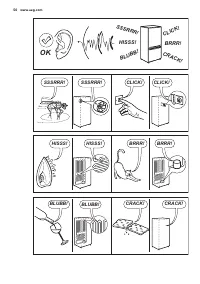
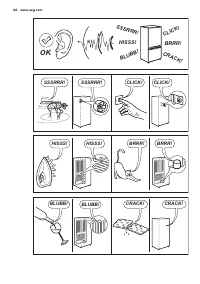
10. GERÄUSCH Während das Gerät in Betrieb ist, entste-hen bestimmte Geräusche (Kompressorund Kühlkreislauf). BRRR ! HISSS! CLICK! BLUBB! CRACK! SSSRR R! OK CLICK! CLICK! SSSRRR! SSSRRR! BRRR! BRRR! HISSS! HISSS! DEUTSCH 17
Page 18 - UMWELTTIPPS
BLUBB! BLUBB! CRACK! CRACK! 11. UMWELTTIPPS Recyceln Sie Materialien mit demSymbol . Entsorgen Sie dieVerpackung in den entsprechendenRecyclingbehältern.Recyceln Sie zum Umwelt- undGesundheitsschutz elektrische undelektronische Geräte. Entsorgen SieGeräte mit diesem Symbol nichtmit dem Hausmüll. Bri...
Page 20 - INSTRUCTIONS DE SÉCURITÉ; Sécurité des enfants et
1. INSTRUCTIONS DE SÉCURITÉ Pour votre sécurité et garantir une utili-sation correcte de l'appareil, lisez atten-tivement cette notice, y compris les con-seils et avertissements, avant d'installeret d'utiliser l'appareil pour la premièrefois. Pour éviter toute erreur ou accident,veillez à ce que tou...
Page 21 - Utilisation quotidienne
Si le circuit frigorifique est endomma-gé :– évitez les flammes vives et toute au- tre source d'allumage – aérez soigneusement la pièce où se trouve l'appareil • Ne modifiez pas les spécifications de l'appareil. Si le câble d'alimentationest endommagé, il peut causer uncourt circuit, un incendie et/...
Page 22 - Maintenance; Protection de; FONCTIONNEMENT; Mise en fonctionnement
• Assurez-vous que la prise murale reste accessible après l'installation de l'ap-pareil. • Branchez à l'alimentation en eau pota- ble uniquement. (Si un branchementsur le réseau d'eau est prévu.) 1.6 Maintenance • Les branchements électriques néces- saires à l'entretien de l'appareil doi-vent être r...
Page 23 - PREMIÈRE UTILISATION; Nettoyage intérieur; UTILISATION QUOTIDIENNE; Clayettes amovibles; CONSEILS UTILES; Bruits de fonctionnement
3. PREMIÈRE UTILISATION 3.1 Nettoyage intérieur Avant d'utiliser l'appareil pour la premiè-re fois, nettoyez l'intérieur et tous les ac-cessoires internes avec de l'eau tiède sa-vonneuse pour supprimer l'odeur carac-téristique du "neuf" puis séchez soi-gneusement. N'utilisez pas de produits ...
Page 24 - ENTRETIEN ET NETTOYAGE; Nettoyage périodique
• Le compresseur peut produire un ron- ronnement aigu ou un bruit de pulsa-tion. Ce phénomène est normal. • La dilatation thermique peut provo- quer un soudain, léger bruit de cra-quement. C'est un phénomène nor-mal et sans gravité. Ce phénomèneest normal. • Un léger claquement se produit lors de la...
Page 25 - Dégivrage du réfrigérateur
Ne pas tirer, déplacer ou endom-mager les tuyaux et/ou câblesqui se trouvent à l'intérieur del'appareil.Ne JAMAIS utiliser de produitsabrasifs ou caustiques ni d'épon-ges avec grattoir pour nettoyerl'intérieur de façon à ne pas l'abî-mer et laisser de fortes odeurs. Nettoyer le condenseur (grille no...
Page 26 - EN CAS D'ANOMALIE DE FONCTIONNEMENT; Symptôme
7. EN CAS D'ANOMALIE DE FONCTIONNEMENT AVERTISSEMENT Avant d'intervenir sur l'appareil,débranchez-le.La résolution des problèmes nonmentionnés dans la présente no-tice, doit être exclusivement con-fiée à un électricien qualifié ou àune personne compétente. Certains bruits pendant le fonc-tionnement ...
Page 28 - Fermeture de la porte; CARACTÉRISTIQUES TECHNIQUES; Emplacement
7.1 Remplacement de l'ampoule d'éclairage 1. Débranchez l'appareil de la prisesecteur. 2. Retirez la vis du diffuseur. 3. Retirez le diffuseur (voir l'illustration). 4. Remplacez l'ampoule défectueusepar une ampoule neuve de puissan-ce identique, spécifiquement con-çue pour les appareils électroména...
Page 29 - Température ambiante; Mise à niveau
matique (indiquée sur la plaque signalé-tique) pour lequel il est prévu. Au delàde ces températures, ses performancespeuvent s'en trouver diminuées : les dif-férentes classes climatiques existantes etles températures ambiantes correspon-dantes en fonction du modèle de l'appa-reil sont les suivantes ...
Page 31 - Installation et fixation à un plan de travail continu; Réversibilité de la porte
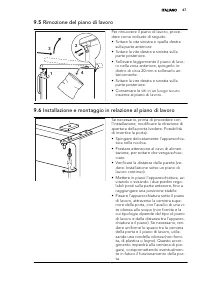
9.6 Installation et fixation à un plan de travail continu Avant le montage, modifiez le sens d'ou-verture de la porte au besoin (consultezla section Réversibilité de la porte).• Encastrez l'appareil dans la niche.• Assurez-vous que le câble d'alimenta- tion n'est pas coincé. • Vérifiez la distance d...
Page 33 - Prise de courant; Branchement électrique; BRUITS
9.8 Prise de courant ATTENTION Assurez-vous que le câble d'ali-mentation n'est pas coincé. La prise de courant nécessaire pour lebranchement de votre appareil à l'ali-mentation électrique doit être position-née de sorte qu'il est possible de retirerla fiche de l'appareil.Si votre appareil est instal...
Page 34 - EN MATIÈRE DE PROTECTION DE L'ENVIRONNEMENT
CLICK! CLICK! SSSRRR! SSSRRR! BRRR! BRRR! HISSS! HISSS! BLUBB! BLUBB! CRACK! CRACK! 11. EN MATIÈRE DE PROTECTION DE L'ENVIRONNEMENT Recyclez les matériaux portant lesymbole . Déposez les emballagesdans les conteneurs prévus à ceteffet.Contribuez à la protection del'environnement et à votre sécurité,...
Page 36 - SERVIZIO CLIENTI E MANUTENZIONE
INDICE 1. ISTRUZIONI DI SICUREZZA . . . . . . . . . . . . . . . . . . . . . . . . . . . . . . . . . . . . . . . . . . . . . . . . . . . 37 2. USO DELL'APPARECCHIO . . . . . . . . . . . . . . . . . . . . . . . . . . . . . . . . . . . . . . . . . . . . . . . . . . . 39 3. PRIMO UTILIZZO . . . . . . . ...
Page 37 - ISTRUZIONI DI SICUREZZA; Sicurezza dei bambini e
1. ISTRUZIONI DI SICUREZZA Per garantire un impiego corretto e sicu-ro dell'apparecchio, prima dell'installa-zione e del primo utilizzo leggere con at-tenzione il libretto istruzioni, inclusi isuggerimenti e le avvertenze. Per evitareerrori e incidenti, è importante garantireche tutte le persone che...
Page 39 - PRIMO UTILIZZO
1.6 Assistenza tecnica • Gli interventi elettrici sull'apparecchia- tura devono essere eseguiti esclusiva-mente da elettricisti qualificati o dapersonale competente. • Gli interventi di assistenza devono es- sere eseguiti esclusivamente da tecni-ci autorizzati e utilizzando solo ricambioriginali. 1....
Page 40 - UTILIZZO QUOTIDIANO; Ripiani rimovibili; CONSIGLI E SUGGERIMENTI UTILI; Rumori normali durante il
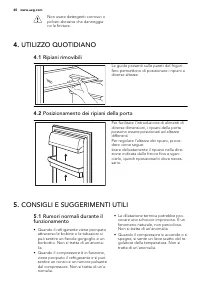
Non usare detergenti corrosivi opolveri abrasive che danneggia-no le finiture. 4. UTILIZZO QUOTIDIANO 4.1 Ripiani rimovibili Le guide presenti sulle pareti del frigori-fero permettono di posizionare i ripiani adiverse altezze. 4.2 Posizionamento dei ripiani della porta Per facilitare l'introduzione ...
Page 41 - PULIZIA E CURA
5.2 Consigli per il risparmio energetico • Non aprire frequentemente la porta e non lasciarla aperta più di quanto as-solutamente necessario. • Se la temperatura ambiente è elevata, il termostato è impostato su una rego-lazione alta e l'apparecchio è a pienocarico, il compressore può funzionarein co...
Page 42 - COSA FARE SE...; Problema
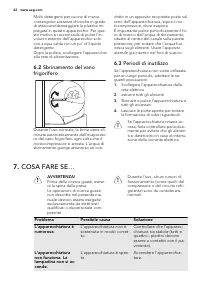
Molti detergenti per cucine di marcacontengono sostanze chimiche in gradodi attaccare/danneggiare la plastica im-piegata in questo apparecchio. Per que-sto motivo si raccomanda di pulire l'in-volucro esterno dell'apparecchio solocon acqua calda con un po' di liquidodetergente.Dopo la pulizia, ricoll...
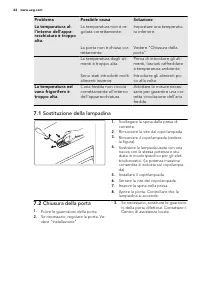
Page 44 - Sostituzione della lampadina; Chiusura della porta
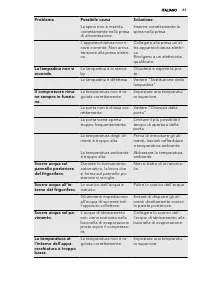
Problema Possibile causa Soluzione La temperatura al-l'interno dell'appa-recchiatura è troppoalta. La temperatura non è re-golata correttamente. Impostare una temperatu-ra inferiore. La porta non è chiusa cor-rettamente. Vedere "Chiusura dellaporta". La temperatura degli ali-menti è troppo a...
Page 45 - Luogo d'installazione; Temperatura ambiente; Livellamento
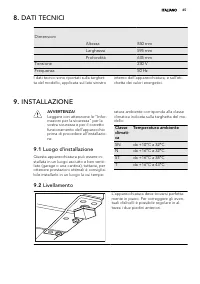
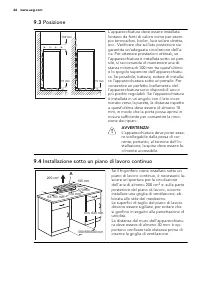
8. DATI TECNICI Dimensioni Altezza 850 mm Larghezza 595 mm Profondità 635 mm Tensione 230 V Frequenza 50 Hz I dati tecnici sono riportati sulla targhet-ta del modello, applicata sul lato sinistro interno dell'apparecchiatura, e sull'eti-chetta dei valori energetici. 9. INSTALLAZIONE AVVERTENZA! Legg...
Page 48 - Reversibilità della porta
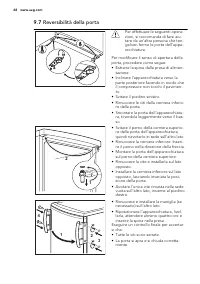
9.7 Reversibilità della porta Per effettuare le seguenti opera-zioni, si raccomanda di farsi aiu-tare da un'altra persona che ten-ga ben ferme le porte dell'appa-recchiatura. Per modificare il senso di apertura dellaporta, procedere come segue:• Estrarre la spina dalla presa di alimen- tazione. • In...
Page 49 - Presa a muro; Collegamento elettrico; RUMOROSITÀ
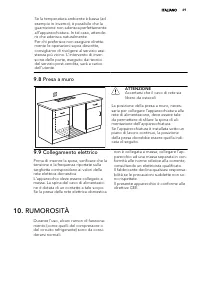
Se la temperatura ambiente è bassa (adesempio in inverno), è possibile che laguarnizione non aderisca perfettamenteall'apparecchiatura. In tal caso, attende-re che aderisca naturalmente.Per chi preferisce non eseguire diretta-mente le operazioni sopra descritte,consigliamo di rivolgersi al servizio ...
Page 51 - CONSIDERAZIONI AMBIENTALI
11. CONSIDERAZIONI AMBIENTALI Riciclare i materiali con il simbolo .Buttare l'imballaggio negli appositicontenitori per il riciclaggio.Aiutare a proteggere l’ambiente e lasalute umana e a riciclare rifiutiderivanti da apparecchiatureelettriche ed elettroniche. Nonsmaltire le apparecchiature cheripor...
Page 52 - CUSTOMER CARE AND SERVICE
CONTENTS 1. SAFETY INSTRUCTIONS . . . . . . . . . . . . . . . . . . . . . . . . . . . . . . . . . . . . . . . . . . . . . . . . . . . . . 53 2. OPERATION . . . . . . . . . . . . . . . . . . . . . . . . . . . . . . . . . . . . . . . . . . . . . . . . . . . . . . . . . . . . . . . 55 3. FIRST USE . . ...
Page 53 - SAFETY INSTRUCTIONS; Children and vulnerable
1. SAFETY INSTRUCTIONS In the interest of your safety and to en-sure the correct use, before installingand first using the appliance, read thisuser manual carefully, including its hintsand warnings. To avoid unnecessary mis-takes and accidents, it is important toensure that all people using the appl...
Page 55 - Environment Protection; OPERATION; Switching on; FIRST USE; Cleaning the interior
1.7 Environment Protection This appliance does not containgasses which could damage theozone layer, in either its refriger-ant circuit or insulation materials.The appliance shall not be dis-carded together with the urbanrefuse and rubbish. The insula-tion foam contains flammable gases: the appliance...
Page 56 - DAILY USE; Movable shelves; HELPFUL HINTS AND TIPS; Normal Operating Sounds
4. DAILY USE 4.1 Movable shelves The walls of the refrigerator are equip-ped with a series of runners so that theshelves can be positioned as desired. 4.2 Positioning the door shelves To permit storage of food packages ofvarious sizes, the door shelves can beplaced at different heights.To make these...
Page 57 - CARE AND CLEANING
5.3 Hints for fresh food refrigeration To obtain the best performance:• do not store warm food or evaporat- ing liquids in the refrigerator • do cover or wrap the food, particularly if it has a strong flavour • position food so that air can circulate freely around it 5.4 Hints for refrigeration Usef...
Page 58 - Periods of non-operation; WHAT TO DO IF...; Problem
Frost is automatically eliminated fromthe evaporator of the refrigerator com-partment every time the motor compres-sor stops, during normal use. The de-frost water drains out through a troughinto a special container at the back ofthe appliance, over the motor compres-sor, where it evaporates.It is i...
Page 60 - Replacing the lamp; Closing the door; TECHNICAL DATA
Problem Possible cause Solution The temperature inthe refrigerator istoo high. There is no cold air circu-lation in the appliance. Make sure that there iscold air circulation in theappliance. 7.1 Replacing the lamp 1. Disconnect the mains plug from themains socket. 2. Remove the screw from the lampc...
Page 61 - INSTALLATION; Positioning; Ambient temperature; Levelling
9. INSTALLATION WARNING! Read the "Safety Information"carefully for your safety and cor-rect operation of the appliancebefore installing the appliance. 9.1 Positioning This appliance can be installed in a dry,well ventilated indoor, also in a garageor cellar, but for optimum performanceinsta...
Page 64 - Door reversibility
9.7 Door reversibility To carry out the following opera-tions, we suggest that this bemade with another person thatwill keep a firm hold on the doorsof the appliance during the oper-ations. To change the opening direction of thedoor, do these steps:• Remove the plug from the power socket. • Tilt bac...
Page 65 - NOISE
If the ambient temperature is cold (i.e. inWinter), the gasket may not fit perfectlyto the cabinet. In that case, wait for thenatural fitting of the gasket.In case you do not want to carry out theabove mentioned operations, contactthe nearest After Sales Service Force.The After Sales Service special...
Page 67 - ENVIRONMENT CONCERNS
11. ENVIRONMENT CONCERNS Recycle the materials with thesymbol . Put the packaging inapplicable containers to recycle it.Help protect the environment andhuman health and to recycle wasteof electrical and electronic appliances. Do not disposeappliances marked with the symbol with the household waste. ...





 AEG AREH30LF
User Manual
AEG AREH30LF
User Manual
 AEG AREI20XLF
User Manual
AEG AREI20XLF
User Manual
 AEG FFB72746PM
User Manual
AEG FFB72746PM
User Manual
 AEG PS254DB
User Manual
AEG PS254DB
User Manual
 AEG NIK85M00AZ
User Manual
AEG NIK85M00AZ
User Manual
 AEG DGE5662HB
User Manual
AEG DGE5662HB
User Manual
 AEG DGE5962HB
User Manual
AEG DGE5962HB
User Manual
 AEG HVB95450IB
User Manual
AEG HVB95450IB
User Manual
 AEG PL700
User Manual
AEG PL700
User Manual
 AEG W14120
User Manual
AEG W14120
User Manual
 AEG DC240
User Manual
AEG DC240
User Manual
 AEG T738A4OBC
User Manual
AEG T738A4OBC
User Manual
 AEG T858M6OBC
User Manual
AEG T858M6OBC
User Manual
 AEG T859M6OBC
User Manual
AEG T859M6OBC
User Manual
 AEG T959M6ORS
User Manual
AEG T959M6ORS
User Manual
 AEG IKE95771FB
User Manual
AEG IKE95771FB
User Manual
 AEG AREI9XLF
User Manual
AEG AREI9XLF
User Manual
 AEG A18SPC3
User Manual
AEG A18SPC3
User Manual
 AEG LF7384O4C
User Manual
AEG LF7384O4C
User Manual