Page 2 - KUNDENDIENST UND -BETREUUNG
INHALT 1. SICHERHEITSHINWEISE . . . . . . . . . . . . . . . . . . . . . . . . . . . . . . . . . . . . . . . . . . . . . . . . . . . . . . 3 2. BETRIEB . . . . . . . . . . . . . . . . . . . . . . . . . . . . . . . . . . . . . . . . . . . . . . . . . . . . . . . . . . . . . . . . . . . 5 3. TÄGLICHER ...
Page 3 - SICHERHEITSHINWEISE; Sicherheit von Kindern und
1. SICHERHEITSHINWEISE Lesen Sie zu Ihrer Sicherheit und für dieoptimale Geräteanwendung vor der In-stallation und dem Gebrauch des Gerä-tes die vorliegende Benutzerinformationaufmerksam durch, einschließlich derRatschläge und Warnungen. Es ist wich-tig, dass zur Vermeidung von Fehlernund Unfällen a...
Page 5 - BETRIEB; Einschalten des Geräts
• Das Gerät darf nicht in der Nähe von Heizkörpern oder Kochern installiertwerden. • Vergewissern Sie sich, dass der Netz- stecker des Gerätes nach der Installati-on frei zugänglich ist. • Wenn ein Wasseranschluss vorgese- hen ist, verbinden Sie das Gerät nurmit dem Trinkwasseranschluss. 1.6 Kundend...
Page 6 - TÄGLICHER GEBRAUCH
3. TÄGLICHER GEBRAUCH 3.1 Vor der ersten Inbetriebnahme Bevor Sie das Gerät in Betrieb nehmen,beseitigen Sie den typischen „Neuge-ruch“ am besten durch Reinigen der In-nenteile mit lauwarmem Wasser und ei-ner neutralen Seife. Sorgfältig nachtrock-nen. Verwenden Sie keine Reinigungs-mittel oder Scheu...
Page 7 - PRAKTISCHE TIPPS UND HINWEISE; Energiespartipps
4. PRAKTISCHE TIPPS UND HINWEISE 4.1 Energiespartipps • Öffnen Sie die Tür nicht zu häufig, und lassen Sie diese nicht länger offen alsunbedingt notwendig. • Wenn die Umgebungstemperatur hoch ist und der Temperaturregler aufeine niedrige Temperatur eingestelltund das Gerät voll beladen ist, kann esz...
Page 8 - REINIGUNG UND PFLEGE; Regelmäßige Reinigung
4.5 Hinweise zur Lagerung gefrorener Produkte So erzielen Sie die besten Ergebnissemit Ihrem Gerät:• Vergewissern Sie sich, dass die gefro- renen Lebensmittel vom Händler an-gemessen gelagert wurden. • Achten Sie unbedingt darauf, die ein- gekauften gefrorenen Lebensmittel inder kürzest möglichen Ze...
Page 9 - Stillstandzeiten
5.2 Abtauen des Kühlschranks Bei normalem Betrieb wird Reif bei je-dem Anhalten des Kompressors automa-tisch vom Verdampfer des Kühlschranksentfernt. Das Tauwasser läuft durch eineAbflussöffnung in einen speziellen Be-hälter an der Rückseite des Geräts überdem Motorkompressor, wo es ver-dampft.Reini...
Page 11 - Ersetzen der Lampe
Störung Mögliche Ursache Abhilfe Wasser fließt in denKühlschrank. Der Wasserablauf ist ver-stopft. Reinigen Sie den Ablauf. Die eingelagerten Le-bensmittel verhindern,dass das Wasser zumWasserablauf fließt. Stellen Sie sicher, dass dieLebensmittel nicht dieRückwand berühren. Wasser fließt aufden Bod...
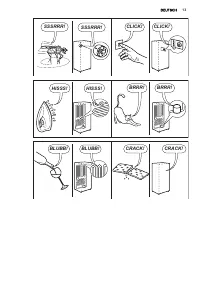
Page 12 - MONTAGE; Aufstellung; Umgebungstemperatur; Elektrischer Anschluss; GERÄUSCHE; BRRR; SSSRR; OK
7. MONTAGE 7.1 Aufstellung WARNUNG! Wenn Sie ein altes Gerät entsor-gen möchten, das ein Schlossoder einen Riegel an der Tür be-sitzt, müssen Sie das Schlossbzw. den Riegel zunächst un-brauchbar machen, um zu verhin-dern, dass sich spielende Kinderdarin einschließen können. Die Steckdose für den Ans...
Page 14 - TECHNISCHE DATEN; UMWELTTIPPS
9. TECHNISCHE DATEN Abmessung der Ausspa-rung Höhe 1225 mm Breite 560 mm Tiefe 550 mm Ausfalldauer 12 h Spannung 230-240 V Frequenz 50 Hz Die technischen Informationen befindensich auf dem Typenschild innen links imGerät sowie auf der Energieplakette. 10. UMWELTTIPPS Recyceln Sie Materialien mit dem...
Page 16 - INSTRUCTIONS DE SÉCURITÉ; Sécurité des enfants et
1. INSTRUCTIONS DE SÉCURITÉ Pour votre sécurité et garantir une utili-sation correcte de l'appareil, lisez atten-tivement cette notice, y compris les con-seils et avertissements, avant d'installeret d'utiliser l'appareil pour la premièrefois. Pour éviter toute erreur ou accident,veillez à ce que tou...
Page 17 - Utilisation quotidienne
Si le circuit frigorifique est endomma-gé :– évitez les flammes vives et toute au- tre source d'allumage – aérez soigneusement la pièce où se trouve l'appareil • Ne modifiez pas les spécifications de l'appareil. Si le câble d'alimentationest endommagé, il peut causer uncourt circuit, un incendie et/...
Page 18 - Maintenance; Protection de; FONCTIONNEMENT; Mise en fonctionnement
• Assurez-vous que la prise murale reste accessible après l'installation de l'ap-pareil. • Branchez à l'alimentation en eau pota- ble uniquement. (Si un branchementsur le réseau d'eau est prévu.) 1.6 Maintenance • Les branchements électriques néces- saires à l'entretien de l'appareil doi-vent être r...
Page 19 - UTILISATION QUOTIDIENNE
3. UTILISATION QUOTIDIENNE 3.1 Avant la première utilisation Avant d'utiliser l'appareil pour la premiè-re fois, nettoyez l'intérieur et tous les ac-cessoires avec de l'eau tiède savonneuse(pour supprimer toute odeur de neuf),puis séchez-les soigneusement. N'utilisez jamais de produitsabrasifs ou ca...
Page 20 - CONSEILS UTILES
3.6 Emplacement des balconnets de la porte Les parois du réfrigérateur sont équi-pées d'une série de glissières afin que les clayettes puissent être positionnéescomme vous le souhaitez. 4. CONSEILS UTILES 4.1 Conseils pour l'économie d'énergie • N'ouvrez pas la porte trop souvent ou plus longtemps q...
Page 21 - Conseils pour la; ENTRETIEN ET NETTOYAGE; Nettoyage périodique
congelés pour éviter une remontée entempérature de ces derniers. • les aliments maigres se conservent mieux et plus longtemps que les ali-ments gras ; le sel réduit la durée deconservation des aliments • la température très basse à laquelle se trouvent les bâtonnets glacés, s'ilssont consommés dès l...
Page 23 - EN CAS D'ANOMALIE DE FONCTIONNEMENT; Anomalie
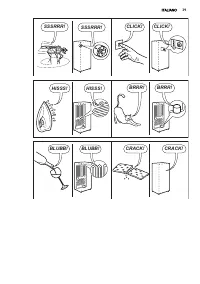
6. EN CAS D'ANOMALIE DE FONCTIONNEMENT AVERTISSEMENT Avant de résoudre les problè-mes, débranchez l'appareil.La résolution des problèmes, nonmentionnés dans le présent ma-nuel, doit être exclusivementconfiée à un électricien qualifiéou une personne compétente. Certains bruits pendant le fonc-tionnem...
Page 24 - Remplacement de l'éclairage; Fermeture de la porte
Anomalie Cause possible Remède Des produits empêchentl'eau de s'écouler dans leréservoir d'eau. Assurez-vous que les pro-duits ne touchent pas laplaque arrière. De l'eau coule sur lesol. L'eau de dégivrage nes'écoule pas dans le pla-teau d'évaporation situéau-dessus du compres-seur. Fixez la gouttiè...
Page 25 - INSTALLATION; Emplacement; Température ambiante; Branchement électrique; BRUITS
7. INSTALLATION 7.1 Emplacement AVERTISSEMENT Si l'appareil qui doit être mis aurebut est équipé d'un dispositifde fermeture, rendez celui-ci inu-tilisable de manière à ce que lesenfants ne puissent pas resterenfermés à l'intérieur de l'appa-reil. La prise de l'appareil doit être fa-cilement accessi...
Page 27 - CARACTÉRISTIQUES TECHNIQUES; EN MATIÈRE DE PROTECTION DE L'ENVIRONNEMENT
9. CARACTÉRISTIQUES TECHNIQUES Dimensions de la niched'encastrement Hauteur 1225 mm Largeur 560 mm Profondeur 550 mm Temps de levée 12 h Tension 230-240 V Fréquence 50 Hz Les caractéristiques techniques figurentsur la plaque signalétique située sur le côté gauche à l'intérieur de l'appareil etsur l'...
Page 28 - SERVIZIO CLIENTI E MANUTENZIONE
INDICE 1. ISTRUZIONI DI SICUREZZA . . . . . . . . . . . . . . . . . . . . . . . . . . . . . . . . . . . . . . . . . . . . . . . . . . . 29 2. USO DELL'APPARECCHIO . . . . . . . . . . . . . . . . . . . . . . . . . . . . . . . . . . . . . . . . . . . . . . . . . . . 31 3. UTILIZZO QUOTIDIANO . . . . ....
Page 29 - ISTRUZIONI DI SICUREZZA; Sicurezza dei bambini e
1. ISTRUZIONI DI SICUREZZA Per garantire un impiego corretto e sicu-ro dell'apparecchio, prima dell'installa-zione e del primo utilizzo leggere con at-tenzione il libretto istruzioni, inclusi isuggerimenti e le avvertenze. Per evitareerrori e incidenti, è importante garantireche tutte le persone che...
Page 31 - UTILIZZO QUOTIDIANO
1.6 Assistenza tecnica • Gli interventi elettrici sull'apparecchia- tura devono essere eseguiti esclusiva-mente da elettricisti qualificati o dapersonale competente. • Gli interventi di assistenza devono es- sere eseguiti esclusivamente da tecni-ci autorizzati e utilizzando solo ricambioriginali. 1....
Page 33 - CONSIGLI E SUGGERIMENTI UTILI
4. CONSIGLI E SUGGERIMENTI UTILI 4.1 Consigli per il risparmio energetico • Non aprire frequentemente la porta e non lasciarla aperta più di quanto as-solutamente necessario. • Se la temperatura ambiente è elevata, il termostato è impostato su una rego-lazione alta e l'apparecchio è a pienocarico, i...
Page 34 - PULIZIA E CURA; Pulizia periodica
• Non aprire frequentemente la porta e limitare il più possibile i tempi di aper-tura; • Una volta scongelati, gli alimenti si de- teriorano rapidamente e non possonoessere ricongelati; • Non superare la durata di conservazio- ne indicata sulla confezione. 5. PULIZIA E CURA ATTENZIONE Staccare la sp...
Page 35 - Periodi di inutilizzo
5.2 Sbrinamento del vano frigorifero Durante l'uso normale, la brina viene eli-minata automaticamente dall'evaporato-re del vano frigorifero ogni volta che ilmotocompressore si arresta. L'acqua disbrinamento giunge attraverso un forodi scarico in un apposito recipiente po-sto sul retro dell'apparecc...
Page 36 - COSA FARE SE...; Problema
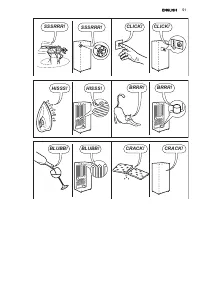
6. COSA FARE SE… AVVERTENZA! Prima della ricerca guasti, stacca-re la spina dalla presa.Le operazioni di ricerca guastinon contenute nel presente ma-nuale sono riservate solo ad elet-tricisti qualificati o a personecompetenti. Durante l'uso normale sonoemessi alcuni suoni (compresso-re, circolazione...
Page 37 - Sostituzione della lampadina; Chiusura della porta
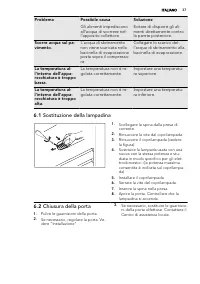
Problema Possibile causa Soluzione Gli alimenti impedisconoall'acqua di scorrere nel-l'apposito collettore. Evitare di disporre gli ali-menti direttamente controla parete posteriore. Scorre acqua sul pa-vimento. L'acqua di sbrinamentonon viene scaricata nellabacinella di evaporazioneposta sopra il c...
Page 38 - INSTALLAZIONE; Luogo d'installazione; Temperatura ambiente; Collegamento elettrico; RUMORI
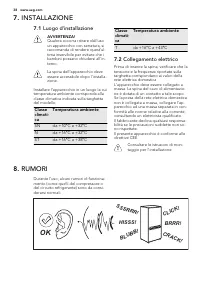
7. INSTALLAZIONE 7.1 Luogo d'installazione AVVERTENZA! Qualora occorra ritirare dall'usoun apparecchio con serratura, siraccomanda di rendere quest'ul-tima inservibile per evitare che ibambini possano chiudersi all'in-terno. La spina dell'apparecchio deveessere accessibile dopo l'installa-zione. Ins...
Page 40 - DATI TECNICI; CONSIDERAZIONI AMBIENTALI
9. DATI TECNICI Nicchia di incasso Altezza 1225 mm Larghezza 560 mm Profondità 550 mm Tempo di salita 12 h Tensione 230-240 V Frequenza 50 Hz I dati tecnici sono riportati sulla targhet-ta del modello, applicata sul lato sinistro interno dell'apparecchiatura, e sull'eti-chetta dei valori energetici....
Page 41 - CUSTOMER CARE AND SERVICE
CONTENTS 1. SAFETY INSTRUCTIONS . . . . . . . . . . . . . . . . . . . . . . . . . . . . . . . . . . . . . . . . . . . . . . . . . . . . . 42 2. OPERATION . . . . . . . . . . . . . . . . . . . . . . . . . . . . . . . . . . . . . . . . . . . . . . . . . . . . . . . . . . . . . . . 44 3. DAILY USE . . ...
Page 42 - SAFETY INSTRUCTIONS; Children and vulnerable
1. SAFETY INSTRUCTIONS In the interest of your safety and to en-sure the correct use, before installingand first using the appliance, read thisuser manual carefully, including its hintsand warnings. To avoid unnecessary mis-takes and accidents, it is important toensure that all people using the appl...
Page 44 - OPERATION; DAILY USE
1.7 Environment Protection This appliance does not containgasses which could damage theozone layer, in either its refriger-ant circuit or insulation materials.The appliance shall not be dis-carded together with the urbanrefuse and rubbish. The insula-tion foam contains flammable gases: the appliance...
Page 45 - HELPFUL HINTS AND TIPS
In this condition, the refrigeratorcompartment temperature mightdrop below 0°C. If this occurs re-set the temperature regulator toa warmer setting. 3.3 Storage of frozen food When first starting-up or after a periodout of use, before putting the productsin the compartment let the appliance runat lea...
Page 46 - CARE AND CLEANING
• do not store warm food or evaporat- ing liquids in the refrigerator • do cover or wrap the food, particularly if it has a strong flavour • position food so that air can circulate freely around it 4.3 Hints for refrigeration Useful hints:Meat (all types) : wrap in polythene bagsand place on the gla...
Page 47 - Periodic cleaning; Defrosting the refrigerator
5.1 Periodic cleaning The equipment has to be cleaned regu-larly:• clean the inside and accessories with lukewarm water and some neutralsoap. • regularly check the door seals and wipe clean to ensure they are cleanand free from debris. • rinse and dry thoroughly. Do not pull, move or damageany pipes...
Page 48 - Periods of non-operation; WHAT TO DO IF...; Problem
5.4 Periods of non-operation When the appliance is not in use forlong periods, take the following precau-tions:• disconnect the appliance from elec-tricity supply • remove all food • defrost (if foreseen) and clean the ap- pliance and all accessories • leave the door/doors ajar to prevent unpleasant...
Page 49 - Replacing the lamp; Closing the door
Problem Possible cause Solution The room temperature istoo high. Decrease the room tem-perature. Water flows on therear plate of the re-frigerator. During the automatic de-frosting process, frost de-frosts on the rear plate. This is correct. Water flows into therefrigerator. The water outlet is clog...
Page 50 - Positioning; Ambient temperature; Electrical connection; NOISES
7. INSTALLATION 7.1 Positioning WARNING! If you are discarding an old appli-ance that has a lock or catch onthe door, you must ensure that itis made unusable to preventyoung children being trapped in-side. The appliance shall have theplug accessible after installation. Install this appliance at a lo...
Page 52 - TECHNICAL DATA; ENVIRONMENT CONCERNS
9. TECHNICAL DATA Dimension of the recess Height 1225 mm Width 560 mm Depth 550 mm Rising Time 12 h Voltage 230-240 V Frequency 50 Hz The technical information are situated inthe rating plate on the internal left sideof the appliance and in the energy label. 10. ENVIRONMENT CONCERNS Recycle the mate...