BonJour 53444 - User Manual
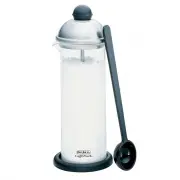
BonJour 53444 Milk Frother – User Manual, read for free online in PDF format. We hope this helps you resolve any issues you may have. If you have further questions, please contact us through the contact form.


IMPORTANT SAFETY, USE AND CARE INFORMATION
Thank you for choosing our cookware. To assure a long and pleasant experience, please read this information
before you use your cookware. These instructions are for your general safety, use and care to avoid personal injury
and damage to your cookware. Please note that some sections may not apply to your specific line of cookware.
Note: This Use and Care makes reference to porcelain enamel and silicone polyester coated cookware. In general,
you can tell if your cookware is porcelain enamel or silicone polyester coated if it has a colored exterior.
COOKING
General:
•
Safety: Keep small children away from the stove while you are cooking.
Never allow a child to sit near or under the stove while cooking. Be
careful around the stove as heat, steam and splatter can cause burns.
•
Pet Warning: Fumes from everyday cooking can be harmful to your
bird and other small pets, particularly smoke from burning foods.
Overheating cooking sprays, oils, fats, margarine and butter will create
dangerous fumes which a bird’s respiratory system cannot handle.
Scorched plastic handles or utensils can also contaminate the air and
endanger birds and other pets. Nonstick cookware with
polytetrafluoroethylene (PTFE) coating can also emit fumes harmful
to birds. Never allow a pan to overheat and never cook with birds or
small pets in or near the kitchen.
•
Unattended Cooking: NEVER LEAVE AN EMPTY PAN ON AN
ACTIVE BURNER. Any material, if heated continuously at a high
enough temperature, will begin to decompose, causing damage to the
stovetop, cookware and/or personal injury.
- Aluminum with Stainless or Copper Base:
WARNING:
IF YOUR
ALUMINUM CORE COOKWARE IS EXPOSED TO
PROLONGED OVERHEATING, OR ALLOWED TO BOIL DRY
ON A HOT BURNER WITHOUT LIQUID OR MOIST FOOD,
THE ALUMINUM CORE MAY MELT AND SEPARATE THE
BASE FROM THE PAN RELEASING HOT MOLTEN
ALUMINUM THAT MAY RESULT IN SEVERE PERSONAL
INJURY AND PROPERTY DAMAGE. If your cookware is
overheated and boils dry and you see molten aluminum near the base,
do not pick up your cookware. Turn burner off, leave cookware on the
stove, and let cool before moving.
- Clad Stainless Steel: These pans may become discolored or warped if
allowed to boil dry.
- Porcelain Enamel or Silicone Polyester: Overheating or allowing to
boil dry can make these pans fuse to the surface of glass top ranges,
requiring the replacement of the glass stovetop. Never leave a
porcelain enamel pan on the glass stovetop. Remove to a
heat-resistant surface such as a wooden cutting board.
•
Match Pan Size to Burner Size: Use burners that are the same size as
the pan you are using. Adjust gas flame so that it does not extend up
the sides of the pan.
•
Sliding Pans: Avoid sliding or dragging your cookware over the surface
of your stovetop, especially glass top ranges, as scratches may result.
We are not responsible for scratched stovetops.
•
Microwaves: Never use your cookware in the microwave.
•
Oven Use:
Caution:
Always use potholders or oven mitts when
removing cookware from the oven. All cookware is oven safe to 350°F
(180°C). Cookware with stainless steel handles is oven safe to 500°F
(260°C). NOTE: Some cookware may be safe at other temperatures
depending upon the product specifics. See packaging for specifics.
Oven use may cause rubberized handles to slightly fade in color but will
not affect performance.
•
Broiler: Never place a nonstick pan under the broiler. Cookware with
metal handles and no nonstick is broiler-safe.
•
Utensils: Some nonstick pans are safe for use with metal utensils such
as spoons, spatulas and whisks. See packaging for specifics.
Sharp-edged tools such as forks and knives should not be used in any
pan and knives should never be used to cut inside the pan. These
utensils will scratch both nonstick and stainless steel surfaces.
Scratches and peeling due to sharp-edged utensils is not covered
under warranty.
•
This cookware is not intended for commercial use or restaurant use.
Nonstick Cookware:
•
Standard Care: Using low to medium heat can preserve the cookware's
exterior and nonstick interior coatings as well as preserve the nutrients
in food. High heat may damage the cookware's coating, voiding
the warranty.
•
Nonstick Sprays: Do not use nonstick cooking sprays on nonstick
cookware - an invisible buildup will impair the nonstick release system
and food will stick in your pan.
•
Oil: If you prefer to keep the use of cooking oil to a minimum, you can
dab your favorite oil on a paper towel and carefully wipe the interior of
the pan before cooking. Heavy vegetable oils may leave a residue that
can affect nonstick performance. Use low heat when heating up oils.
Oils can quickly overheat and cause a fire.
•
Staining: Nonstick staining occurs even with normal use, but is not
considered a defect and is not covered under warranty.
CLEANING
•
Standard Care: Before first use and after each use, wash pans
thoroughly with mild dishwashing detergent and warm water. If food
remains on the surface, boil a mixture of water and vinegar into the pan
to dislodge the food particles.
- Copper Bottom Pan: A protective layer has been applied to the
copper base to prevent tarnishing during packaging. BEFORE FIRST
USE, remove this layer by dissolving 3 tablespoons of baking soda in
3 quarts of hot water and soak each pan for 20 minutes. Then rinse
with cold water and dry. After removing the protective layer and to
preserve the shiny finish, a copper polish can be used to bring back
the original luster.
•
Spots and Stains:
-
Never use oven cleaners to clean cookware. They will ruin
the cookware.
- Hard-Anodized: To lessen a stain, make a paste of baking soda and
water, apply to pan and scrub with a nonabrasive plastic mesh pad
such as Scotch-Brite
®
. Do not use steel wool, coarse scouring pads
or powder. Please note that plain hard-anodized exterior cookware is
porous. Staining will occur if food is spilled or allowed to boil over
onto the exterior of the pan.
- Stainless Steel or Nonstick: A spotted white film may form which can
be removed with a mild solution of water and lemon juice or vinegar.
"Loading the manual" means you need to wait until the file loads and becomes available for online reading. Some manuals are very large, and the time they take to appear depends on your internet speed.

