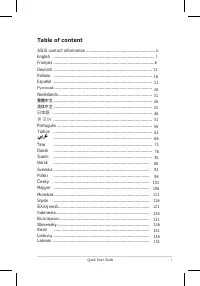
Page 2 - Contents; Introducing the Notebook PC; Table of Contents; Downloaded from LpManual.com Manuals
2 Contents Table of Contents 1. Introducing the Notebook PC About This User’s Manual ������������������������������������������������������������������������������������������ 6 Notes For This Manual ������������������������������������������������������������������������������������������� 6 Prepar...
Page 3 - Using the Notebook PC
Contents 4. Using the Notebook PC Pointing Device 36 Using the Touchpad 36 Touchpad Usage Illustrations 37 Caring for the Touchpad 38 Automatic Touchpad Disabling 38 Storage Devices 39 Expansion Card 39 Optical Drive (external) 40 Flash Memory Card Reader 43 Hard Disk Drive 44 Memory (RAM) 45 Connec...
Page 5 - About This User’s Manual; show what is actually used in the product itself.
5 1. Introducing the Notebook PC About This User’s Manual Notes For This Manual Safety Precautions Preparing your Notebook PC NOTE: Photos and icons in this manual are used for artistic purposes only and do not show what is actually used in the product itself. <000> Downloaded from LpManual.co...
Page 6 - are major sections of this User’s Manuals:; Introducing the Notebook PC; Introduces you to the Notebook PC and this User’s Manual.; Knowing the Parts; Gives you information on the Notebook PC’s components.; Using the Notebook PC; Gives you information on using the Notebook PC’s components.; Notes For This Manual; NOTE: Tips and information for special situations.
1 Introducing the Notebook PC About This User’s Manual You are reading the Notebook PC User’s Manual. This User’s Manual provides informa- tion on the various components in the Notebook PC and how to use them. The following are major sections of this User’s Manuals: 1. Introducing the Notebook PC In...
Page 7 - Safety Precautions; any extra moisture with a dry cloth.; throw the battery in fire.
7 Introducing the Notebook PC 1 Safety Precautions The following safety precautions will increase the life of the Notebook PC. Follow all precautions and instructions. Except as described in this manual, refer all servicing to qualified personnel. Do not use damaged power cords, accessories, or othe...
Page 8 - the battery pack when the Notebook PC is in use.; Airplane Precautions; takeoffs and landings.; Transportation Precautions; To prepare the Notebook PC for transport, you should turn it OFF and; disconnect all external peripher-; . The hard disk drive’s head retracts when the power is turned; careful not to rub or scrape the Notebook PC surfaces.; Cover Your Notebook PC
1 Introducing the Notebook PC CAUTION! There are three main types of airport security devices: X-ray machines (used on items placed on conveyor belts), magnetic detectors (used on people walking through security checks), and magnetic wands (hand-held devices used on people or individual items). You ...
Page 9 - Preparing your Notebook PC; tion on using your Notebook PC.; Install the battery pack; the display panel down to the table or else; Open the Display Panel; The power switch turns ON and OFF the Notebook; System Settings
Introducing the Notebook PC 1 Preparing your Notebook PC These are only quick instructions for using your Notebook PC. Read the later pages for detailed informa- tion on using your Notebook PC. 1. Install the battery pack 2. Connect the AC Power Adapter IMPORTANT! When opening, do not force the disp...
Page 11 - Basic sides of the Notebook PC
11 2. Knowing the Parts Basic sides of the Notebook PC NOTE: Photos and icons in this manual are used for artistic purposes only and do not show what is actually used in the product itself. <000> Downloaded from LpManual.com Manuals
Page 12 - Knowing the Parts; Top Side; NOTE: The keyboard will be different for each territory.
12 2 Knowing the Parts 8 2 7 6 3 1 5 4 9 Top Side Refer to the diagram below to identify the components on this side of the Notebook PC. NOTE: The keyboard will be different for each territory. Downloaded from LpManual.com Manuals
Page 13 - your identification key.
13 Knowing the Parts 2 2 3 4 5 6 1 7 8 9 Microphone (Built-in) The built-in mono microphone can be used for video conferencing, voice narrations, or simple audio recordings. Status Indicators (top) Status indicators represent various hardware/software conditions. See indicator details in section 3. ...
Page 14 - Bottom Side; LAP OR OTHER PARTS OF THE BODY TO AVOID INJURY FROM THE HEAT.
14 2 Knowing the Parts Bottom Side Refer to the diagram below to identify the components on this side of the Notebook PC. 1 2 3 4 7 5 6 WARNING! The bottom of the Notebook PC can get very hot. Be careful when handling the Notebook PC while it is in operation or recently been in operation. High tempe...
Page 15 - tion after inserting the battery pack.; SIM Card Compartment (on selected models)
15 Knowing the Parts 2 2 3 4 1 6 7 5 Memory (RAM) Compartment The memory compartment provides expansion capabilities for additional memory. Additional memory will increase application performance by decreasing hard disk access. The BIOS au- tomatically detects the amount of memory in the system and ...
Page 16 - without restarting the computer.; Right Side; WARNING: DO NOT USE THE NOTEBOOK PC WHILE OPERATING MOTOR VEHICLES.; VGA Performance Switch (on selected models); Note: You must reboot the Notebook PC after changing this setting.
1 2 Knowing the Parts 1 5 <000> ExpressCard Slot One 26pin Express card slot is available to support one ExpressCard/34mm or one ExpressCard/54mm expansion card. This new interface is faster by using a serial bus supporting USB 2.0 and PCI Express instead of the slower parallel bus used in the...
Page 17 - connectors up to two meters.; Kensington; The Kensington; CAUTION: MAY BECOME WARM TO HOT WHEN IN USE. BE SURE
17 Knowing the Parts 2 8 7 6 <000> E-SATA Port (on selected models) External SATA or eSATA allows external connection of Serial-ATA devices originally designed for use inside the computer. It is up to six times faster than existing USB 2.0, & 1394 for external storage solutions and is also...
Page 18 - Left Side; NTSC and PAL formats.; Air Vents; do not block any of the air vents or else overheating may occur.; Wireless Switch
1 2 Knowing the Parts 2 3 4 1 5 Left Side Refer to the diagram below to identify the components on this side of the Notebook PC. 1 2 4 3 5 6 7 8 9 TV-Out Port The TV-Out port is an S-Video connector that allows routing the Notebook PC’s display to a television or video projection device. You can cho...
Page 19 - entertainment system.; Headphone Output Jack; Microphone Input Jack
1 Knowing the Parts 2 Flash Memory Slot Normally an external memory card reader must be purchased separately in order to use memory cards from devices such as digital cameras, MP3 players, mobile phones, and PDAs. This Notebook PC has a built-in high-speed memory card reader that can conveniently re...
Page 20 - Rear Side; Modem Port; else damage will occur to the Notebook PC.; LAN Port; convenient use without additional adapters.; Battery Pack
20 2 Knowing the Parts 1 Rear Side Refer to the diagram below to identify the components on this side of the Notebook PC. 3 4 1 2 Modem Port The RJ-11 modem port with two pins is smaller than the RJ-45 LAN port and supports a standard telephone cable. The internal modem supports up to 56K V.90 trans...
Page 22 - Getting Started; WARNING! THE POWER ADAPTER MAY BECOME WARM TO HOT WHEN IN USE. BE; Power System; Using AC Power; outlet to the DC power required by the Notebook; adapters for almost every country.
22 3 Getting Started IMPORTANT! Damage may occur if you use a different adapter to power the Notebook PC or use the Notebook PC’s adapter to power other electrical devices. If there is smoke, burning scent, or extreme heat coming from the AC-DC adapter, seek servic- ing. Seek servicing if you suspec...
Page 23 - turned ON, as this may result in the loss of working data.; To install the battery pack:; WARNING! For safety reasons, DO NOT throw the battery in fire, DO NOT; Battery Care; shelf life, it is not recommended to buy extras for storing.; Using Battery Power; Installing and Removing the Battery Pack
23 Getting Started 3 IMPORTANT! Never attempt to remove the battery pack while the Notebook PC is turned ON, as this may result in the loss of working data. IMPORTANT! Only use battery packs and power adapters supplied with this Notebook PC or specifically approved by the manufacturer or retailer fo...
Page 24 - may result in data loss.; Powering ON the Notebook PC; the installation of a new operating system.; Self Monitoring and Reporting Technology; disk checking program: click
24 3 Getting Started IMPORTANT! If warnings are still given during bootup after running a software disk checking utility, you should take your Notebook PC in for servicing. Continued use may result in data loss. IMPORTANT! To protect the hard disk drive, always wait at least 5 seconds after turn- in...
Page 25 - Note: Screen captures shown; Checking Battery Power; and the size of the display panel.; Charging the Battery Pack
25 Getting Started 3 NOTE: You will be warned when battery power is low. If you continue to ignore the low battery warnings, the Notebook PC eventually enters suspend mode (Windows default uses STR). WARNING! Suspend-to-RAM (STR) does not last long when the battery power is depleted. Suspend-to-Disk...
Page 26 - Notebook PC before turning it back ON.; Emergency Shutdown; shutdown your Notebook PC:; Power Options; click the arrowhead next to the lock icon.; Restarting or Rebooting; to allow restart. To restart the system manually, choose; Restart; on the bottom�
2 3 Getting Started IMPORTANT! To protect the hard drive, wait at least 5 seconds after turning OFF your Notebook PC before turning it back ON. IMPORTANT! Do not use emergency shutdown while data is being written; doing so can result in loss or destruction of your data. Emergency Shutdown In case yo...
Page 27 - Sleep and Hibernate; “Sleep” and “Hibernate” saves power when your Notebook PC is not in; Power Management Modes
27 Getting Started 3 Sleep and Hibernate Power management settings can be found in the Windows > Control Panel > Power Options . In System Settings , you can define “Sleep/Hibernate” or “Shut Down” for closing the display panel or pressing the power button. “Sleep” and “Hibernate” saves power ...
Page 28 - Special Keyboard Functions; Colored Hot Keys; the functions should remain the same.; Decreases the display brightness; NOTE: Must connect an external monitor “before” booting up.
2 3 Getting Started <000> Special Keyboard Functions Colored Hot Keys The following defines the colored hot keys on the Notebook PC’s keyboard. The colored commands can only be accessed by first pressing and holding the function key while pressing a key with a colored command. 1.3 MEGA PIXELS ...
Page 29 - Toggles the “Scroll Lock” ON and OFF. Allows you to use a larger
2 Getting Started 3 Colored Hot Keys (cont.) 1.3 MEGA PIXELS TURBO NORMAL Scr Lk (Del): Toggles the “Scroll Lock” ON and OFF. Allows you to use a larger portion of the keyboard for cell navigation. Num Lk (Ins) : Toggles the numeric keypad (number lock) ON and OFF. Allows you to use a larger portion...
Page 30 - the keyboard as shown here.; Microsoft Windows Keys; of each key as shown in the figure. When the numeric keypad is; Keyboard as Cursors; With Number Lock OFF; ] and one of the cursor keys; With Number Lock ON; ] and one of the cursor keys shown
30 3 Getting Started <000> NOTE: The red arrows are illustrated here for your reference. They are not labeled on the keyboard as shown here. Microsoft Windows Keys There are two special Windows keys on the keyboard as described below. The key with the Windows Logo activates the Start menu loca...
Page 31 - Switches; Switches and Status Indicators; Power Switch; Control Panel “Power Options.”; Power4Gear eXtreme Key; The Power4Gear eXtreme key toggles power savings between
31 Getting Started 3 Switches Switches and Status Indicators Power Switch The power switch turns ON and OFF the Notebook PC or putting the Notebook PC into sleep or hibernation modes. Actual behavior of the power switch can be customized in Windows Control Panel “Power Options.” Power4Gear eXtreme K...
Page 32 - Status Indicators; The Notebook PC’s battery is charging when AC power is connected.; disk. The light flashes proportional to the access time.
32 3 Getting Started <000> Status Indicators Battery Charge Indicator The battery charge indicator shows the status of the battery’s power as follows: ON: The Notebook PC’s battery is charging when AC power is connected. OFF: The Notebook PC’s battery is charged or completely drained. Blinking...
Page 33 - Push once to skip to the; Audio Volume Controls; Toggles the audio volume ON and OFF; Multimedia Control Keys (on selected models); Hold down to
33 Using the Notebook PC 4 CD Play/Pause During CD stop, begins CD play. During CD play, pauses CD play. CD Stop During CD stop: Ejects the CD tray. During CD play: Stops CD play. CD Skip to Next Track (Fast Forward) & Audio Volume Up During CD play, this button has two functions: Track: Push on...
Page 34 - Using the Notebook PC
34 4 Using the Notebook PC Downloaded from LpManual.com Manuals
Page 36 - IMPORTANT! Do not use any objects in; Pointing Device; Using the Touchpad; Light pressure with the tip of your finger is all that is; Moving The Cursor; Place your finger in the center of the touchpad and; Slide your finger up or down on the right side to
3 4 Using the Notebook PC <000> IMPORTANT! Do not use any objects in place of your finger to operate the touch - pad or else damage may occur to the touchpad’s surface. Pointing Device The Notebook PC’s integrated touchpad pointing device is fully compatible with all two/three-but- ton and scr...
Page 37 - Touchpad Usage Illustrations; Hold left button and slide finger
37 Using the Notebook PC 4 Double-clicking/Double-tapping - This is a common skill for launching a program directly from the corresponding icon you select. Move the cursor over the icon you wish to execute, press the left button or tap the pad twice in rapid succession, and the system launches the c...
Page 38 - touchpad. The touchpad responds best to light pressure.; Caring for the Touchpad; • Do not touch the touchpad if your fingers are dirty or wet.; Automatic Touchpad Disabling; Control; Find; Mouse; properties in the “Control Panel”�
3 4 Using the Notebook PC <000> NOTE: The touchpad responds to movement not to force. There is no need to tap the surface too hard. Tapping too hard does not increase the responsiveness of the touchpad. The touchpad responds best to light pressure. Caring for the Touchpad The touchpad is press...
Page 39 - Storage Devices; • Expansion Card; Expansion Card; Inserting an Expansion Card; Card” instructions below.; Removing an Expansion Card
3 Using the Notebook PC 4 Storage Devices Storage devices allow the Notebook PC to read or write documents, pictures, and other files to various data storage devices. This Notebook PC has the following storage devices: • Expansion Card • Optical drive • Flash memory reader • Hard disk drive Expansio...
Page 40 - IMPORTANT! See Appendix for important; the CD drive lens and other mechanisms. Make; Inserting an optical disc
40 4 Using the Notebook PC <000> Optical Drive (external) Connecting an external optical drive The USB 2.0 port provides a convenient solution to connect the external optical drive. Normally, an additional power adapter is required for an external optical drive but this Notebook PC features a ...
Page 41 - CD drive while data is read.; in case the electronic eject does not work. Do not; Note: Make sure not to stab the activity; Emergency eject
41 Using the Notebook PC 4 NOTE: It is normal to hear as well as feel the CD spinning with great intensity in the CD drive while data is read. 3. Hold the disc by the edge and face the disc’s printed side up. Push down on both sides of the disc’s center until the disc snaps onto the hub. The hub sho...
Page 42 - slowly to prevent damage.
42 4 Using the Notebook PC A CD drive letter should be present regardless of the presence of a CD disc in the drive. After the CD is properly inserted, data can be accessed just like with hard disk drives; except that nothing can be written to or changed on the CD. Using the proper software, a CD-RW...
Page 43 - ting, or deleting data on the card or else data loss may occur.; Flash Memory Card Reader; because it utilizes the internal high-bandwidth PCI bus.; change so compatibility may change without warning.; Flash Memory Card Examples; WARNING! To prevent data loss, use “Windows Safely Remove Hard-
43 Using the Notebook PC 4 IMPORTANT! Never remove cards while or immediately after reading, copying, format- ting, or deleting data on the card or else data loss may occur. Memory Stick Duo/Pro/Duo Pro/MG (with MS adapater) Memory Stick (MS) Memory Stick Magic Gate (MG) Memory Stick Select SD (Secu...
Page 44 - Hard Disk Drive; Removing the hard disk drive: Installing the hard disk drive:
44 4 Using the Notebook PC <000> 1 2 3 4 7 5 6 Hard Disk Drive Compartment The hard disk drive is secured in a compartment. Visit an authorized service center or retailer for informa- tion on hard disk drive upgrades for your Notebook PC. Only purchase hard disk drives from authorized retailer...
Page 46 - Connections; Modem Connection; Once the driver is setup, the modem is ready to use.
4 4 Using the Notebook PC <000> NOTE: The built-in modem and network cannot be installed later as an upgrade. After purchase, modem and/or network can be installed as an expansion card. CAUTION: For electrical safety concerns, only use telephone cables rated 2AWG or higher. (see Glossary for m...
Page 47 - Network Connection
47 Using the Notebook PC 4 Example of the Notebook PC connected to a Network Hub or Switch for use with the built-in Ethernet controller. Network Connection Connect a network cable, with RJ-45 connectors on each end, to the modem/network port on the Note- book PC and the other end to a hub or switch...
Page 48 - Wireless LAN Connection (on selected models); Infrastructure mode
4 4 Using the Notebook PC These are examples of the Notebook PC connected to a Wireless Network� Desktop PC PDA Notebook PC Access Point Desktop PC PDA Notebook PC Wireless LAN Connection (on selected models) The optional built-in wireless LAN is a compact easy-to-use wireless Ethernet adapter. Impl...
Page 49 - Wireless LAN; Windows Wireless Network Connection; Connecting to a network; Connect to a network
4 Using the Notebook PC 4 2� Press [FN F2] repeatedly until Wireless LAN ON or WLAN & Bluetooth ON is shown� Windows Wireless Network Connection Connecting to a network 4� Right click on the network icon and select Connect to a network � 3� You should see the “Not Connected” network icon� 5� Sel...
Page 50 - Bluetooth Wireless Connection (on selected models); a USB or ExpressCard Bluetooth module in order to use Bluetooth.; connect to the Internet. You may also use it for SMS messaging.; Bluetooth-enabled computers or PDAs; Turning ON and Launching Bluetooth Utility; Wireless LAN ON
50 4 Using the Notebook PC <000> Bluetooth Wireless Connection (on selected models) Notebook PCs with Bluetooth technology eliminates the need for cables for connecting Bluetooth-enabled devices. Examples of Bluetooth-enabled devices may be Notebook PCs, Desktop PCs, mobile phones, and PDAs. N...
Page 52 - Fingerprint Registration (on selected models); � This wizard will automatically start when TPM is
52 4 Using the Notebook PC <000> 1.3 MEGA PIXELS TURBO NORMAL Fingerprint Registration (on selected models) The fingerprint scanner can be used for instant and secure user authentication. These instructions will show you how to setup the fingerprint registration. 1� This wizard will automatica...
Page 53 - Select a finger on the diagram and swipe the; Finish; and configure your preferences.
53 Using the Notebook PC 4 5. Select a finger on the diagram and swipe the corresponding finger on the scanner slowly. You must swipe your finger multiple times for verification. You must register at least two fingers to decrease the chance of any problems� 6� Click Finish when done� Fingerprint Reg...
Page 54 - SIM Card Installation; book PC and remove the battery to prevent damage.
54 4 Using the Notebook PC <000> SIM Card Installation 1 2 3 4 7 5 6 (1) Remove the screws to the compartment. IMPORTANT! Before installing a SIM card, shut down the Note- book PC and remove the battery to prevent damage. 1 2 3 (2) Slide the SIM cover as shown to unlock. (3) Insert a SIM card ...
Page 56 - Icons and indicators on the main window; The number of bars beside the antenna increases as signal
5 4 Using the Notebook PC <000> Watcher window Icons and indicators on the main window The main Watcher window provides status information and allows you to initiate and monitor data con- nections or make and receive phone calls (if voice is supported by your 3G modem and your service provider...
Page 57 - When the modem is connected to the network, the main Watcher window; System Tray Icons
57 Using the Notebook PC 4 <000> <000> Roaming. You are connected to a network other than your local service provider’s. There may be a surcharge for roaming service. (This service may not be available.) New SMS message. Click the icon to open the SMS Express window and read your message...
Page 58 - Quick Start; safely and lawfully.; Safety Information; WARNING! DO NOT USE ASUS MAP ON THE NOTEBOOK PC WHILE OPERATING; judgment and ask for directions in these situations.
5 4 Using the Notebook PC Quick Start Start up/Main Menu After the ASUS Map software starts, you will see the reminder warning to use your ASUS Map software safely and lawfully. Safety Information WARNING! DO NOT USE ASUS MAP ON THE NOTEBOOK PC WHILE OPERATING A MOTOR VEHICLE. The ASUS Map software ...
Page 59 - These are the basic screens and buttons on the ASUS Map software.; Other button definitions
5 Using the Notebook PC 4 Basic Parts These are the basic screens and buttons on the ASUS Map software. Navigation screen Exit screen OK Go Back Point of Interest screen Center Go Back Menu Main Menu screen Go Back Center 2D View 3D View 3D/2D Split View Zoom In Go Back Menu Zoom Out Views POI Cente...
Page 60 - • Sort by Distance
0 4 Using the Notebook PC Step 1 -- Select Destination You have many ways to select a destination. For this example, let’s find a nearby Airport. Select by touching the screen:• Use this button (or press F3) to activate main menu.• Start Route Guidance• Point of Interest• State/Province NOTE: The so...
Page 61 - guidance to your destination.
1 Using the Notebook PC 4 ASUS Map Software (on selected models) (cont.) Step 2 -- Map/Guide along Route Proceed to the highlighted route and drive while the ASUS Map software provides audible and visual guidance to your destination. Downloaded from LpManual.com Manuals
Page 62 - That’s it! You’ve arrived at the selected destination.
2 4 Using the Notebook PC Step 3 -- Arrive at Destination That’s it! You’ve arrived at the selected destination. ASUS Map Software (on selected models) (cont.) Refer to the complete manual on the ASUS Map software disc to become more familiar with the many options available on your ASUS Map software...