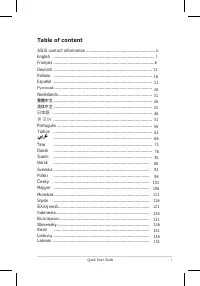
Page 2 - Contents; Introducing the Notebook PC; Table of Contents
2 Contents Table of Contents 1. Introducing the Notebook PC About This User’s Manual ������������������������������������������������������������������������������������������ 6 Notes For This Manual ������������������������������������������������������������������������������������������� 6 Prepar...
Page 3 - Using the Notebook PC
3 Contents Switches and Status Indicators �������������������������������������������������������������������������������� 32 Switches��������������������������������������������������������������������������������������������������������������� 32 Status Indicators ���������������������������������...
Page 5 - About This User’s Manual; show what is actually used in the product itself.
1. Introducing the Notebook PC About This User’s Manual Notes For This Manual Safety Precautions Preparing your Notebook PC NOTE: Photos and icons in this manual are used for artistic purposes only and do not show what is actually used in the product itself.
Page 6 - are major sections of this User’s Manuals:; Introducing the Notebook PC; Introduces you to the Notebook PC and this User’s Manual.; Knowing the Parts; Gives you information on the Notebook PC’s components.; Using the Notebook PC; Gives you information on using the Notebook PC’s components.; Notes For This Manual; NOTE: Tips and information for special situations.
1 Introducing the Notebook PC About This User’s Manual You are reading the Notebook PC User’s Manual. This User’s Manual provides informa- tion on the various components in the Notebook PC and how to use them. The following are major sections of this User’s Manuals: 1. Introducing the Notebook PC In...
Page 7 - Safety Precautions; any extra moisture with a dry cloth.; throw the battery in fire.
7 Introducing the Notebook PC 1 Safety Precautions The following safety precautions will increase the life of the Notebook PC. Follow all precautions and instructions. Except as described in this manual, refer all servicing to qualified personnel. Do not use damaged power cords, accessories, or othe...
Page 8 - the battery pack when the Notebook PC is in use.; Airplane Precautions; takeoffs and landings.; Transportation Precautions; To prepare the Notebook PC for transport, you should turn it OFF and; disconnect all external peripher-; . The hard disk drive’s head retracts when the power is turned; careful not to rub or scrape the Notebook PC surfaces.; Cover Your Notebook PC
1 Introducing the Notebook PC CAUTION! There are three main types of airport security devices: X-ray machines (used on items placed on conveyor belts), magnetic detectors (used on people walking through security checks), and magnetic wands (hand-held devices used on people or individual items). You ...
Page 9 - Preparing your Notebook PC; tion on using your Notebook PC.; Install the battery pack; the display panel down to the table or else; Open the Display Panel; The power switch turns ON and OFF the Notebook; System Settings
Introducing the Notebook PC 1 Preparing your Notebook PC These are only quick instructions for using your Notebook PC. Read the later pages for detailed informa- tion on using your Notebook PC. 1. Install the battery pack 2. Connect the AC Power Adapter IMPORTANT! When opening, do not force the disp...
Page 11 - Basic sides of the Notebook PC
11 2. Knowing the Parts Basic sides of the Notebook PC NOTE: Photos and icons in this manual are used for artistic purposes only and do not show what is actually used in the product itself.
Page 12 - Knowing the Parts; Top Side; NOTE: The keyboard will be different for each territory.; Camera Indicator; by supported software.; O p e n m a x
12 2 Knowing the Parts 1 Top Side Refer to the diagram below to identify the components on this side of the Notebook PC. NOTE: The keyboard will be different for each territory. 4 3 2 1 7 6 8 9 5 11 10 Camera Indicator The camera indicator shows when the built-in camera is in use. The camera may be ...
Page 13 - Details; CAUTION: The lens can be adjusted facing forward or facing back-; Control Panel “Power Options.”
13 Knowing the Parts 2 2 3 4 5 7 8 9 10 Instant Keys Instant keys allow you to launch frequently used applications with one push of a button. Details are described in section 3. Touchpad and Buttons The touchpad with its buttons is a pointing device that provides the same functions as a desk- top mo...
Page 14 - Bottom Side; LAP OR OTHER PARTS OF THE BODY TO AVOID INJURY FROM THE HEAT.
14 2 Knowing the Parts Bottom Side Refer to the diagram below to identify the components on this side of the Notebook PC. 6 5 7 2 3 1 4 WARNING! The bottom of the Notebook PC can get very hot. Be careful when handling the Notebook PC while it is in operation or recently been in operation. High tempe...
Page 15 - do not block any of the air vents or else overheating may occur.; Audio Speakers; features are software controlled.; Battery Lock - Spring
1 Knowing the Parts 2 2 3 4 1 6 7 5 Memory (RAM) Compartment The memory compartment provides expansion capabilities for additional memory. Additional memory will increase application performance by decreasing hard disk access. The BIOS automatically detects the amount of memory in the system and con...
Page 16 - Left Side; or projector to allow viewing on a larger external display.; LAN Port; convenient use without additional adapters.; Modem Port; else damage will occur to the Notebook PC.
1 2 Knowing the Parts Left Side Refer to the diagram below to identify the components on this side of the Notebook PC. 2 3 4 1 5 1 2 3 4 5 6 7 8 9 10 11 12 Display (Monitor) Output The 15-pin D-sub monitor port supports a standard VGA-compatible device such as a monitor or projector to allow viewing...
Page 17 - without restarting the computer.; SPDIF Output Jack; entertainment system.; Headphone Output Jack; Microphone Input Jack; Antenna Input; NOTE: Use the provided adapter for use with coaxial connectors.
17 Knowing the Parts 2 8 10 7 6 9 11 12 2.0 USB Port (2.0/1.1) The USB (Universal Serial Bus) port is compatible with USB 2.0 or USB 1.1 devices such as keyboards, pointing devices, cameras, hard disk drives, printers, and scanners connected in a series up to 12Mbits/sec (USB 1.1) and 480Mbits/sec (...
Page 18 - Right Side; Optical Drive Emergency Eject; tions for details on each model.; Optical Drive Electronic Eject; Windows “Computer” and selecting; Eject
18 2 Knowing the Parts Right Side Refer to the diagram below to identify the components on this side of the Notebook PC. 2 3 1 4 1 2 3 4 Optical Drive Emergency Eject (location varies by model) The emergency eject is used to eject the optical drive tray in case the electronic eject does not work. Do...
Page 19 - Front Side; Flash Memory Slot
19 Knowing the Parts 2 Front Side Refer to the diagram below to identify the components on this side of the Notebook PC. 1 1 3 4 2 Infrared Port (IrDA) (front side or right side depending on model) The infrared (IrDA) communication port allows convenient wireless data communication with infrared-equ...
Page 20 - Rear Side; Kensington; The Kensington; CAUTION: MAY BECOME WARM TO HOT WHEN IN USE. BE SURE; Cooling Fan
20 2 Knowing the Parts Rear Side Refer to the diagram below to identify the components on this side of the Notebook PC. 4 1 2 3 1 2 Kensington ® Lock Port The Kensington ® lock port allows the Notebook PC to be secured using Kensington ® com- patible Notebook PC security products. These security pro...
Page 22 - Getting Started; WARNING! THE POWER ADAPTER MAY BECOME WARM TO HOT WHEN IN USE. BE; Power System; Using AC Power; outlet to the DC power required by the Notebook; adapters for almost every country.
22 3 Getting Started <--- IMPORTANT! Damage may occur if you use a different adapter to power the Notebook PC or use the Notebook PC’s adapter to power other electrical devices. If there is smoke, burning scent, or extreme heat coming from the AC-DC adapter, seek servic- ing. Seek servicing if yo...
Page 23 - turned ON, as this may result in the loss of working data.; To install the battery pack:; WARNING! For safety reasons, DO NOT throw the battery in fire, DO NOT; Battery Care; shelf life, it is not recommended to buy extras for storing.; Using Battery Power; Installing and Removing the Battery Pack
23 Getting Started 3 IMPORTANT! Never attempt to remove the battery pack while the Notebook PC is turned ON, as this may result in the loss of working data. IMPORTANT! Only use battery packs and power adapters supplied with this Notebook PC or specifically approved by the manufacturer or retailer fo...
Page 24 - may result in data loss.; Powering ON the Notebook PC; the installation of a new operating system.; Self Monitoring and Reporting Technology; disk checking program: click
24 3 Getting Started IMPORTANT! If warnings are still given during bootup after running a software disk checking utility, you should take your Notebook PC in for servicing. Continued use may result in data loss. IMPORTANT! To protect the hard disk drive, always wait at least seconds after turn- ing ...
Page 25 - Checking Battery Power; and the size of the display panel.
2 Getting Started 3 NOTE: You will be warned when battery power is low. If you continue to ignore the low battery warnings, the Notebook PC eventually enters suspend mode (Windows default uses STR). WARNING! Suspend-to-RAM (STR) does not last long when the battery power is depleted. Suspend-to-Disk ...
Page 26 - Charging the Battery Pack; authorized service center.; Battery Calibration (on selected models)
2 3 Getting Started WARNING! Do not leave the battery pack discharged. The battery pack will discharge over time. If not using a battery pack, it must continued to be charged every three months to extend recovery capacity or else it may fail to charge in the future. NOTE: The battery stops charging ...
Page 27 - Notebook PC before turning it back ON.; Emergency Shutdown; shutdown your Notebook PC:; Power Options; click the arrowhead next to the lock icon.; Restarting or Rebooting; to allow restart. To restart the system manually, choose; Restart; on the bottom�
27 Getting Started 3 IMPORTANT! To protect the hard drive, wait at least seconds after turning OFF your Notebook PC before turning it back ON. IMPORTANT! Do not use emergency shutdown while data is being written; doing so can result in loss or destruction of your data. Emergency Shutdown In case you...
Page 28 - Thermal Power Control; half way) will reappear as if you never left. “Shut Down” will close all; Power Management Modes
2 3 Getting Started <--- Thermal Power Control There are three power control methods for controlling the Notebook PC’s thermal state. These power control cannot be configured by the user and should be known in case the Notebook PC should enter these states. The following temperatures represent th...
Page 29 - Special Keyboard Functions; Colored Hot Keys; Decreases the display brightness; NOTE: Must connect an external monitor “before” booting up.
2 Getting Started 3 Special Keyboard Functions Colored Hot Keys The following defines the colored hot keys on the Notebook PC’s keyboard. The colored commands can only be accessed by first pressing and holding the function key while pressing a key with a colored command. NOTE: The Hot Key locations ...
Page 30 - Decreases the speaker volume (only in Windows OS)
30 3 Getting Started Colored Hot Keys (cont.) Scr Lk (Del): Toggles the “Scroll Lock” ON and OFF. Allows you to use a larger portion of the keyboard for cell navigation. Num Lk (Ins) : Toggles the numeric keypad (number lock) ON and OFF. Allows you to use a larger portion of the keyboard for number ...
Page 31 - the keyboard as shown here.; Microsoft Windows Keys; of each key as shown in the figure. When the numeric keypad is; Keyboard as Cursors; With Number Lock OFF; ] and one of the cursor keys; With Number Lock ON; ] and one of the cursor keys shown
31 Getting Started 3 NOTE: The red arrows are illustrated here for your reference. They are not labeled on the keyboard as shown here. Microsoft Windows Keys There are two special Windows keys on the keyboard as described below. The key with the Windows Logo activates the Start menu located at the b...
Page 32 - Switches; Switches and Status Indicators; Power4Gear eXtreme Key; The Power4Gear eXtreme key toggles power savings between; Touchpad Lock Key
32 3 Getting Started Switches Switches and Status Indicators Power4Gear eXtreme Key The Power4Gear eXtreme key toggles power savings between various power saving modes. The power saving modes control many aspects of the Notebook PC to maximize performance versus battery time. Applying or removing th...
Page 33 - Status Indicators; disk. The light flashes proportional to the access time.
33 Getting Started 3 Status Indicators Top Capital Lock Indicator Indicates that capital lock [Caps Lock] is activated when lighted. Capital lock allows some of the keyboard letters to type using capitalized letters (e.g. A, B, C). When the capital lock light is OFF, the typed letters will be in the...
Page 34 - Push once to skip to the; Audio Volume Controls; Toggles the audio volume ON and OFF; Multimedia Control Keys (on selected models); Hold down to
34 4 Using the Notebook PC CD Play/Pause During CD stop, begins CD play. During CD play, pauses CD play. CD Stop During CD stop: Ejects the CD tray. During CD play: Stops CD play. CD Skip to Next Track (Fast Forward) & Audio Volume Up During CD play, this button has two functions: Track: Push on...
Page 36 - Using the Notebook PC; IMPORTANT! Do not use any objects in; Pointing Device; Using the Touchpad; Moving The Cursor; Scrolling on the fingerprint scanner
3 4 Using the Notebook PC IMPORTANT! Do not use any objects in place of your finger to operate the touch - pad or else damage may occur to the touchpad’s surface. Pointing Device The Notebook PC’s integrated touchpad pointing device is fully compatible with all two/three-but- ton and scrolling knob ...
Page 37 - Touchpad Usage Illustrations; Hold left button and slide finger
37 Using the Notebook PC 4 Double-clicking/Double-tapping - This is a common skill for launching a program directly from the corresponding icon you select. Move the cursor over the icon you wish to execute, press the left button or tap the pad twice in rapid succession, and the system launches the c...
Page 38 - touchpad. The touchpad responds best to light pressure.; Caring for the Touchpad; • Do not touch the touchpad if your fingers are dirty or wet.; Automatic Touchpad Disabling; Control; Select this option to enable this feature�; Mouse; properties in the “Control Panel”�
3 4 Using the Notebook PC NOTE: The touchpad responds to movement not to force. There is no need to tap the surface too hard. Tapping too hard does not increase the responsiveness of the touchpad. The touchpad responds best to light pressure. Caring for the Touchpad The touchpad is pressure sensitiv...
Page 39 - Storage Devices; • Expansion Card; Expansion Card; Inserting an Expansion Card; first and label side up. Standard ExpressCards; Removing an Expansion Card
3 Using the Notebook PC 4 Storage Devices Storage devices allow the Notebook PC to read or write documents, pictures, and other files to various data storage devices. This Notebook PC has the following storage devices: • Expansion Card • Optical drive • Flash memory reader • Hard disk drive Expansio...
Page 40 - Optical Drive; Inserting an optical disc; the CD drive lens and other mechanisms. Make; The hub should be higher than the
40 4 Using the Notebook PC Optical Drive Inserting an optical disc 1. While the Notebook PC’s power is ON, press the drive’s eject button and the tray will eject out partially. 2. Gently pull on the drive’s front panel and slide the tray completely out. Be careful not to touch the CD drive lens and ...
Page 41 - slowly to prevent damage.; Using the Optical Drive; Eject the tray and gently pry the edge of the disc; Note: Make sure not to stab the activity; Emergency eject
41 Using the Notebook PC 4 A CD drive letter should be present regardless of the presence of a CD disc in the drive. After the CD is properly inserted, data can be accessed just like with hard disk drives; except that nothing can be written to or changed on the CD. Using the proper software, a CD-RW...
Page 42 - ting, or deleting data on the card or else data loss may occur.; Flash Memory Card Reader; because it utilizes the internal high-bandwidth PCI bus.; change so compatibility may change without warning.; Flash Memory Card Examples; WARNING! To prevent data loss, use “Windows Safely Remove Hard-
42 4 Using the Notebook PC Memory Stick Duo/Pro/Duo Pro/MG (with MS adapater) Memory Stick (MS) Memory Stick Magic Gate (MG) Memory Stick Select SD (Secure Digital) MiniSD (with SD adapter) Memory Stick Micro (with MS adapter) xD Picture Card MMC (Multimedia Card) MMC Plus RS-MMC (Reduced Size) (wit...
Page 43 - Hard Disk Drive
43 Using the Notebook PC 4 Removing/Installing the screws: Removing/Installing the drive: 6 5 7 2 3 1 4 Hard Disk Drive Compartment The hard disk drive is secured in a compartment. Visit an authorized service center or retailer for informa- tion on hard disk drive upgrades for your Notebook PC. Only...
Page 45 - Connections; Modem Connection; Once the driver is setup, the modem is ready to use.
4 Using the Notebook PC 4 NOTE: The built-in modem and network cannot be installed later as an upgrade. After purchase, modem and/or network can be installed as an expansion card. CAUTION: For electrical safety concerns, only use telephone cables rated 2AWG or higher. (see Glossary for more informat...
Page 46 - Network Connection
4 4 Using the Notebook PC WARNING! Only use analog telephone outlets. The built-in modem does not support the voltage used in digital phone systems. Do not connect the RJ-11 to digital phone systems found in many commercial buildings or else damage will occur! Example of the Notebook PC connected to...
Page 47 - Wireless LAN Connection (on selected models); Infrastructure mode
47 Using the Notebook PC 4 These are examples of the Notebook PC connected to a Wireless Network� Desktop PC PDA Notebook PC Access Point Desktop PC PDA Notebook PC Wireless LAN Connection (on selected models) The optional built-in wireless LAN is a compact easy-to-use wireless Ethernet adapter. Imp...
Page 48 - Wireless LAN; Windows Wireless Network Connection; Connecting to a network; Connect to a network
4 4 Using the Notebook PC <--- 2� Press [FN F2] repeatedly until Wireless LAN ON or WLAN & Bluetooth ON is shown� Windows Wireless Network Connection Connecting to a network 4� Right click on the network icon and select Connect to a network � 3� You should see the “Not Connected” network icon...
Page 49 - Bluetooth Wireless Connection (on selected models); a USB or ExpressCard Bluetooth module in order to use Bluetooth.; connect to the Internet. You may also use it for SMS messaging.; Bluetooth-enabled computers or PDAs; Turning ON and Launching Bluetooth Utility; Wireless LAN ON
4 Using the Notebook PC 4 Bluetooth Wireless Connection (on selected models) Notebook PCs with Bluetooth technology eliminates the need for cables for connecting Bluetooth-enabled devices. Examples of Bluetooth-enabled devices may be Notebook PCs, Desktop PCs, mobile phones, and PDAs. Note: If your ...
Page 51 - Fingerprint Registration (on selected models); � This wizard will automatically start when TPM is
1 Using the Notebook PC 4 Fingerprint Registration (on selected models) The fingerprint scanner can be used for instant and secure user authentication. These instructions will show you how to setup the fingerprint registration. 1� This wizard will automatically start when TPM is enabled in BIOS (see...
Page 52 - Select a finger on the diagram and swipe the; Finish; and configure your preferences.
2 4 Using the Notebook PC 5. Select a finger on the diagram and swipe the corresponding finger on the scanner slowly. You must swipe your finger multiple times for verification. You must register at least two fingers to decrease the chance of any problems� 6� Click Finish when done� Fingerprint Regi...
Page 53 - Note: Digital television reception is available; Antenna placement; Can be safely placed on flat surfaces such as; Cable connection; necessary to change the coaxial plug to fit the slim Note
53 Using the Notebook PC 4 Antenna Connections (on selected models) This page shows multimedia connections for TV Tuner and/or FM Radio Models. TV and radio features require built-in modules only on selected models. DTV/FM antenna connection Connect the provided digital TV/FM radio antenna to the No...
Page 55 - Appendix
Appendix Optional Accessories & Connections Operating System and Software System BIOS Settings Common Problems and Solutions Windows Software Recovery Glossary Declarations and Safety Statements Notebook PC Information NOTE: Photos and icons in this manual are used for artistic purposes only and...
Page 56 - Optional Accessories; USB Flash Memory Disk; WARNING! To prevent system failures, use Windows “Safely
A Appendix Optional Accessories These items, if desired, come as optional items to complement your Notebook PC. USB Flash Memory Disk A USB flash memory disk is an optional item that can replace the 1.44MB floppy disk and provide storage up to several hundred megabytes, higher transfer speeds, and g...
Page 57 - Optional Connections; USB Keyboard and Mouse
Appendix A Optional Connections These items, if desired, may be purchased from third-parties. USB Keyboard and Mouse Attaching an external USB keyboard will allow data entry to be more comfortable. Attaching an external USB mouse will allow Windows navigation to be more comfortable. Both the externa...
Page 58 - Add a Bluetooth Device
A Appendix RE S E T OF F O N 5� Prepare the Bluetooth mouse�• Install two “AA” batteries�• Turn ON the power switch on the bottom of the mouse� The bottom sensor should glow red� • Push the “RESET” button on the bottom of the Bluetooth mouse� Bluetooth Mouse Setup (optional) This process can be used...
Page 59 - Next
Appendix A Note: “RESET” may be necessary after changing batteries. Repeat steps if necessary. 6� Click Next when the Bluetooth mouse is ready� 7� A list of nearby Bluetooth devices will be shown� Select the Bluetooth mouse and click Next � 8� Select “Don’t use a passkey” and click Next � 10� Click ...
Page 60 - device drivers and utilities are installed.; Operating System and Software; soft Windows; compatibility of other operating systems cannot be guaranteed.
A Appendix Support Software This Notebook PC comes with a support disc that provides BIOS, drivers and applications to enable hardware features, extend functionality, help manage your Notebook PC, or add functionality not provided by the native operating system. If updates or replace- ment of the su...
Page 61 - System BIOS Settings; Boot Device
Appendix A System BIOS Settings Boot Device Battery Calibration (on selected models) 2. Select each item and press [ Enter ] to select a device. 1. On the Boot screen, select Boot Device Priority. 1. On the Power screen, select Start Battery Calibration . 1. You will first be instructed to connect t...
Page 62 - Password Check
A Appendix Security Setting 1� On the Security screen, select Change Supervisor or Change User Password. 2� Type in a password and press [ Enter ]� 3� Re-type the password and press [ Enter ]� 4� Password is then set� 1� Leave the password field blank and press [ Enter ]� To clear the password: 2� P...
Page 63 - Common Problems and Solutions; Hardware Problem - Optical Disc; The optical disc drive is not able to read or write discs.; Update the BIOS to the latest version and try again.; Unknown Reason - System Unstable; Cannot wake up from the hibernation.; If not the case, try MS System Restore to an earlier date.; The built-in camera does not work correctly.; Check “Device Manager” to see if there are any problems.; Hardware Problem - Battery
Appendix A Common Problems and Solutions Hardware Problem - Optical Disc The optical disc drive is not able to read or write discs. 1. Update the BIOS to the latest version and try again. 2. If updating the BIOS does not help, try better quality discs and try again. 3. If the problem still exist, co...
Page 64 - air flow from the main air vent.
A Appendix Hardware Problem - Power ON/OFF Error I cannot power ON the Notebook PC. Diagnostics: 1. Power On by Battery only? (Y = 2, N = 4) 2. Able to see BIOS (ASUS Logo)? (Y = 3, N = A) 3. Able to load the OS? (Y = B, N = A) 4. Adapter power LED ON? (Y = 5, N = C) 5. Power ON by Adapter only? (Y ...
Page 65 - A blue screen with white text appears after system bootup.
Appendix A Software Problem - ASUS bundled software When I power ON the Notebook PC, there will be an “Open policy file error” message. A. Reinstall the latest version “Power4 Gear” utility to solve your problem. It is available on the ASUS website. Unknown Reason - Blue screen with white text A blu...
Page 66 - Utility CD that came with your Notebook PC.
A Appendix Software Problem - BIOS Updating the BIOS. 1. Please verify the Notebook PC’s exact model and download the latest BIOS file for your model from the ASUS website. 2. Use the “WINFLASH” utility to update your BIOS. The utility can be found in your Driver & Utility CD that came with your...
Page 67 - updating the virus definition file.
Appendix A Common Problems and Solutions (Cont.) Symantec’s Norton Internet Security (NIS) 1. Sometimes NIS will show an alert to stop a Trojan virus from a local IP address. This problem can be solved by making sure the virus definition file is the latest one and regularly updating the virus defini...
Page 68 - and then
A Appendix 11. Insufficient privilege message. Many settings, including disabling or uninstalling NIS, require you to be logged into Windows with Administrator privileges. Log Off and switch to a user account with Administrator privileges. Common Problems and Solutions (Cont.) 9. Windows Firewall mu...
Page 69 - Windows Vista Software Recovery; Using Hard Disk Partition; About the Recovery Partition; Read the “ASUS Preload Wizard” screen and click; Recover Windows to first partition only.
Appendix A Windows Vista Software Recovery Using Hard Disk Partition The Recovery Partition includes an image of the operating system, drivers, and utilities installed on your Notebook PC at the factory. The Recovery Partition provides a comprehensive recovery solution that quickly restores your Not...
Page 70 - Using the Recovery DVD:; Select a partition option and click
A Appendix Windows Vista Software Recovery (Cont.) Using DVD (on selected models) The Recovery DVD includes an image of the operating system, drivers, and utilities installed on your Notebook PC at the factory. The Recovery DVD provides a comprehensive recovery solution that quickly restores your No...
Page 71 - Glossary; ACPI (Advanced Configuration and Power Management Interface); Modern standard for reducing power usage in computers.; Boot; will reboot your computer.; Clock Throttling
Appendix A Glossary ACPI (Advanced Configuration and Power Management Interface) Modern standard for reducing power usage in computers. APM (Advanced Power Management) Modern standard for reducing power usage in computers. AWG (American Wire Gauge) NOTE: This table is for general reference only and ...
Page 73 - Laser Classifications; in most grocery stores or lasers used in optical drives.; PCI Bus (Peripheral Component Interconnect Local Bus); pansion card manufacturers.
Appendix A Glossary (Cont.) Kensington ® Locks Kensington ® locks (or compatible) allow the Notebook PC to be secured usually using a metal cable and lock that prevent the Notebook PC to be removed from a fixed object. Some security products may also include a motion detector to sound an alarm when ...
Page 74 - in STR mode. In STD mode, the Notebook PC will appear to be powered OFF.; System Disk; rising edge and falling edge.
A Appendix Glossary (Cont.) RAM (Random Access Memory) RAM (usually just called memory) is the place in a computer where the operating system, applica- tion programs, and data in current use are temporarily kept so that they can be quickly reached by the computer’s processor instead of having to rea...
Page 75 - Declarations and Safety Statements; DVD-ROM Drive Information; Regional Playback Information; America
Appendix A Declarations and Safety Statements DVD-ROM Drive Information The Notebook PC comes with an optional DVD-ROM drive or a CD-ROM drive. In order to view DVD titles, you must install your own DVD viewer software. Optional DVD viewer software may be purchased with this Notebook PC. The DVD-ROM...
Page 76 - Internal Modem Compliancy; Overview; tone multifrequency signalling.; which the equipment may have inter-working difficulties”; Network Compatibility Declaration
A Appendix Internal Modem Compliancy The Notebook PC with internal modem model complies with JATE (Japan), FCC (US, Canada, Korea, Taiwan), and CTR21. The internal modem has been approved in accordance with Council Decision 98/482/EC for pan-European single terminal connection to the public switched...
Page 77 - Country Applied More Testing; Denmark
Appendix A Internal Modem Compliancy (Cont.) This table shows the countries currently under the CTR21 standard. Country Applied More Testing Austria 1 Yes No Belgium Yes No Czech Republic No Not Applicable Denmark 1 Yes Yes Finland Yes No France Yes No Germany Yes No Greece Yes No Hungary No Not App...
Page 78 - Federal Communications Commission Statement; • This device may not cause harmful interference, and; void your authority to operate the equipment.; CE Mark Warning; case the user may be required to take adequate measures.
A Appendix Federal Communications Commission Statement This device complies with FCC Rules Part 15. Operation is subject to the following two conditions: • This device may not cause harmful interference, and • This device must accept any interference received, including interference that may cause u...
Page 79 - • Essential requirements as in [Article 3]; FCC Radio Frequency Interference Requirements; conjunction with any other antenna or transmitter.; FCC Radio Frequency (RF) Exposure Caution Statement; ranges and is restricted to indoor environments only.; GHz frequency by specified firmware controlled in the USA.”
Appendix A R&TTE Directive (1//EC) The following items were completed and are considered relevant and sufficient for the R&TTE (Radio & Telecommunications Terminal Equipment) directive: • Essential requirements as in [Article 3] • Protection requirements for health and safety as in [Arti...
Page 80 - France Restricted Wireless Frequency Bands; 3 Puy du Dôme; NOTE: Your WLAN Card transmits less than 100mW, but more than 10mW.; Wireless Operation Channel for Different Domains
A Appendix France Restricted Wireless Frequency Bands Some areas of France have a restricted frequency band. The worst case maximum authorized power indoors are: • 10mW for the entire 2.4 GHz band (2400 MHz–2483.5 MHz) • 100mW for frequencies between 2446.5 MHz and 2483.5 MHz NOTE: Channels 10 throu...
Page 81 - UL Safety Notices; or laundry tub, in a wet basement or near a swimming pool.; Do not use; shock from lightning.; Do not use; the Notebook PC in the vicinity of a gas leak.; Do not; manufacturer or authorized retailers.; Power Safety Requirement
Appendix A UL Safety Notices Required for UL 1459 covering telecommunications (telephone) equipment intended to be electrically connected to a telecommunication network that has an operating voltage to ground that does not exceed 200V peak, 300V peak-to-peak, and 105V rms, and installed or used in a...
Page 82 - teries according to the manufacturer’s instructions. (English)
A Appendix Nordic Lithium Cautions (for lithium-ion batteries) (Japanese) CAUTION! Danger of explosion if battery is incorrectly replaced. Replace only with the same or equivalent type recommended by the manufacturer. Dispose of used bat - teries according to the manufacturer’s instructions. (Englis...
Page 83 - Service warning label; authorized service provider.; CDRH Regulations; ous radiation exposure.; Macrovision Corporation Product Notice; is intended for home and other limited viewing uses only
Appendix A Service warning label WARNING: Making adjustments or performing procedures other than those specified in the user’s manual may result in hazardous laser exposure. Do not attempt to disas- semble the optical drive. For your safety, have the optical drive serviced only by an authorized serv...
Page 86 - Notebook PC Information
A Appendix Notebook PC Information This page is provided for recording information concerning your Notebook PC for future reference or for technical support. Keep this User’s Manual in a secured location if passwords are filled out. Owner’s Name: ___________________________ Owner’s Telephone: ______...