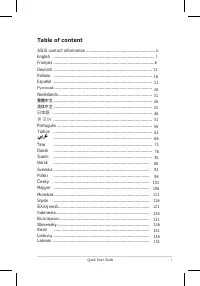
Page 3 - Contents; Where to find more information; Getting started; Starting for the first time; Connecting devices to your computer
iii Contents Notices ...........................................................................................................vSafety information ......................................................................................... viiConventions used in this guide ...............................
Page 4 - Using the Utilities; ASUS MyLogo2TM; Troubleshooting
iv Contents Chapter 6: Using the Utilities ASUS AI Manager ....................................................................................... 6-1ASUS EPU-4 Engine .................................................................................. 6-6ASUS Update .....................................
Page 5 - Notices; REACH; • This device may not cause harmful interference and
v Notices REACH Complying with the REACH (Registration, Evaluation, Authorisation, and Restriction of Chemicals) regulatory framework, we published the chemical substances in our products at ASUS REACH website at http://green.asus.com/english/REACH.htm Federal Communications Commission Statement Thi...
Page 6 - This class B digital apparatus complies with Canadian ICES-003.; Macrovision Corporation Product Notice; uses only; unless otherwise authorized by Macrovision Corporation; . Reverse engineering; according to the manufacturer’s instructions.
vi RF exposure warning This equipment must be installed and operated in accordance with provided instructions and the antenna(s) used for this transmitter must be installed to provide a separation distance of at least 20 cm from all persons and must not be co-located or operating in conjunction with...
Page 7 - Safety information; expose to strong magnetic or electrical fields.
vii Safety information Disconnect the AC power and peripherals before cleaning. Wipe the Desktop PC using a clean cellulose sponge or chamois cloth dampened with solution of nonabrasive detergent and a few drops of warm water then remove any extra moisture with a dry cloth. • DO NOT place on uneven ...
Page 8 - Conventions used in this guide; ASUS websites
viii Conventions used in this guide To ensure that you perform certain tasks properly, take note of the following symbols used throughout this manual. DANGER/WARNING : Information to prevent injury to yourself when trying to complete a task. CAUTION: Information to prevent damage to the components w...
Page 9 - Package contents
ix ASUS Essentio Desktop PC Keyboard x1 Mouse x1 Installation Guide Power cord x1 Installation Guide x1 Warranty card x1 Nero 9 burning software DVD x1 Antenna (optional) x2 Package contents • If any of the above items is damaged or missing, contact your retailer. • The illustrated items above are f...
Page 10 - Chapter 1; Getting to know your computer; Front panel; Thank you for purchasing the ASUS Essentio CG1330 Desktop PC!
ASUS CG1330 1-1 Chapter 1 Getting started Getting to know your computer Front panel 1 4 Illustrations are for reference only. The ports and their locations, and the chassis color vary with different models. Welcome! Thank you for purchasing the ASUS Essentio CG1330 Desktop PC! The ASUS Essentio CG13...
Page 11 - Rear panel; Optical disk drive eject button.; Insert a Memory StickTM / Memory
1-2 Chapter 1: Getting started Rear panel 1. USB 2.0 ports. These Universal Serial Bus 2.0 (USB 2.0) ports connect to USB 2.0 devices such as a mouse, printer, scanner, camera, PDA, and others. 2. Microphone port. This port connects to a microphone. 3. Headphone port. This port connects to a headpho...
Page 12 - This port is for a PS/2 keyboard or; LAN port LED indications
ASUS CG1330 1-3 1. Power connector. Plug the power cord to this connector. 2. Power switch. Switch to turn ON/OFF the power supply to your computer. 3. Air vents. These vents allow air ventilation. DO NOT block the air vents on the chassis. Always provide proper ventilation for your computer. 4. PS/...
Page 14 - Setting up your computer; Connecting an external monitor; Using the ASUS Graphics Card (on selected models only); To connect an external monitor using the ASUS Graphics Card:; Plug the monitor to a power source.
ASUS CG1330 1-5 Setting up your computer This section guides you through connecting the main hardware devices, such as the external monitor, keyboard, mouse, and power cord, to your computer. Connecting an external monitor Using the ASUS Graphics Card (on selected models only) Connect your monitor t...
Page 15 - Using the onboard display output ports; Connect your monitor to the onboard display output port.
1-6 Chapter 1: Getting started • If your computer comes with an ASUS Graphics Card, the graphics card is set as the primary display device in the BIOS. Hence, connect your monitor to a display output port on the graphics card. • To connect multiple external monitors to your computer, refer to Connec...
Page 16 - computer and the other end to a power source.
ASUS CG1330 1-7 Connecting a USB keyboard and a USB mouse Connect a USB keyboard and a USB mouse to the USB ports on the rear panel of your computer. Connecting the power cord Connect one end of the power cord to the power connector on the rear panel of your computer and the other end to a power sou...
Page 17 - Turning your computer ON/OFF; Turning your computer ON; To turn your computer ON:; Turning your computer OFF; To turn your computer OFF:; Click
1-8 Chapter 1: Getting started Turning your computer ON/OFF This section describes how to turn on/off your computer after setting up your computer. Turning your computer ON To turn your computer ON: 1. Turn your monitor ON. 2. Turn the power switch ON, then press the power button on your computer. T...
Page 18 - Chapter 2; Using Windows; configuring the basic settings of your Windows; To start for the first time:; From dropdown list, select your language. Click
ASUS CG1330 2-1 Chapter 2 Using Windows ® 7 Starting for the first time When you start your computer for the first time, a series of screens appear to guide you in configuring the basic settings of your Windows ® 7 operating system. To start for the first time: 1. Turn your computer on. Wait for a f...
Page 19 - Using the Start menu; Help and; Launching items from the Start menu; To launch items from the Start menu:; From the Windows
2-2 Chapter 2: Using Windows ® 7 Using Windows ® 7 desktop Notification area Taskbar Start menu Using the Start menu The Start menu gives you access to programs, utilities, and other useful items on your computer. It also provides you with more information about Windows 7 through its Help and Suppor...
Page 20 - Using the Getting Started item; as personalizing Windows; To use the Getting Started item:; Select; Getting Started; Using the taskbar; Launching a program from the taskbar; To launch a program from the taskbar:
ASUS CG1330 2-3 Using the Getting Started item The Getting Started item on the Start menu contains information about some basic tasks such as personalizing Windows ® , adding new users, and transferring files to help you to familiarize yourself with using Windows ® 7. To use the Getting Started item...
Page 21 - Pinning items on the jumplists; to the program’s or item’s related links.You may; Unpinning items from the jumplist; Right-click the item that you want to pin on the
2-4 Chapter 2: Using Windows ® 7 Pinning items on the jumplists When you right-click an icon on the taskbar, a jumplist launches to provide you with quick-access to the program’s or item’s related links.You may pin items on the jumplist such as favorite websites, often-visited folders or drives, or ...
Page 22 - By default, the notification area shows these three icons:; Action Center notification; Displaying an alert notification; To display an alert notification:; Click the Notification icon
ASUS CG1330 2-5 Unpinning programs from the Start menu To unpin programs from the Start menu: 1. From the Windows ® taskbar, click the Start icon to launch the Start menu. 2. From the Start menu, right-click the program that you want to unpin, then select Remove from this list . Unpinning programs f...
Page 23 - Customizing icons and notifications; To customize icons and notifications:; From the notification area, click on the arrow icon; Customize
2-6 Chapter 2: Using Windows ® 7 Customizing icons and notifications You may choose to display or hide the icons and notifications on the taskbar or on the notification area. To customize icons and notifications: 1. From the notification area, click on the arrow icon . 2. Click Customize . 3. From t...
Page 24 - Managing your files and folders; Windows; Launching Windows; To launch Windows Explorer:; Computer; to launch Windows Explorer.; Exploring files and folders; To explore files and folders:; Launch Windows Explorer.
ASUS CG1330 2-7 Managing your files and folders Using Windows ® Explorer Windows ® Explorer allows you to view, manage, and organize your files and folders. Launching Windows ® Explorer To launch Windows Explorer: 1. From the Windows ® taskbar, click the Start icon to launch the Start menu. 2. Click...
Page 25 - Customizing the file/folder view; Arranging your files; To arrange your files:; Arrange by; field, click to display the dropdown list.
2-8 Chapter 2: Using Windows ® 7 Customizing the file/folder view To customize the file/folder view: 1. Launch Windows Explorer. 2. From the navigation pane, select the location of your data. 3. From the toolbar, click the View icon . 4. From the View menu, move the slider to select how you want to ...
Page 26 - Sorting your files; Sort; Grouping your files; Group by; Adding a new folder; From the toolbar, click; New folder
ASUS CG1330 2-9 Sorting your files To sort your files: 1. Launch Windows Explorer. 2. Right-click anywhere on the View pane. 3. From the menu that appears, select Sort by , then select your preferred sorting type. Grouping your files To group your files: 1. Launch Windows Explorer. 2. Right-click an...
Page 27 - Backing up your files; Setting up a backup; Restoring your system; computer’s system settings without affecting your personal data.; Follow the onscreen instructions to finish the process.
2-10 Chapter 2: Using Windows ® 7 Backing up your files Setting up a backup To set up a backup: 1. Click > All Programs > Maintenance > Backup and Restore . 2. Click Set up backup . Click Next . Restoring your system The Windows ® System Restore feature creates a restore point where the com...
Page 28 - Protecting your computer; To launch Windows; To launch Windows 7 Action Center, click; Open; From Windows 7 Action Center, click the task that you want to do.
ASUS CG1330 2-11 Protecting your computer Using Windows ® 7 Action Center Windows ® 7 Action Center provides you with alert notifications, security information, system maintenance information, and the option to automatically troubleshoot and fix some common computer problems. You may customize the n...
Page 29 - and performance of your computer.; All Programs; From the Windows Update screen, click the task that you want to do.
2-12 Chapter 2: Using Windows ® 7 Using Windows ® Update Windows Update allows you to check and install the latest updates to enhance the security and performance of your computer. Launching Windows ® Update To launch Windows ® Update: 1. From the Windows ® taskbar, click the Start icon to launch th...
Page 30 - Setting up a user account and password; Setting up a user account
ASUS CG1330 2-13 Setting up a user account and password You may create user accounts and passwords for people who will use your computer. Setting up a user account To set up a user account: 1. From the Windows ® taskbar, click > Getting Started > Add new users . 2. Select Manage another accoun...
Page 31 - Setting up a user’s password; To set up a user’s password:; Select the user that you would like to set a password.; Create a password; Key in a password and confirm it. Key in your password’s hint.; Create password
2-14 Chapter 2: Using Windows ® 7 Setting up a user’s password To set up a user’s password: 1. Select the user that you would like to set a password. 2. Select Create a password . 3. Key in a password and confirm it. Key in your password’s hint. 4. When done, click Create password .
Page 32 - Activating the anti-virus software; To activate Trend Micro Internet Security:; Carefully read the license terms. Click; Next; Getting Windows; Help and Support
ASUS CG1330 2-15 Activating the anti-virus software Trend Micro Internet Security is pre-installed on your computer. It is a third-party anti-virus software protecting your computer from virus attacking. It is purchased separately. You have a 60-day trial period after activating it. To activate Tren...
Page 33 - To remove a USB storage device:; from the Windows notification area on your; Eject USB2.0 FlashDisk; When the; Safe to Remove Hardware; Chapter 3; Connecting a USB storage device; To connect a USB storage device:
3-1 ASUS CG1330 To remove a USB storage device: 1. Click from the Windows notification area on your computer, then click Eject USB2.0 FlashDisk . 2. When the Safe to Remove Hardware message pops up, remove the USB storage device from your computer. Chapter 3 Connecting devices to your computer Conne...
Page 34 - Connecting microphone and speakers; Connecting Headphone and Mic
3-2 Chapter 3: Connecting devices to your computer Connecting microphone and speakers This desktop PC comes with microphone ports and speaker ports on both the front and rear panels. The audio I/O ports located on the rear panel allow you to connect 2-channel, 4-channel, 6-channel, and 8-channel ste...
Page 36 - Connecting 8-channel Speakers
3-4 Chapter 3: Connecting devices to your computer Connecting 8-channel Speakers
Page 37 - Connecting multiple external displays; Setting up multiple displays; To set up multiple displays:; Turn off your computer.; section in Chapter 1 for details on how
3-5 ASUS CG1330 Connecting multiple external displays Your desktop PC may come with VGA, HDMI, or DVI ports and allows you to connect multiple external displays. Setting up multiple displays When using multiple monitors, you are allowed to set display modes. You can use the additional monitor as a d...
Page 38 - on the confirmation message.
3-6 Chapter 3: Connecting devices to your computer 5. Select the display mode from the Multiple displays: drop-down list. • Duplicate these displays : Select this option to use the additional monitor as a duplicate of your main display. • Extend these displays : Select this option to use the additio...
Page 39 - Connecting an HDTV; Connect a High Definition TV (HDTV) to the HDMI port of your computer.
3-7 ASUS CG1330 Connecting an HDTV Connect a High Definition TV (HDTV) to the HDMI port of your computer. • You need an HDMI cable to connect the HDTV and the computer. The HDMI cable is purchased separately. • To get the best display performance, ensure that your HDMI cable is less than 15 meters.
Page 40 - Chapter 4; Using your computer; Proper posture when using your Desktop PC; To maintain the proper posture:
4-1 ASUS CG1330 Chapter 4 Using your computer Proper posture when using your Desktop PC When using your Desktop PC, maintaining the proper posture is necessary to prevent strain to your wrists, hands, and other joints or muscles. This section provides you with tips on avoiding physical discomfort an...
Page 41 - When finished, right-click the memory card drive icon on the; Using the memory card reader; read from and write to different memory card drives.; To use the memory card:; Insert the memory card into the card slot.
4-2 Chapter 4: Using your computer 3. When finished, right-click the memory card drive icon on the Computer screen, click Eject , and then remove the card. Never remove cards while or immediately after reading, copying, formatting, or deleting data on the card or else data loss may occur. To prevent...
Page 42 - Using the optical drive; Inserting an optical disc; To insert an optical disc:; Place the disc to the optical drive with the label side facing up.; Removing an optical disc; To remove an optical disc:; screen, and then click; Eject; Remove the disc from the disc tray.
ASUS CG1330 4-3 Using the optical drive Inserting an optical disc To insert an optical disc: 1. While your system is on, press the eject button below the drive bay cover to open the tray. 2. Place the disc to the optical drive with the label side facing up. 3. Push the tray to close it. 4. Select a ...
Page 43 - Using the multimedia keyboard
4-4 Chapter 4: Using your computer Using the multimedia keyboard (on selected models only) The keyboard varies with models. The illustrations on this section are for reference only. ` 6 7 8 9 10 11 12 13 14 15 16 17 2 3 4 5 1 18 19 20 21 22 The special function keys only work on Windows ® Vista / Wi...
Page 44 - ASUS-Razer Arctosa Gaming keyboard
4-5 ASUS CG1330 ASUS-Razer Arctosa Gaming keyboard Keys Description 1. Plays or pauses playback in a media player. 2. Stops playback in a media player. 3. Goes to the previous track in a media player. 4. Goes to the next track in a media player. 5. Decreases the system volume. 6. Increases the syste...
Page 46 - Chapter 5; Connecting to the Internet; Connecting via a DSL/cable modem; Wired connection; computer and the other end to a DSL/cable modem.; Turn on the DSL/cable modem and your computer.
ASUS CG1330 5-1 Chapter 5 Connecting to the Internet Connecting via a DSL/cable modem To connect via a DSL/cable modem: 1. Set up your DSL/cable modem. Wired connection Use an RJ-45 cable to connect your computer to a DSL/cable modem or a local area network (LAN). Modem RJ-45 cable 2. Connect one en...
Page 47 - Connecting via a local area network (LAN); To connect via a LAN:; computer and the other end to your LAN.; Turn on your computer.
5-2 Chapter 5: Connecting to the Internet Connecting via a local area network (LAN) To connect via a LAN: 1. Connect one end of an RJ-45 cable to the LAN (RJ-45) port on the rear panel of your computer and the other end to your LAN. RJ-45 cable LAN 2. Turn on your computer. 3. Configure the necessar...
Page 48 - Wireless connection (on selected models only)
ASUS CG1330 5-3 Wireless connection (on selected models only) Connect your computer to the Internet through a wireless connection. • To increase the range and sensitivity of the wireless radio signal, connect the external antennas to the antenna connectors on the ASUS WLAN Card. • Place the antennas...
Page 49 - To connect to a wireless network:; Click the network icon; Connect; click; OK
5-4 Chapter 5: Connecting to the Internet To connect to a wireless network: 1. Click the network icon in the notification area to display the available wireless networks. 2. Select the wireless network that you want to connect to, then click Connect . 3. You may need to key in the network security k...
Page 50 - Wait while your computer is connecting to the wireless network.
ASUS CG1330 5-5 5. The wireless connection is established successfully. The connection status is displayed and the network icon displays the connected status. 4. Wait while your computer is connecting to the wireless network.
Page 51 - Chapter 6; ASUS AI Manager; Installing AI Manager; To install AI Manager:; Click the; Utilities; Launching AI Manager
ASUS CG1330 6-1 Chapter 6 Using the Utilities After launching the application, the AI Manager icon appears in the Windows ® taskbar. Right-click this icon to switch between the quick bar and the main window, and to launch the AI Manager either from the quick bar or taskbar. ASUS AI Manager ASUS AI M...
Page 52 - AI Manager quick bar; Information tab to display the menu’s contents.; Main; The Main menu contains five utilities:; AI Disk; window and select the items you want to clear. Click
6-2 Chapter 6: Using the Utilities AI Manager quick bar The AI Manager quick bar saves the desktop space and allows you to launch the ASUS utilities or display system information easily. Click any of the Main, My Favorites, Support or Information tab to display the menu’s contents. Click the Maximiz...
Page 53 - AI Security; a password with at most 20 alphanumeric characters.
ASUS CG1330 6-3 AI Security AI Security enables you to set a password to secure your devices, such as USB flash disks and CD/DVD disks, from unauthorized access. To lock a device: 1. When using AI Security for the first time, you are asked to set a password. Key in a password with at most 20 alphanu...
Page 54 - AI Booting; To specify the boot sequence:; AI Probe; Temperature; tab, then select an item to enable and
6-4 Chapter 6: Using the Utilities AI Booting AI Booting allows you to specify the boot device priority sequence. To specify the boot sequence: 1. Select a device, then click the left/right button to specify the boot sequence. 2. When done, press Apply . AI Probe AI Probe automatically detects and d...
Page 55 - My Favorites; Support
ASUS CG1330 6-5 My Favorites My Favorites allows you to add applications that you frequently use, saving you from searching for the applications throughout your computer. To add an application: 1. Click Add , then locate the application you want to add to My Favorites . 2. Click Open on the file loc...
Page 56 - Information; Installing ASUS EPU-4
6-6 Chapter 6: Using the Utilities Information Click the tab on the Information window to see the detailed information about your system, motherboard, CPU, BIOS, installed device(s), and memory. ASUS EPU-4 Engine ASUS EPU-4 Engine is an energy-efficient tool that provides you with a total system pow...
Page 57 - Calibrate; CPU status
ASUS CG1330 6-7 2. When you launch ASUS EPU-4 for the first time, a message appears asking you to calibrate the EPU functions. Click Calibrate and wait for a few seconds for the calibration process to complete. The ASUS EPU-4 main menu appears. Calibration allows the system to detect the CPU propert...
Page 58 - Displays the current or total reduced CO2 emission.
6-8 Chapter 6: Using the Utilities 3 HDD status Lights up when the power saving mode is activated. 4 Fan status Display the current fan status. 5 CO2 Emission button Displays the current or total reduced CO2 emission. 6 Mode properties Displays the properties of each mode. 7 Exit button Closes the A...
Page 59 - To configure the mode settings:
ASUS CG1330 6-9 Configuring the mode settings To configure the mode settings: 1. From the ASUS EPU-4 main menu, click Setting to launch the Setting screen. 2. Click the tab to configure the settings of High Performance mode. Click the tab to configure the settings of Maximum Power Saving mode. 3. Co...
Page 60 - ASUS Update; Installing ASUS Update; Updating the BIOS; From the dropdown list, select any of the updating process:; Updating from the Internet; Updating from a BIOS file; Update BIOS from a file; b. Locate the BIOS file from the
6-10 Chapter 6: Using the Utilities • ASUS Update requires an Internet connection either through a network or an Internet Service Provider (ISP). • This utility is available in the support DVD that comes with the motherboard package. ASUS Update The ASUS Update is a utility that allows you to manage...
Page 61 - Launch MyLogo to replace system boot logo before flashing; When prompted, locate the new BIOS file, then click
ASUS CG1330 6-11 ASUS MyLogo2™ The ASUS MyLogo2™ utility lets you customize the boot logo. The boot logo is the image that appears on screen during the Power-On Self-Tests (POST). ASUS MyLogo2™ is automatically installed when you install the ASUS Update utility from the Support DVD. To launch ASUS M...
Page 62 - Nero 9; Installing Nero 9; Insert the Nero 9 DVD into your optical drive.; From the main menu, click; Nero 9 Essentials
6-12 Chapter 6: Using the Utilities Nero 9 Nero 9 allows you to create, copy, burn, edit, share, and update different kinds of data. Installing Nero 9 To install Nero 9: 1. Insert the Nero 9 DVD into your optical drive. 2. If Autorun is enabled, the main menu appears automatically. If Autorun is dis...
Page 63 - Select the language you want to use for Installation Wizard. Click; Tick; I accept the License Conditions
ASUS CG1330 6-13 4. Select the language you want to use for Installation Wizard. Click Next . 5. Click Next to continue. 6. Tick I accept the License Conditions . When done, click Next .
Page 64 - Typical; Yes, I want to help by sending anonymous application data to Nero; then click
6-14 Chapter 6: Using the Utilities 7. Select Typical then click Next . 8. Tick Yes, I want to help by sending anonymous application data to Nero then click Next . 9. When done, click Exit .
Page 65 - Burning files; Data Burning; Select the files that you want to burn. When done, click; Add
ASUS CG1330 6-15 Burning files To burn files: 1. From the main menu, click Data Burning > Add . 2. Select the files that you want to burn. When done, click Add .
Page 66 - After selecting files that you want to burn, click; Recovering your system
6-16 Chapter 6: Using the Utilities 3. After selecting files that you want to burn, click Burn to burn the files to a disc. For more details about using Nero 9, refer to the Nero website at www.nero.com Recovering your system The bundled Recovery DVD assists you in reinstalling the operating system ...
Page 67 - begins its system configurations. Follow the; Quickly recover your system; System Recovery
ASUS CG1330 6-17 This recovery DVD is for ASUS Desktop PC only. DO NOT use it on other computers. Visit the ASUS website at www.asus.com for any updates. 4. Tick I accept then click Next . 5. Follow the onscreen instructions to complete the recovery process. 6. Click OK on the confirmation message t...
Page 68 - Chapter 7; My computer cannot be powered on and the power LED on the front; Turning; I cannot connect to a wireless network using the ASUS WLAN Card
7-1 ASUS CG1330 Chapter 7 Troubleshooting This chapter presents some problems you might encounter and the possible solutions. ? My computer cannot be powered on and the power LED on the front panel does not light up • Check if your computer is properly connected. • Check if the wall outlet is functi...
Page 69 - No display on the monitor.; My computer cannot detect my USB storage device.; Restoring your
7-2 Chapter 7: Troubleshooting ? No display on the monitor. • Check if the monitor is powered on. • Ensure that your monitor is properly connected to the video output port on your computer. • If your computer comes with a discrete graphics card, ensure that you connect your monitor to a video output...
Page 70 - The picture on the HDTV is stretched.; on the confirmation; My speakers produce no sound.; Adjust your speakers’ volume.; The DVD drive cannot read a disc.
7-3 ASUS CG1330 ? The picture on the HDTV is stretched. • It is caused by the different resolutions of your monitor and your HDTV. Adjust the screen resolution to fit your HDTV. To change the screen resolution: 1. Do any of the following to open the Screen Resolution setting screen: • Click > Con...
Page 71 - The DVD drive eject button is not respond.
7-4 Chapter 7: Troubleshooting ? The DVD drive eject button is not respond. 1. Click > Computer . 2. Right-click , then click Eject from the menu.