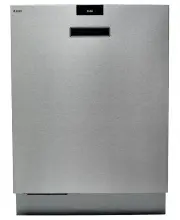
Page 2 - Contents; Front panel
Contents 2 Front panel 3 Safety instructions 4 Before washing for the first time 5 Loading the dishwasher 8 Using the dishwasher 12 Settings 14 Care and cleaning 16 Troubleshooting 19 Technical information 20 Installation 24 ASKO Service 24 Information for test institute 25 Your notes 28 Quick guide...
Page 3 - Safety instructions
Safety instructions NOTE! • Read the operating instructions and keep them in a safe place! • Number of place settings: 14• Never use the dishwasher for any purpose other than that specified in these operatinginstructions. • Do not load the dishwasher door or dishwash- er baskets with anything other ...
Page 4 - Checking water hardness
Before washing for thefirst time 1. Checking water hardness In order to achieve good dishwashing results, the dishwasher needssoft water (water with low mineral content). Hard water leaves a whitecoating on dishes and the dishwasher. Water hardness is specified using the German water hardness scale(...
Page 5 - Loading the dishwasher; Greener dishwashing
Water hardness 0/1/2/3/4/5/6/7/8/9 3 Choose a setting depending on the hardness of your water supply. See the water hardness table below. It is important that this setting is correct! 0-3 4-5 6-8 9-11 12-14 15-19 20-24 25-29 30-39 40 0-5 6-9 10-14 15-20 21-25 26-34 35-43 44-52 53-70 71 °dH °fH °dH °...
Page 7 - Cutlery basket
Foldable tines Lower the foldable tines (plate supports) when washing pots and pans.Release the foldable tines by pressing the catch inwards before adjust-ing their position. Washing large plates Move the foldable tines and their mounts to widen the distance betweenthe tine rows to adapt the lower b...
Page 8 - Using the dishwasher; Add detergent
Using the dishwasher Add detergent Press to open 1 Prewash detergent compartment 2 Main wash detergent compartment Detergent is added according to water hardness. Follow the instructions on the detergent packaging. This dishwasheris fitted with a water softener, so use detergent and rinse aid dosess...
Page 9 - The main power switch; Starting the dishwasher; Status indicator
Eco Speed mode 2:00 Eco 2:15 58°C S TA RT S T O P Starting the dishwasher Select from more programs Open the door and press the main power switch. Select the program The main power switch Open the door and press the main power switch. Also turn on the watertap if it is turned off. Select a program T...
Page 12 - Open the dishwasher's Settings menu
Settings Open the dishwasher's Settings menu Open the door and press the main power switch until the display lights up. To open the dishwasher's Settings menu, press the Navigation buttons: x 3, x 3 To exit the dishwasher's Settings menu, select Exit and confirm your selection with Start/Stop. S TA ...
Page 14 - Care and cleaning; Top up rinse aid; Top up salt
Care and cleaning Top up rinse aid When the rinse aid needs topping up, the above symbol lights on thedisplay. Press to open 1 Open the rinse aid compartment lid. 2 Carefully top up with rinse aid to the level marked max . 3 Wipe up any splashes of rinse aid around the compartment. 4 Close the lid f...
Page 15 - The door and the door seal; Unblocking the drainage pump; Unblocking the inlet hose filter
2 Unscrew the spray arm bearings counterclockwise to remove the spray arm from the upper basket. Lower spray arm • Pull the lower spray arm straight up to release it. The door and the door seal Regularly clean the sides of the door and the door seal. Use a slightlydamp cloth (with a little cleaner i...
Page 16 - Troubleshooting
Troubleshooting Action Type of fault on the display Clear the drainage pump. See the chapter Care and cleaning. If the problem persists, call the service department. Overfilling water 1 F10 See “Water remains in the dishwasher” in the table “Problem” below. If the problem persists, call the service ...
Page 19 - Technical information; Information on energy labelling; Technical data
Technical information Information on energy labelling Energy labelling AS/NZS 2007 Australian standard: 14 Number of place settings: ECO wash 1) Dishwashing programs: 1:58 hours:minutes Program time: Cold water 20 °C Connection: IEC 60704-2-3 Test method for noise measurement: 1) This dishwashing pr...
Page 20 - Installation; Placing the dishwasher
Installation 819*- 872 559 714 596 131-186 50 30-94 1198 700 [mm] Nominal dimensions. Actual measurements may vary. *Remove locking nuts for an installed height of 820-821 mm. Safety instructions • Connections to electricity, water and drainage must be performed by a qualified professional. • Always...
Page 21 - Affix the protective film
If the dishwasher is built-in the surrounding cabinetry must be resistantto any condensation from the dishwasher. B. Freestanding A freestanding dishwasher must be fitted with anti-tip brackets. Thiscomprises two brackets, which are screwed into place as illustrated. The dishwasher is then pushed in...
Page 22 - Electrical connection
Drainage connection This dishwasher is suitable for installing in a raised recess (to attainan ergonomic working height). This means that the dishwasher can beplaced so that the drainage hose runs to a lower level than the bottomof the dishwasher, such as by routing it directly to a floor drain. The...
Page 23 - Screwing the dishwasher into place; Dishwasher kick panel
Screwing the dishwasher into place (Applicable only to built-in dishwashers.) 2x After fastening the machine, check that the front feet still touch thefloor. Screw the dishwasher into place with two extra screws If there is an air gap of more than 3 mm between the underside of theworktop and the top...
Page 24 - ASKO Service; Information about your product
ASKO Service Information about your product There is a QR code on the compliance plate. Scan the code to viewinformation about your product. Contact the service department Read the chapter Troubleshooting before contacting the service de-partment. If you have encountered a problem that you cannot re...
Page 25 - Your notes
Page 28 - Quick guide
Quick guide Load the baskets 1. (See page 5.) Do not rinse dishes under running water before loading them in the dishwasher. Simply scrape offlarge food particles before loading the dishwasher. Check that the spray arms can rotate freely 2. Check also that the water tap is on. Don't forget! Empty th...