Page 2 - REPARATUR- UND KUNDENDIENST; SICHERHEITSHINWEISE; Lesen Sie vor der Montage und dem Gebrauch des
INHALTSVERZEICHNIS 1. SICHERHEITSHINWEISE............................................................................................. 2 2. SICHERHEITSANWEISUNGEN...................................................................................4 3. BETRIEB..............................................
Page 4 - SICHERHEITSANWEISUNGEN; Montage
• Betreiben Sie in den Lebensmittelfächern des Geräts keine anderen als die vom Hersteller empfohlenen Elektrogeräte. • Reinigen Sie das Gerät nicht mit einem Wasser- oder Dampfstrahl. • Reinigen Sie das Gerät mit einem weichen, feuchten Tuch. Verwenden Sie ausschließlich Neutralreiniger. Benutzen S...
Page 6 - BETRIEB; Einschalten des Geräts
• Prüfen Sie regelmäßig den Wasserabfluss des Geräts und reinigen Sie ihn gegebenenfalls. Bei verstopftem Wasserabfluss sammelt sich das Abtauwasser am Boden des Geräts an. 2.6 Service • Wenden Sie sich zur Reparatur des Geräts an einen autorisierten Kundendienst. • Verwenden Sie ausschließlich Orig...
Page 7 - TÄGLICHER GEBRAUCH
4. TÄGLICHER GEBRAUCH WARNUNG! Siehe Kapitel Sicherheitshinweise. 4.1 Einfrieren frischer Lebensmittel Der Gefrierraum eignet sich zum Einfrieren von frischen Lebensmitteln und zum längerfristigen Lagern von bereits gefrorenen und tiefgefrorenen Lebensmitteln.Für das Einfrieren frischer Lebensmittel...
Page 8 - TIPPS UND HINWEISE
4.5 Verstellbare Ablagen Die Wände des Kühlschranks sind mit einer Reihe von Führungsschienen ausgestattet, die verschiedene Möglichkeiten für das Einsetzen der Ablagen bieten. Die Glasablage über der Gemüseschublade sollte jedoch nicht verstellt werden, um eine korrekte Luftzirkulation zu gewährlei...
Page 9 - REINIGUNG UND PFLEGE; Allgemeine Warnhinweise
und ordnen Sie sie auf einer beliebigen Ablage ein. • Obst und Gemüse: Gründlich reinigen und in der speziellen Schublade aufbewahren. Bananen, Kartoffeln, Zwiebeln und Knoblauch sollten im Kühlschrank nicht unverpackt aufbewahrt werden. • Butter und Käse: Diese sollten stets in speziellen luftdicht...
Page 12 - FEHLERSUCHE
7. FEHLERSUCHE WARNUNG! Siehe Kapitel Sicherheitshinweise. 7.1 Was tun, wenn ... Störung Mögliche Ursache Abhilfe Das Gerät funktioniert nicht. Das Gerät ist ausgeschaltet. Schalten Sie das Gerät ein. Der Netzstecker wurde nichtrichtig in die Steckdose ge-steckt. Stecken Sie den Netzsteckerkorrekt i...
Page 14 - Austauschen der Lampe; MONTAGE; Aufstellung
Störung Mögliche Ursache Abhilfe Die eingelagerten Lebens-mittel waren nicht verpackt. Verpacken Sie die Lebens-mittel in geeigneten Verpa-ckungen, bevor Sie sie in dasGerät legen. Die Tür geht nicht leicht auf. Sie haben versucht die Tür erneut zu öffnen, nachdemSie sie kurz zuvor geschlos-sen habe...
Page 15 - Standort; TECHNISCHE DATEN; Technische Daten
Klimaklasse übereinstimmt, die auf dem Typenschild des Geräts angegeben ist. Klima-klasse Umgebungstemperatur SN +10 °C bis +32 °C N +16 °C bis +32 °C ST +16 °C bis + 38 °C T +16 °C bis +43 °C Bei einigen Modellen können Funktionsstörungen auftreten, wenn sie außerhalb dieses Temperaturbereichs betr...
Page 16 - GARANTIE; UMWELTTIPPS
10. CH GARANTIE Kundendienst Servicestellen Industriestrasse 10 5506 Mägenwil Le Trési 6 1028 Préverenges Via Violino 11 6928 Manno Morgenstrasse 131 3018 Bern Zürcherstrasse 204E 9000 St. Gallen Seetalstrasse 11 6020 Emmenbrücke Schlossstrasse 1 4133 Pratteln Comercialstrasse 19 7000 Chur Ersatztei...
Page 17 - INFORMATIONS DE SÉCURITÉ; soigneusement les instructions fournies. Le fabricant ne
TABLE DES MATIÈRES 1. INFORMATIONS DE SÉCURITÉ............................................................................... 17 2. CONSIGNES DE SÉCURITÉ......................................................................................19 3. FONCTIONNEMENT............................................
Page 19 - CONSIGNES DE SÉCURITÉ; Installation
• Ne pulvérisez pas d'eau ni de vapeur pour nettoyer l'appareil. • Nettoyez l'appareil avec un chiffon doux humide. Utilisez uniquement des produits de nettoyage neutres. N'utilisez pas de produits abrasifs, de tampons à récurer, de solvants ni d'objets métalliques. • Ne conservez aucune substance e...
Page 21 - FONCTIONNEMENT; Mise en marche; UTILISATION QUOTIDIENNE; Congélation d'aliments
• Le circuit frigorifique et les matériaux d'isolation de cet appareil préservent la couche d'ozone. • La mousse isolante contient un gaz inflammable. Contactez votre service municipal pour obtenir des informations sur la marche à suivre pour mettre l'appareil au rebut. • N'endommagez pas la partie ...
Page 22 - CONSEILS
4.2 Conservation d'aliments congelés et surgelés À la mise en service ou après un arrêt prolongé, placez le thermostat sur la position maximale pendant 2 heures environ avant d'introduire les produits dans le compartiment. En cas de décongélation accidentelle, due par exemple à une coupure de couran...
Page 24 - ENTRETIEN ET NETTOYAGE; Avertissements généraux
5.6 Conseils pour le stockage des aliments surgelés Pour obtenir les meilleures performances possibles :• assurez-vous que les denrées surgelées achetées dans le commerce ont été correctement entreposées par le revendeur ; • prévoyez un temps réduit au minimum pour le transport des denrées du magasi...
Page 26 - EN CAS D'ANOMALIE DE FONCTIONNEMENT; En cas d'anomalie de fonctionnement
3. Dégivrez (si nécessaire) et nettoyez l'appareil ainsi que tous les accessoires. 4. Nettoyez l'appareil et tous les accessoires. 5. Laissez la porte/les portes ouverte(s) pour éviter la formation d'odeurs désagréables. AVERTISSEMENT! Si, toutefois, vous n'avez pas la possibilité de débrancher et d...
Page 28 - Remplacement de
Problème Cause probable Solution L'épaisseur de givre est su-périeure à 4 - 5 mm. Dégivrez l'appareil. La porte a été ouverte tropsouvent. N'ouvrez la porte qu'en casde nécessité. L'air froid ne circule pasdans l'appareil. Assurez-vous que de l'airfroid circule dans l'appareil. Trop d'eau s'est cond...
Page 29 - INSTALLATION; Positionnement; Emplacement; CARACTÉRISTIQUES TECHNIQUES; Caractéristiques techniques
2. Si nécessaire, ajustez la porte. Reportez-vous au chapitre « Installation ». 3. Si nécessaire, remplacez les joints de porte défectueux. Contactez le service après-vente agréé. 8. INSTALLATION AVERTISSEMENT! Reportez-vous aux chapitres concernant la sécurité. 8.1 Positionnement Installez cet appa...
Page 31 - EN MATIÈRE DE PROTECTION DE
11. EN MATIÈRE DE PROTECTION DE L'ENVIRONNEMENT Recyclez les matériaux portant lesymbole . Déposez les emballages dans les conteneurs prévus à cet effet. Contribuez à la protection de l'environnement et à votre sécurité, recyclez vos produits électriques et électroniques. Ne jetez pas les appareilsp...
Page 32 - SERVIZIO CLIENTI E MANUTENZIONE; INFORMAZIONI DI SICUREZZA; Leggere attentamente le istruzioni fornite prima di
INDICE 1. INFORMAZIONI DI SICUREZZA............................................................................... 32 2. ISTRUZIONI DI SICUREZZA...................................................................................... 34 3. FUNZIONAMENTO.....................................................
Page 34 - ISTRUZIONI DI SICUREZZA; Installazione
• Non nebulizzare acqua né utilizzare vapore per pulire l'apparecchiatura. • Pulire l'apparecchiatura con un panno inumidito e morbido. Utilizzare solo detergenti neutri. Non usare prodotti abrasivi, spugnette abrasive, solventi od oggetti metallici. • Non conservare in questa apparecchiatura sostan...
Page 38 - CONSIGLI E SUGGERIMENTI UTILI
5. CONSIGLI E SUGGERIMENTI UTILI 5.1 Rumori normali durante il funzionamento I seguenti rumori sono da considerarsi normali:• Un gorgoglio o borbottio dalle serpentine quando viene pompato il refrigerante. • Un ronzio o un rumore pulsante dal compressore quando viene pompato il refrigerante. • Uno s...
Page 39 - PULIZIA E CURA; Avvertenze generali
• gli alimenti magri si conservano meglio e più a lungo di quelli ricchi di grassi. Il sale riduce la durata di conservazione dell'alimento; • i ghiaccioli, se consumati appena prelevati dal vano congelatore, possono causare ustioni da freddo; • è consigliabile riportare su ogni confezione la data d...
Page 41 - Periodi di non utilizzo; RISOLUZIONE DEI PROBLEMI
4. Una volta completato lo sbrinamento, asciugare accuratamente l'interno. 5. Accendere l’apparecchiatura. Dopo tre ore reintrodurre nel vano congelatore gli alimenti precedentemente rimossi. 6.6 Periodi di non utilizzo Se l'apparecchiatura non viene utilizzata per un lungo periodo, adottare le segu...
Page 43 - Sostituzione della
Problema Causa possibile Soluzione La temperatura degli alimen-ti è troppo alta. Prima di introdurre gli ali-menti, lasciarli raffreddare atemperatura ambiente. Sono stati introdotti moltialimenti contemporanea-mente. Introdurre gli alimenti un po-co alla volta. Lo spessore dello strato dibrina supe...
Page 44 - Chiusura della porta; INSTALLAZIONE; Luogo d'installazione; Ubicazione
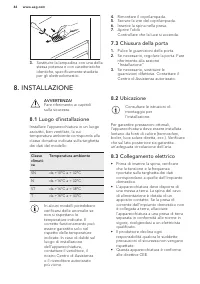
3. Sostituire la lampadina con una della stessa potenza e con caratteristiche identiche, specificamente studiata per gli elettrodomestici. 4. Rimontare il coprilampada. 5. Serrare la vite del coprilampada. 6. Inserire la spina nella presa. 7. Aprire l'oblò. Controllare che la luce si accenda. 7.3 Ch...
Page 45 - DATI TECNICI; Dati tecnici; GARANZIA
9. DATI TECNICI 9.1 Dati tecnici Altezza mm 1404 Larghezza mm 545 Profondità mm 604 Tempo di risalita Ore 19 Tensione Volt 230 - 240 Frequenza Hz 50 I dati tecnici sono riportati sulla targhetta dei dati applicata sul lato esterno o interno dell'apparecchiatura e sull'etichetta dei valori energetici...
Page 46 - CONSIDERAZIONI SULL'AMBIENTE
11. CONSIDERAZIONI SULL'AMBIENTE Riciclare i materiali con il simbolo . Buttare l'imballaggio negli appositi contenitori per il riciclaggio. Aiutare a proteggere l’ambiente e la salute umana e a riciclare rifiuti derivanti da apparecchiature elettriche ed elettroniche. Non smaltire le apparecchiatur...
Page 47 - CUSTOMER CARE AND SERVICE; SAFETY INFORMATION; Before the installation and use of the appliance,
CONTENTS 1. SAFETY INFORMATION........................................................................................... 47 2. SAFETY INSTRUCTIONS...........................................................................................49 3. OPERATION..................................................
Page 49 - SAFETY INSTRUCTIONS
• Do not store explosive substances such as aerosol cans with a flammable propellant in this appliance. • If the supply cord is damaged, it must be replaced by the manufacturer, its Authorised Service Centre or similarly qualified persons in order to avoid a hazard. 2. SAFETY INSTRUCTIONS 2.1 Instal...
Page 50 - OPERATION
flames and sources of ignition in the room. Ventilate the room. • Do not let hot items to touch the plastic parts of the appliance. • Do not put soft drinks in the freezer compartment. This will create pressure on the drink container. • Do not store flammable gas and liquid in the appliance. • Do no...
Page 51 - DAILY USE; Freezing fresh food
A medium setting is generally the most suitable. However, the exact setting should be chosen keeping in mind that the temperature inside the appliance depends on: • room temperature • how often the door is opened • the quantity of food stored • the location of the appliance. If the ambient temperatu...
Page 52 - HINTS AND TIPS
4.5 Movable shelves The walls of the refrigerator are equipped with a series of runners so that the shelves can be positioned as desired. Do not move the glass shelf above the vegetable drawer to ensure correct air circulation. 5. HINTS AND TIPS 5.1 Normal operating sounds The following sounds are n...
Page 53 - CARE AND CLEANING
5.5 Hints for freezing To help you make the most of the freezing process, here are some important hints:• the maximum quantity of food which can be frozen in 24 hours is shown on the rating plate; • the freezing process takes 24 hours no further food to be frozen should be added during this period; ...
Page 55 - Periods of non-operation; TROUBLESHOOTING
6.6 Periods of non-operation When the appliance is not in use for long periods, take the following precautions: 1. Disconnect the appliance from electricity supply. 2. Remove all food. 3. Defrost (if necessary) and clean the appliance and all accessories. 4. Clean the appliance and all accessories. ...
Page 57 - Replacing the lamp
Problem Possible cause Solution There is too much con-densed water on the rearwall of the refrigerator. Door was opened too fre-quently. Open the door only whennecessary. Door was not closed com-pletely. Make sure the door is closedcompletely. Stored food was not wrap-ped. Wrap food in suitable pack...
Page 58 - Positioning; Location; TECHNICAL DATA; Technical data
8. INSTALLATION WARNING! Refer to Safety chapters. 8.1 Positioning Install the appliance in a dry, well ventilated indoors where the ambient temperature corresponds to the climate class indicated on the rating plate of the appliance. Climateclass Ambient temperature SN +10°C to + 32°C N +16°C to + 3...
Page 59 - GUARANTEE; ENVIRONMENTAL CONCERNS
The technical information is situated in the rating plate, on the external or internal side of the appliance and in the energy label. 10. CH GUARANTEE Customer Service Centres Point of Service Industriestrasse 10 5506 Mägenwil Le Trési 6 1028 Préverenges Via Violino 11 6928 Manno Morgenstrasse 131 3...