Page 2 - KUNDENDIENST UND -BETREUUNG
INHALT 1. SICHERHEITSHINWEISE . . . . . . . . . . . . . . . . . . . . . . . . . . . . . . . . . . . . . . . . . . . . . . . . . . . . . . 3 2. GERÄTEBESCHREIBUNG . . . . . . . . . . . . . . . . . . . . . . . . . . . . . . . . . . . . . . . . . . . . . . . . . . . . . 5 3. VOR DER ERSTEN INBETRIEBNAH...
Page 3 - SICHERHEITSHINWEISE; Sicherheit von Kindern und; Elektrischer Anschluss
1. SICHERHEITSHINWEISE Lesen Sie vor der Montage und dem Ge-brauch des Geräts zuerst die Gebrauchs-anleitung. Der Hersteller übernimmt kei-ne Verantwortung für Verletzungen undBeschädigungen durch unsachgemäßeMontage. Bewahren Sie die Gebrauchs-anleitung griffbereit auf. 1.1 Sicherheit von Kindern u...
Page 6 - TÄGLICHER GEBRAUCH
Benutzen Sie keine Scheuermit-tel, scheuernde Reinigungs-schwämmchen oder Lösungsmit-tel zum Reinigen des Geräts unddes Zubehörs. 3.2 Einschalten des Geräts und Einstellen der Temperatur Den Temperaturregler im Uhrzeigersinndrehen, um das Gerät einzuschalten,und gleichzeitig die Temperatur einzu-ste...
Page 7 - TIPPS UND HINWEISE; Energiesparen
Kleine Mengen gefrorener Lebensmittelkönnen direkt aus dem Gefrierraum ge-kocht werden. Dabei verlängert sichaber die Garzeit. 4.4 Glasablagen Die Glasablagen können in verschie-denen Höhen eingesetzt werden. 4.5 Positionierung der Türablagen Sie können die Türablagen in verschie-denen Höhen einsetz...
Page 8 - REINIGUNG UND PFLEGE; Reinigung
lade. Bewahren Sie Fleisch nicht län-ger als 2 Tage im Kühlschrank auf. • Decken Sie gekochte Lebensmittel und kalte Gerichte ab und stellen Siesie auf eine der Ablagen. • Waschen Sie Obst und Gemüse und legen Sie es dann in die Obst-/Gemü-seschublade. • Verpacken Sie Butter und Käse in luft- dichte...
Page 10 - Ersetzen der Lampe; FEHLERSUCHE; Problem
3. Tauen Sie das Gerät ab. 4. Reinigen und trocknen Sie das Gerätund alle Zubehörteile. 5. Lassen Sie die Türen offen, um unan-genehme Gerüche zu verhindern. 6.5 Ersetzen der Lampe 1. Ziehen Sie den Netzstecker aus derNetzsteckdose. 2. Lösen Sie die Schraube an der Lam-penabdeckung. 3. Nehmen Sie di...
Page 12 - TECHNISCHE DATEN; Normale Geräusche
8. TECHNISCHE DATEN 8.1 Normale Geräusche Während das Gerät in Betrieb ist, entste-hen bestimmte Geräusche (Kompressorund Kühlkreislauf). 12 www.aeg.com
Page 13 - BRRR; SSSRR; OK; Standort
BRRR ! HISSS! CLICK! BLUBB! CRACK! SSSRR R! OK CLICK! CLICK! BRRR! BRRR! HISSS! HISSS! BLUBB! BLUBB! SSSRRR! CRACK! CRACK! SSSRRR! 8.2 Standort Dieses Gerät kann auch in einer trocke-nen, gut belüfteten Garage oder in ei-nem Keller installiert werden, doch füreine optimale Leistung sollte dieses Ge-...
Page 14 - Umgebungstemperatur; Technische Daten; UMWELTTIPPS
Klima-klasse Umgebungstemperatur SN +10 °C bis +32 °C N +16 °C bis +32 °C ST +16 °C bis +38 °C T +16 °C bis +43 °C 8.3 Technische Daten Abmessungen Höhe 1404 mm Breite 545 mm Tiefe 604 mm Lagerzeit bei Störung 19 Std. Spannung 230 V Frequenz 50 Hz Weitere Angaben finden Sie auf dem Ty-penschild oder...
Page 16 - INSTRUCTIONS DE SÉCURITÉ; Sécurité des enfants et; Installation; Branchement électrique
1. INSTRUCTIONS DE SÉCURITÉ Avant d'installer et d'utiliser cet appareil,lisez soigneusement les instructions four-nies. Le fabricant ne peut être tenu pourresponsable des dommages et blessuresliés à une mauvaise installation ou utilisa-tion. Conservez toujours cette noticeavec votre appareil pour v...
Page 17 - Utilisation; Entretien et nettoyage; Éclairage interne
• Le câble d'alimentation doit rester en dessous du niveau de la fiche secteur. • Ne tirez pas sur le câble d'alimenta- tion électrique pour débrancher l'ap-pareil. Tirez toujours sur la prise decourant. 1.3 Utilisation • Cet appareil est conçu uniquement pour un usage domestique et des uti-lisation...
Page 18 - Mise au rebut; DESCRIPTION DE L'APPAREIL
1.6 Mise au rebut AVERTISSEMENT Risque de blessure ou d'asphy-xie. • Débranchez l'appareil de l'alimenta- tion secteur. • Coupez le câble d'alimentation et mettez-le au rebut. • Retirez le dispositif de verrouillage de la porte pour empêcher les enfants etles animaux de s'enfermer dans l'ap-pareil. ...
Page 19 - Mise en fonctionnement; UTILISATION QUOTIDIENNE; Congélation d'aliments
4. Mettez en fonctionnement l'appareilet réglez la position du dispositif deréglage de température. N'utilisez pas de produits abra-sifs, de tampons à récurer ni desolvants pour nettoyer l'appareilet les accessoires. 3.2 Mise en fonctionnement de l'appareil et réglage de latempérature Tournez la man...
Page 20 - CONSEILS
Une coupure de courant peutprovoquer la décongélation.Si le courant a été coupé pen-dant une durée supérieure à lavaleur d'« autonomie de fonc-tionnement », vous devez con-sommer ou faire cuire immédia-tement les aliments décongelés.Reportez-vous au chapitre « CA-RACTÉRISTIQUES TECHNI-QUES » pour co...
Page 21 - ENTRETIEN ET NETTOYAGE; Nettoyage
5.2 Réfrigération • N'introduisez pas d'aliments chauds dans le réfrigérateur. Attendez qu'ilsrefroidissent. • Ne placez pas de liquides qui s'évapo- rent dans le réfrigérateur. • Placez les aliments ayant un parfum ou une odeur prononcés dans des réci-pients. • Assurez-vous que l'air circule autour...
Page 22 - Dégivrage automatique du réfrigérateur
• Nettoyez la grille du condenseur et le compresseur situés à l'arrière de l'ap-pareil avec une brosse. Cela permetde réduire la consommation d'énergieet de maintenir l'appareil en bon étatde fonctionnement. • Veillez à ne pas tirer sur les tuyaux ou les câbles, les dépla-cer ni les endommager. • Ve...
Page 23 - Remplacement de l'éclairage; EN CAS D'ANOMALIE DE FONCTIONNEMENT; Anomalie
2. Retirez tous les aliments. 3. Dégivrez l'appareil. 4. Nettoyez soigneusement et séchezentièrement l'appareil et tous les ac-cessoires. 5. Laissez les portes ouvertes pour évi-ter la formation de mauvaises odeurs. 6.5 Remplacement de l'éclairage 1. Débranchez la fiche de l'appareil dela prise sect...
Page 25 - CARACTERISTIQUES TECHNIQUES; Bruits normaux
Anomalie Solution possible Réglez le thermostat sur une position de réglagemoins élevé. 8. CARACTERISTIQUES TECHNIQUES 8.1 Bruits normaux L'appareil émet certains bruits pendantson fonctionnement (compresseur, cir-cuit frigorifique). FRANÇAIS 25
Page 27 - Température ambiante; Caractéristiques techniques; EN MATIÈRE DE PROTECTION DE L'ENVIRONNEMENT
Classeclimati-que Température ambiante SN +10 °C à + 32 °C N +16 °C à + 32 °C ST +16 °C à + 38 °C T +16 °C à + 43 °C 8.3 Caractéristiques techniques Dimensions Hauteur 1404 mm Largeur 545 mm Profondeur 604 mm Autonomie de fonction-nement 19 h Tension 230 V Fréquence 50 Hz Pour plus d'informations, r...
Page 28 - SERVIZIO CLIENTI E MANUTENZIONE
INDICE 1. ISTRUZIONI DI SICUREZZA . . . . . . . . . . . . . . . . . . . . . . . . . . . . . . . . . . . . . . . . . . . . . . . . . . . 29 2. DESCRIZIONE DEL PRODOTTO . . . . . . . . . . . . . . . . . . . . . . . . . . . . . . . . . . . . . . . . . . . . . . 31 3. PREPARAZIONE AL PRIMO UTILIZZO . . ...
Page 29 - ISTRUZIONI DI SICUREZZA; Sicurezza dei bambini e
1. ISTRUZIONI DI SICUREZZA Leggere attentamente le istruzioni forni-te prima di installare e utilizzare l'appa-recchiatura. Il produttore non è respon-sabile se un'installazione ed un uso noncorretto dell'apparecchiatura provocanolesioni e danni. Tenere sempre le istru-zioni a portata di mano in cas...
Page 32 - UTILIZZO QUOTIDIANO
Non usare prodotti abrasivi, spu-gnette abrasive o solventi perpulire l'apparecchiatura e gli ac-cessori. 3.2 Attivazione dell'apparecchiatura eimpostazione dellatemperatura Ruotare la manopola della temperaturain senso orario per attivare l'apparec-chiatura e, contemporaneamente, impo-stare la temp...
Page 33 - CONSIGLI E SUGGERIMENTI UTILI; Risparmio energetico
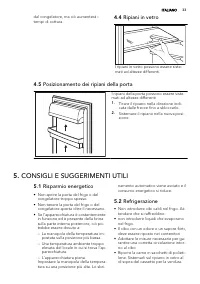
dal congelatore, ma ciò aumenterà itempi di cottura. 4.4 Ripiani in vetro I ripiani in vetro possono essere siste-mati ad altezze differenti. 4.5 Posizionamento dei ripiani della porta I ripiani della porta possono essere siste-mati ad altezze differenti. 1. Tirare il ripiano nella direzione indi-ca...
Page 34 - PULIZIA E CURA; Pulizia
Non conservare la carne nel frigo perpiù di 2 giorni. • Coprire i cibi cotti e le pietanze fredde e sistemarli su uno dei ripiani. • Lavare frutta e verdura e sistemarla nel cassetto per la verdura. • Conservare il burro e i formaggi negli speciali contenitori ermetici, in fogli dialluminio o sacche...
Page 35 - Se l'apparecchiatura non
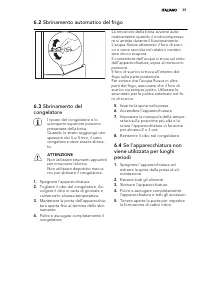
6.2 Sbrinamento automatico del frigo La rimozione della brina avviene auto-maticamente quando il motocompresso-re si arresta durante il funzionamento.L'acqua fluisce attraverso il foro di scari-co e viene raccolta nel relativo conteni-tore da cui evapora.Il contenitore dell'acqua si trova sul retrod...
Page 36 - Sostituzione della lampadina; RISOLUZIONE DEI PROBLEMI; Problema
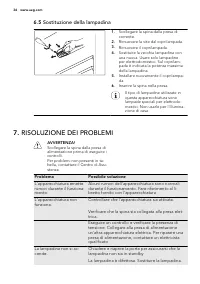
6.5 Sostituzione della lampadina 1. Scollegare la spina dalla presa dicorrente. 2. Rimuovere la vite dal coprilampada. 3. Rimuovere il coprilampada 4. Sostituire la vecchia lampadina conuna nuova. Usare solo lampadineper elettrodomestici. Sul coprilam-pada è indicata la potenza massimadella lampadin...
Page 38 - DATI TECNICI; Rumori normali
8. DATI TECNICI 8.1 Rumori normali Durante l'uso, alcuni rumori di funziona-mento (come quelli del compressore o del circuito refrigerante) sono da consi-derarsi normali. 38 www.aeg.com
Page 39 - Luogo d'installazione
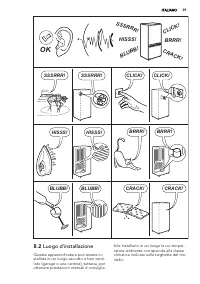
BRRR ! HISSS! CLICK! BLUBB! CRACK! SSSRR R! OK CLICK! CLICK! BRRR! BRRR! HISSS! HISSS! BLUBB! BLUBB! SSSRRR! CRACK! CRACK! SSSRRR! 8.2 Luogo d'installazione Questa apparecchiatura può essere in-stallata in un luogo asciutto e ben venti-lato (garage o una cantina); tuttavia, perottenere prestazioni o...
Page 40 - Temperatura ambiente; Dati tecnici; CONSIDERAZIONI AMBIENTALI
Classeclimati-ca Temperatura ambiente SN da +10°C a 32°C N da +16°C a 32°C ST da +16°C a 38°C L da +16°C a 43°C 8.3 Dati tecnici Dimensioni Altezza 1404 mm Larghezza 545 mm Profondità 604 mm Tempo di risalita 19 h Tensione 230 V Frequenza 50 Hz Per ulteriori informazioni, fare riferimen-to alla targ...
Page 41 - CUSTOMER CARE AND SERVICE
CONTENTS 1. SAFETY INSTRUCTIONS . . . . . . . . . . . . . . . . . . . . . . . . . . . . . . . . . . . . . . . . . . . . . . . . . . . . . 42 2. PRODUCT DESCRIPTION . . . . . . . . . . . . . . . . . . . . . . . . . . . . . . . . . . . . . . . . . . . . . . . . . . . . 44 3. BEFORE FIRST USE . . . . ....
Page 42 - SAFETY INSTRUCTIONS; Children and vulnerable
1. SAFETY INSTRUCTIONS Before the installation and use of the ap-pliance, carefully read the supplied in-structions. The manufacturer is not re-sponsible if an incorrect installation anduse causes injuries and damages. Alwayskeep the instructions with the appliancefor future reference. 1.1 Children ...
Page 44 - Activating the appliance
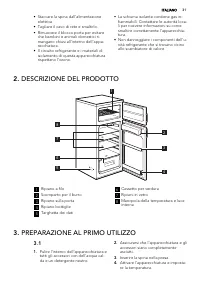
2. PRODUCT DESCRIPTION 1 7 5 8 6 2 3 4 1 Wire shelf 2 Compartment for butter 3 Door shelf 4 Bottle shelf 5 Rating plate 6 Vegetable drawer 7 Glass shelves 8 Temperature knob and internal light 3. BEFORE FIRST USE 3.1 1. Clean the inner parts of the appli-ance and all the accessories withwarm water a...
Page 45 - DAILY USE; Freezing the fresh food
Turn the temperature knob to highersettings to obtain maximum cold tem-perature. We recommend that you set amedium cold temperature. The conditions that follow can have aneffect on the temperature setting. • The room temperature and the loca- tion where the appliance is installed. • How frequently t...
Page 46 - Positioning the door shelves; HINTS AND TIPS; Energy saving
4.5 Positioning the door shelves You can put the door shelf at differentheights. 1. Pull the shelf in the direction of thearrows until it disengages. 2. Put the shelf in the new position. 5. HINTS AND TIPS 5.1 Energy saving • Do not to open the door of the fridge or of the freezer frequently . • Do ...
Page 47 - Storage of the frozen food; CARE AND CLEANING; Cleaning
• Wrap the food in aluminium foil or put it in polythene bags. Make sure thatthe packaging is airtight. • Do not put fresh food together with frozen food. This to prevent the tem-perature of the frozen food to in-crease. • The storage time for fat food is shorter than for non-fat food or for low-fat...
Page 48 - TROUBLESHOOTING
6.3 Defrosting of the freezer There can be frost on the freezershelves and around the top com-partment.Defrost the freezer when the lay-er of frost has a thickness of 3 or5 mm. CAUTION! Do not use sharp metal tools toremove the frost.Do not use mechanical devicesto defrost the freezer. 1. Deactivate...
Page 50 - TECHNICAL INFORMATION; Normal sounds
Problem Possible solution The temperature in thefridge is not sufficientlycold. Make sure that there is cold air circulation. There is too much frost. Make sure that the food is closed in special con-tainers or packaging. Make sure that the appliance door is closed. Set the temperature knob to a low...
Page 51 - Positioning
BRRR ! HISSS! CLICK! BLUBB! CRACK! SSSRR R! OK CLICK! CLICK! BRRR! BRRR! HISSS! HISSS! BLUBB! BLUBB! SSSRRR! CRACK! CRACK! SSSRRR! 8.2 Positioning This appliance can be installed in a dry,well ventilated indoor (garage or cellar)also, but for optimum performance in-stall this appliance at a location...
Page 52 - Ambient temperature; Technical data; ENVIRONMENT CONCERNS
Cli-mateclass Ambient temperature SN +10°C to + 32°C N +16°C to + 32°C ST +16°C to + 38°C T +16°C to + 43°C 8.3 Technical data Dimensions Height 1404 mm Width 545 mm Depth 604 mm Rising Time 19 h Voltage 230 V Frequency 50 Hz For more information, refer to the ratingplate and to the energy label. 9....